Institute of Occupational Health and Environmental Health, School of Public Health, Lanzhou University, Lanzhou, Gansu, 730000, People's Republic of China.
Shanghai Key Laboratory of Meteorology and Health, Shanghai Meteorological Bureau, Shanghai, 200030, People's Republic of China.
Environ Res. 2021 Mar;194:110596. doi: 10.1016/j.envres.2020.110596. Epub 2020 Dec 9.
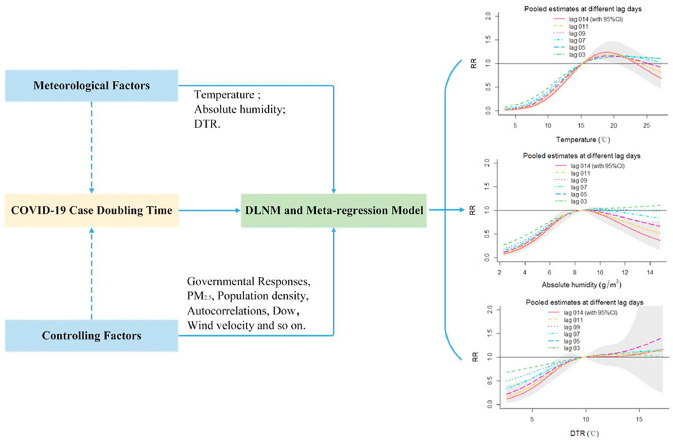
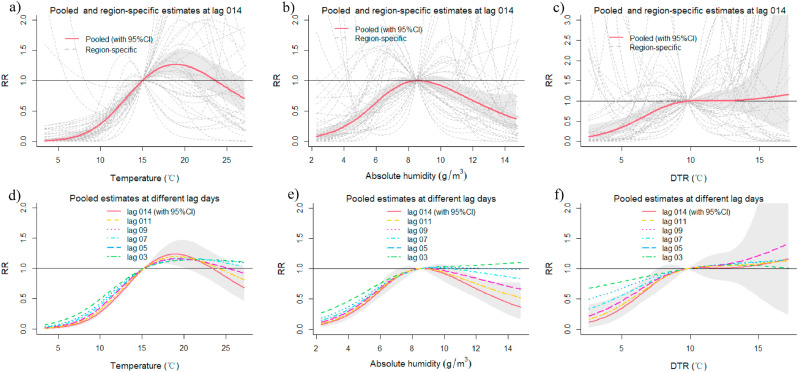
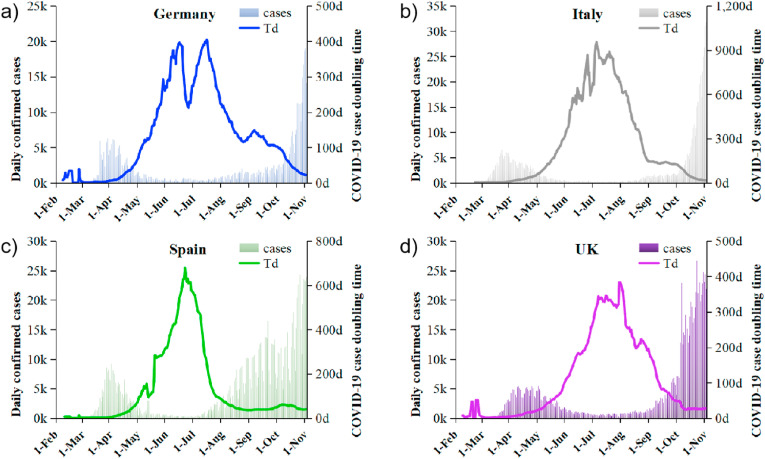
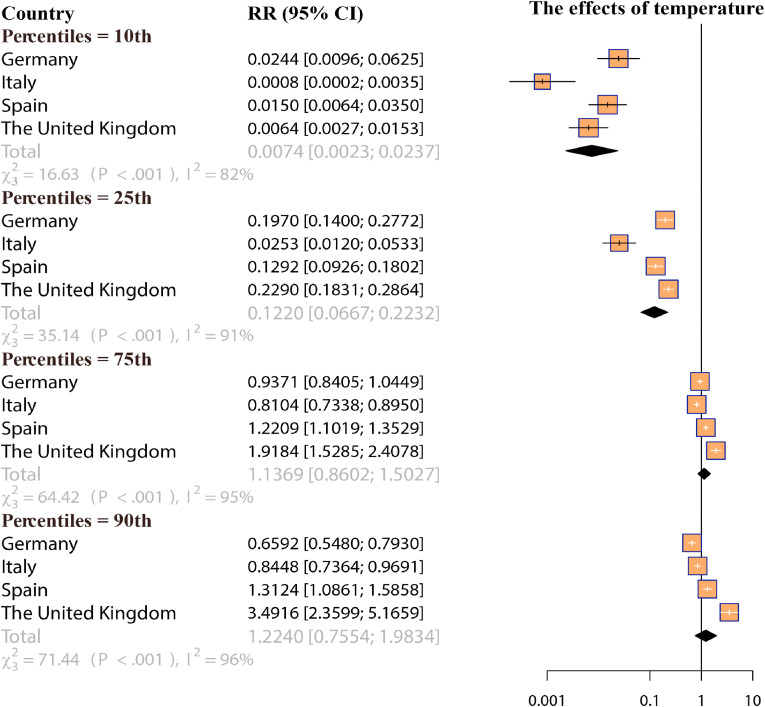
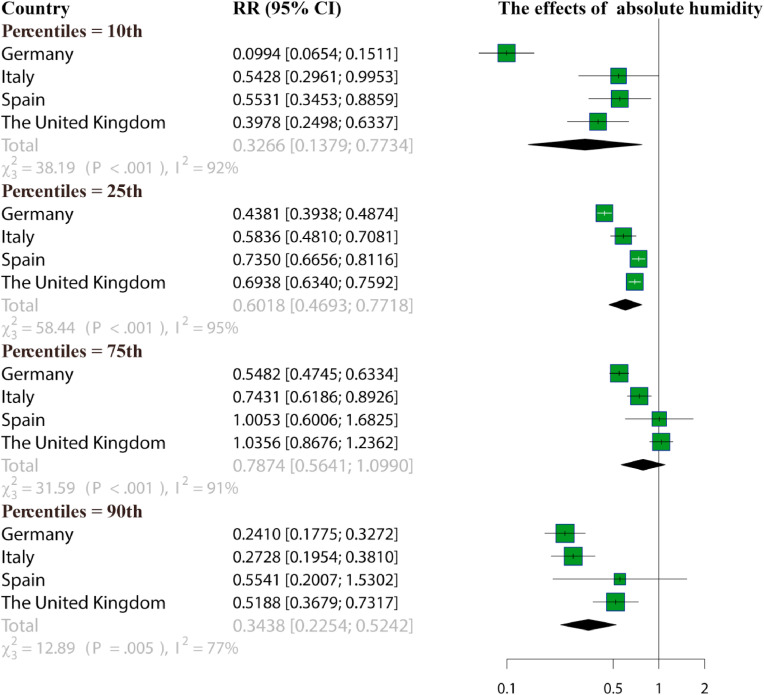
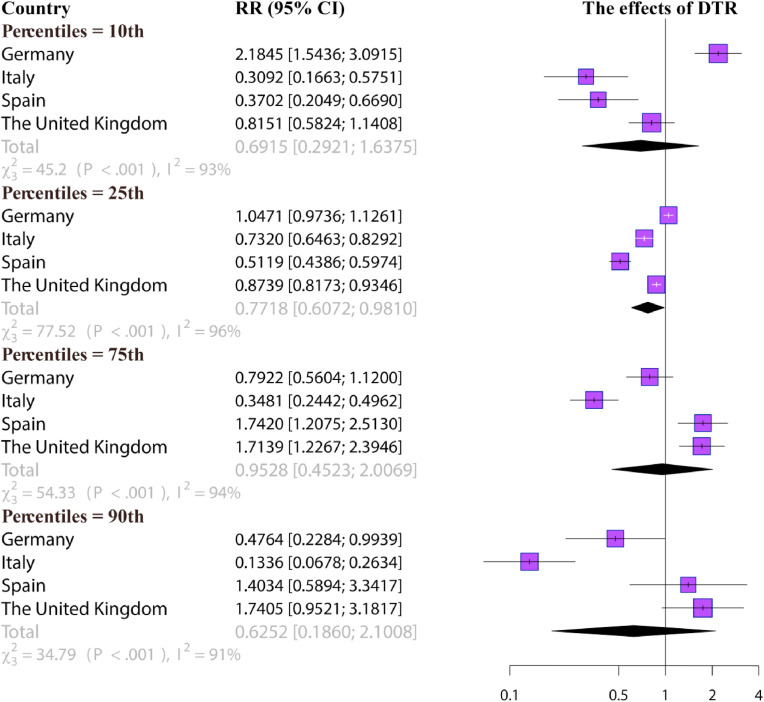
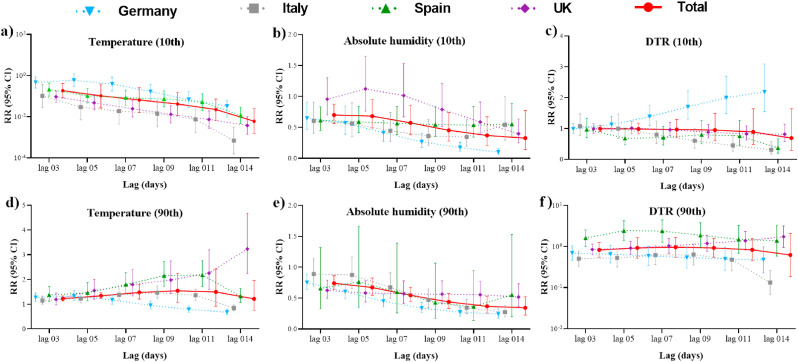
With the global lockdown, meteorological factors are highly discussed for COVID-19 transmission. In this study, national-specific and region-specific data sets from Germany, Italy, Spain and the United Kingdom were used to explore the effect of temperature, absolute humidity and diurnal temperature range (DTR) on COVID-19 transmission. From February 1st to November 1st, a 7-day COVID-19 case doubling time (Td), meteorological factors with cumulative 14-day-lagged, government response index and other factors were fitted in the distributed lag nonlinear models. The overall relative risk (RR) of the 10th and the 25th percentiles temperature compared to the median were 0.0074 (95% CI: 0.0023, 0.0237) and 0.1220 (95% CI: 0.0667, 0.2232), respectively. The pooled RR of lower (10th, 25th) and extremely high (90th) absolute humidity were 0.3266 (95% CI: 0.1379, 0.7734), 0.6018 (95% CI: 0.4693, 0.7718) and 0.3438 (95% CI: 0.2254, 0.5242), respectively. While the DTR did not have a significant effect on Td. The total cumulative effect of temperature (10th) and absolute humidity (10th, 90th) on Td increased with the change of lag days. Similarly, a decline in temperature and absolute humidity at cumulative 14-day-lagged corresponded to the lower RR on Td in pooled region-specific effects. In summary, the government responses are important factors in alleviating the spread of COVID-19. After controlling that, our results indicate that both the cold and the dry environment also likely facilitate the COVID-19 transmission.
随着全球封锁,气象因素在 COVID-19 传播中备受关注。本研究利用德国、意大利、西班牙和英国的国家和地区特定数据集,探讨了温度、绝对湿度和日较差(DTR)对 COVID-19 传播的影响。从 2 月 1 日至 11 月 1 日,拟合了 COVID-19 病例倍增时间(Td)的 7 天、气象因素的 14 天滞后累积、政府反应指数和其他因素的分布式滞后非线性模型。与中位数相比,第 10 和第 25 百分位数温度的总体相对风险(RR)分别为 0.0074(95%CI:0.0023,0.0237)和 0.1220(95%CI:0.0667,0.2232)。较低(第 10 和第 25)和极高(第 90)绝对湿度的汇总 RR 分别为 0.3266(95%CI:0.1379,0.7734)、0.6018(95%CI:0.4693,0.7718)和 0.3438(95%CI:0.2254,0.5242)。而 DTR 对 Td 没有显著影响。温度(第 10)和绝对湿度(第 10、90)对 Td 的总累积效应随滞后天数的增加而增加。同样,在区域特定效应的累积 14 天滞后中,温度和绝对湿度的下降对应于 Td 的较低 RR。总之,政府的反应是缓解 COVID-19 传播的重要因素。在控制了这一点之后,我们的结果表明,寒冷和干燥的环境也可能促进 COVID-19 的传播。