Department of Biomedical Informatics, Vanderbilt University Medical Center, Nashville, TN, USA.
Department of Biomedical Informatics, Vanderbilt University Medical Center, Nashville, TN, USA; Division of Hematology and Oncology, Department of Medicine, Vanderbilt University Medical Center, Nashville, TN, USA.
J Biomed Inform. 2021 Jan;113:103657. doi: 10.1016/j.jbi.2020.103657. Epub 2020 Dec 10.
During the COVID-19 pandemic, health systems postponed non-essential medical procedures to accommodate surge of critically-ill patients. The long-term consequences of delaying procedures in response to COVID-19 remains unknown. We developed a high-throughput approach to understand the impact of delaying procedures on patient health outcomes using electronic health record (EHR) data.
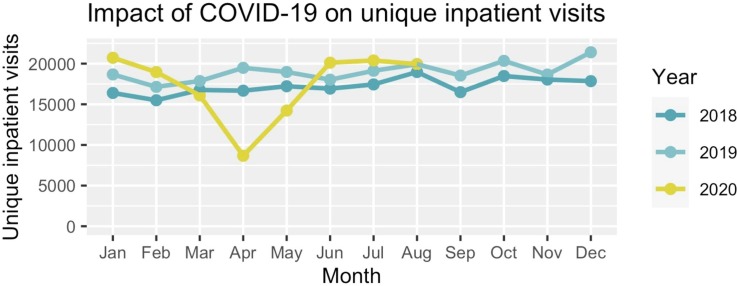
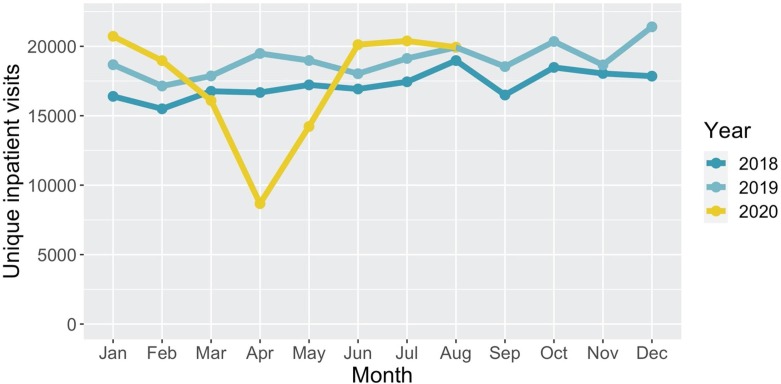
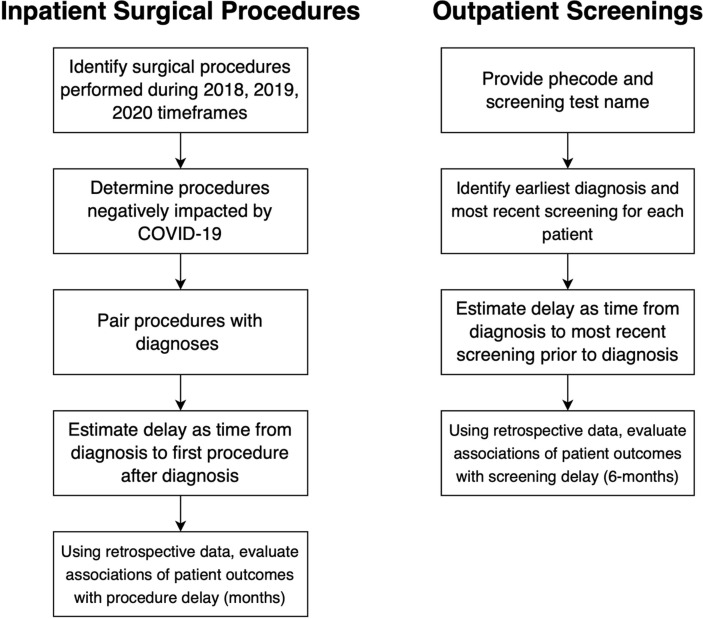
We used EHR data from Vanderbilt University Medical Center's (VUMC) Research and Synthetic Derivatives. Elective procedures and non-urgent visits were suspended at VUMC between March 18, 2020 and April 24, 2020. Surgical procedure data from this period were compared to a similar timeframe in 2019. Potential adverse impact of delay in cardiovascular and cancer-related procedures was evaluated using EHR data collected from January 1, 1993 to March 17, 2020. For surgical procedure delay, outcomes included length of hospitalization (days), mortality during hospitalization, and readmission within six months. For screening procedure delay, outcomes included 5-year survival and cancer stage at diagnosis.
We identified 416 surgical procedures that were negatively impacted during the COVID-19 pandemic compared to the same timeframe in 2019. Using retrospective data, we found 27 significant associations between procedure delay and adverse patient outcomes. Clinician review indicated that 88.9% of the significant associations were plausible and potentially clinically significant. Analytic pipelines for this study are available online.
Our approach enables health systems to identify medical procedures affected by the COVID-19 pandemic and evaluate the effect of delay, enabling them to communicate effectively with patients and prioritize rescheduling to minimize adverse patient outcomes.
在 COVID-19 大流行期间,医疗系统为了容纳大量重症患者而推迟了非必要的医疗程序。针对 COVID-19 推迟程序的长期后果尚不清楚。我们开发了一种高通量方法,使用电子健康记录 (EHR) 数据了解推迟程序对患者健康结果的影响。
我们使用了范德比尔特大学医学中心 (VUMC) 研究和综合衍生品的 EHR 数据。VUMC 于 2020 年 3 月 18 日至 2020 年 4 月 24 日暂停了择期手术和非紧急就诊。在此期间的手术程序数据与 2019 年同期进行了比较。使用从 1993 年 1 月 1 日至 2020 年 3 月 17 日收集的 EHR 数据评估了心血管和癌症相关程序延迟的潜在不利影响。对于手术程序延迟,结果包括住院时间(天)、住院期间的死亡率和六个月内的再入院率。对于筛查程序延迟,结果包括 5 年生存率和诊断时的癌症分期。
与 2019 年同期相比,我们在 COVID-19 大流行期间发现了 416 种受到负面影响的手术程序。使用回顾性数据,我们发现了 27 个程序延迟与不良患者结果之间的显著关联。临床医生审查表明,88.9%的显著关联是合理的,且可能具有临床意义。本研究的分析管道可在线获取。
我们的方法使医疗系统能够识别受 COVID-19 大流行影响的医疗程序,并评估延迟的影响,使他们能够与患者进行有效沟通,并优先重新安排计划以最大程度地减少不良患者结果。