• 文献检索
  • 文档翻译
  • 深度研究
  • 学术资讯
  • Suppr Zotero 插件Zotero 插件
  • 邀请有礼
  • 套餐&价格
  • 历史记录
应用&插件
Suppr Zotero 插件Zotero 插件浏览器插件Mac 客户端Windows 客户端微信小程序
定价
高级版会员购买积分包购买API积分包
服务
文献检索文档翻译深度研究API 文档MCP 服务
关于我们
关于 Suppr公司介绍联系我们用户协议隐私条款
关注我们

Suppr 超能文献

核心技术专利:CN118964589B侵权必究
粤ICP备2023148730 号-1Suppr @ 2026

文献检索

告别复杂PubMed语法,用中文像聊天一样搜索,搜遍4000万医学文献。AI智能推荐,让科研检索更轻松。

立即免费搜索

文件翻译

保留排版,准确专业,支持PDF/Word/PPT等文件格式,支持 12+语言互译。

免费翻译文档

深度研究

AI帮你快速写综述,25分钟生成高质量综述,智能提取关键信息,辅助科研写作。

立即免费体验

定量蛋白质组学分析揭示了热积累蛋白在苔藓植物获得耐热性中的作用。

Quantitative proteomic analysis to capture the role of heat-accumulated proteins in moss plant acquired thermotolerance.

机构信息

Department of Plant Molecular Biology, Faculty of Biology and Medicine, University of Lausanne, Lausanne, Switzerland.

Department of Ecology, Agronomy and Aquaculture, University of Zadar, Zadar, Croatia.

出版信息

Plant Cell Environ. 2021 Jul;44(7):2117-2133. doi: 10.1111/pce.13975. Epub 2020 Dec 21.

DOI:10.1111/pce.13975
PMID:33314263
原文链接:https://pmc.ncbi.nlm.nih.gov/articles/PMC8359368/
Abstract

At dawn of a scorching summer day, land plants must anticipate upcoming extreme midday temperatures by timely establishing molecular defences that can keep heat-labile membranes and proteins functional. A gradual morning pre-exposure to increasing sub-damaging temperatures induces heat-shock proteins (HSPs) that are central to the onset of plant acquired thermotolerance (AT). To gain knowledge on the mechanisms of AT in the model land plant Physcomitrium patens, we used label-free LC-MS/MS proteomics to quantify the accumulated and depleted proteins before and following a mild heat-priming treatment. High protein crowding is thought to promote protein aggregation, whereas molecular chaperones prevent and actively revert aggregation. Yet, we found that heat priming (HP) did not accumulate HSP chaperones in chloroplasts, although protein crowding was six times higher than in the cytosol. In contrast, several HSP20s strongly accumulated in the cytosol, yet contributing merely 4% of the net mass increase of heat-accumulated proteins. This is in poor concordance with their presumed role at preventing the aggregation of heat-labile proteins. The data suggests that under mild HP unlikely to affect protein stability. Accumulating HSP20s leading to AT, regulate the activity of rare and specific signalling proteins, thereby preventing cell death under noxious heat stress.

摘要

在一个炎热夏日的黎明,陆生植物必须通过及时建立分子防御来应对即将到来的极端正午高温,这些防御可以使热敏膜和蛋白质保持功能。清晨逐渐暴露在逐渐升高的亚损伤温度下会诱导热休克蛋白(HSPs),这对于植物获得耐热性(AT)的发生至关重要。为了深入了解模式陆生植物Physcomitrium patens 中 AT 的机制,我们使用无标记 LC-MS/MS 蛋白质组学技术,在轻度热预处理前后定量测定了积累和耗尽的蛋白质。人们认为高蛋白质拥挤会促进蛋白质聚集,而分子伴侣则可以预防和积极逆转聚集。然而,我们发现热预处理(HP)并没有在叶绿体中积累 HSP 伴侣,尽管蛋白质拥挤程度比细胞质高六倍。相比之下,几种 HSP20 在细胞质中强烈积累,但仅占热积累蛋白质净质量增加的 4%。这与它们防止热敏蛋白聚集的假定作用极不一致。数据表明,在不太可能影响蛋白质稳定性的轻度 HP 下,积累 HSP20 会导致 AT,调节稀有和特定信号蛋白的活性,从而防止在有害热应激下发生细胞死亡。
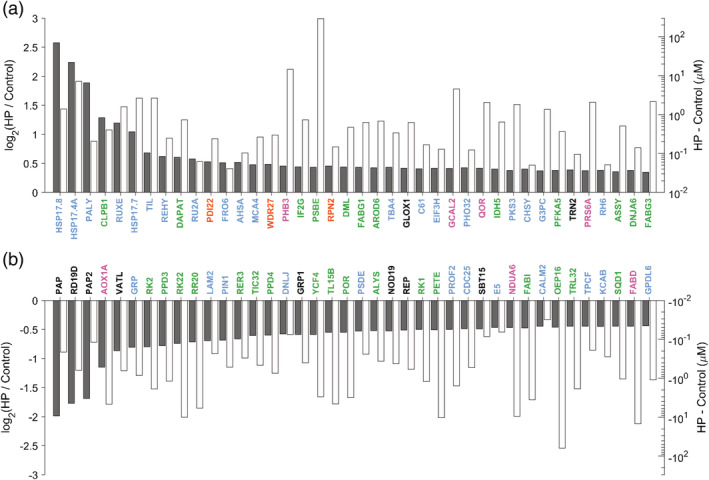
https://cdn.ncbi.nlm.nih.gov/pmc/blobs/1da3/8359368/27a40a8f5279/PCE-44-2117-g005.jpg
https://cdn.ncbi.nlm.nih.gov/pmc/blobs/1da3/8359368/3128f1ce68ff/PCE-44-2117-g006.jpg
https://cdn.ncbi.nlm.nih.gov/pmc/blobs/1da3/8359368/01ded76cb41a/PCE-44-2117-g001.jpg
https://cdn.ncbi.nlm.nih.gov/pmc/blobs/1da3/8359368/5b1dee718b65/PCE-44-2117-g002.jpg
https://cdn.ncbi.nlm.nih.gov/pmc/blobs/1da3/8359368/446c20f93c79/PCE-44-2117-g003.jpg
https://cdn.ncbi.nlm.nih.gov/pmc/blobs/1da3/8359368/97692a2eadec/PCE-44-2117-g004.jpg
https://cdn.ncbi.nlm.nih.gov/pmc/blobs/1da3/8359368/27a40a8f5279/PCE-44-2117-g005.jpg
https://cdn.ncbi.nlm.nih.gov/pmc/blobs/1da3/8359368/3128f1ce68ff/PCE-44-2117-g006.jpg
https://cdn.ncbi.nlm.nih.gov/pmc/blobs/1da3/8359368/01ded76cb41a/PCE-44-2117-g001.jpg
https://cdn.ncbi.nlm.nih.gov/pmc/blobs/1da3/8359368/5b1dee718b65/PCE-44-2117-g002.jpg
https://cdn.ncbi.nlm.nih.gov/pmc/blobs/1da3/8359368/446c20f93c79/PCE-44-2117-g003.jpg
https://cdn.ncbi.nlm.nih.gov/pmc/blobs/1da3/8359368/97692a2eadec/PCE-44-2117-g004.jpg
https://cdn.ncbi.nlm.nih.gov/pmc/blobs/1da3/8359368/27a40a8f5279/PCE-44-2117-g005.jpg

相似文献

1
Quantitative proteomic analysis to capture the role of heat-accumulated proteins in moss plant acquired thermotolerance.定量蛋白质组学分析揭示了热积累蛋白在苔藓植物获得耐热性中的作用。
Plant Cell Environ. 2021 Jul;44(7):2117-2133. doi: 10.1111/pce.13975. Epub 2020 Dec 21.
2
Recovery from heat, salt and osmotic stress in Physcomitrella patens requires a functional small heat shock protein PpHsp16.4.在石松中,从小热休克蛋白 PpHsp16.4 中恢复对热、盐和渗透胁迫的需要。
BMC Plant Biol. 2013 Nov 5;13:174. doi: 10.1186/1471-2229-13-174.
3
Comparative proteomics in tall fescue to reveal underlying mechanisms for improving Photosystem II thermotolerance during heat stress memory.对高羊茅进行比较蛋白质组学研究,以揭示在热胁迫记忆过程中提高光系统 II 耐热性的潜在机制。
BMC Genomics. 2024 Jul 9;25(1):683. doi: 10.1186/s12864-024-10580-z.
4
The CNGCb and CNGCd genes from Physcomitrella patens moss encode for thermosensory calcium channels responding to fluidity changes in the plasma membrane.来自石莼属苔藓的 CNGCb 和 CNGCd 基因编码对质膜流动性变化有响应的热敏钙通道。
Cell Stress Chaperones. 2014 Jan;19(1):83-90. doi: 10.1007/s12192-013-0436-9. Epub 2013 May 12.
5
Heat Shock Signaling in Land Plants: From Plasma Membrane Sensing to the Transcription of Small Heat Shock Proteins.陆地植物中的热激信号传导:从质膜感知到小分子热激蛋白的转录
Front Plant Sci. 2021 Aug 9;12:710801. doi: 10.3389/fpls.2021.710801. eCollection 2021.
6
Plasma membrane cyclic nucleotide gated calcium channels control land plant thermal sensing and acquired thermotolerance.质膜环核苷酸门控钙通道控制陆地植物的热感应和获得耐热性。
Plant Cell. 2012 Aug;24(8):3333-48. doi: 10.1105/tpc.112.095844. Epub 2012 Aug 17.
7
Proteome and transcriptome reveal the involvement of heat shock proteins and antioxidant system in thermotolerance of Clematis florida.蛋白质组和转录组揭示了热休克蛋白和抗氧化系统在Clematis florida 耐热性中的作用。
Sci Rep. 2020 Jun 1;10(1):8883. doi: 10.1038/s41598-020-65699-2.
8
Analysis of transcriptional response to heat stress in Rhazya stricta.刺山柑对热胁迫转录反应的分析
BMC Plant Biol. 2016 Nov 14;16(1):252. doi: 10.1186/s12870-016-0938-6.
9
Mechanisms of elevated CO-induced thermotolerance in plants: the role of phytohormones.高浓度 CO 诱导植物耐热性的机制:植物激素的作用。
Plant Cell Rep. 2021 Dec;40(12):2273-2286. doi: 10.1007/s00299-021-02751-z. Epub 2021 Jul 16.
10
Patterns of gene expression in pollen of cotton (Gossypium hirsutum) indicate downregulation as a feature of thermotolerance.棉花(Gossypium hirsutum)花粉中基因表达的模式表明,下调是耐热性的一个特征。
Plant J. 2022 Feb;109(4):965-979. doi: 10.1111/tpj.15608. Epub 2021 Dec 17.

引用本文的文献

1
BPM Proteins Modulate Heat Stress Response in Seedlings.BPM蛋白调节幼苗的热应激反应。
Plants (Basel). 2025 Jun 27;14(13):1969. doi: 10.3390/plants14131969.
2
Integrating proteomic and phosphoproteomic profiles provide new insights into ABA-dependent signal regulation network in maize response to heat stress.整合蛋白质组学和磷酸化蛋白质组学图谱为玉米应对热胁迫时ABA依赖的信号调控网络提供了新见解。
BMC Plant Biol. 2025 Jul 1;25(1):792. doi: 10.1186/s12870-025-06821-2.
3
Plant Signaling Hormones and Transcription Factors: Key Regulators of Plant Responses to Growth, Development, and Stress.

本文引用的文献

1
Bacterial Hsp90 Facilitates the Degradation of Aggregation-Prone Hsp70-Hsp40 Substrates.细菌热休克蛋白90促进易聚集的热休克蛋白70-热休克蛋白40底物的降解。
Front Mol Biosci. 2021 Apr 15;8:653073. doi: 10.3389/fmolb.2021.653073. eCollection 2021.
2
Transcriptome analysis of heat stress and drought stress in pearl millet based on Pacbio full-length transcriptome sequencing.基于 Pacbio 全长转录组测序的珍珠粟热胁迫和干旱胁迫的转录组分析。
BMC Plant Biol. 2020 Jul 8;20(1):323. doi: 10.1186/s12870-020-02530-0.
3
Plant small heat shock proteins - evolutionary and functional diversity.
植物信号激素与转录因子:植物生长、发育及胁迫响应的关键调控因子
Plants (Basel). 2025 Mar 31;14(7):1070. doi: 10.3390/plants14071070.
4
Protein research in millets: current status and way forward.小米中的蛋白质研究:现状与展望。
Planta. 2024 Jul 3;260(2):43. doi: 10.1007/s00425-024-04478-z.
5
Cell death in bryophytes: emerging models to study core regulatory modules and conserved pathways.苔藓植物细胞死亡:研究核心调控模块和保守途径的新兴模型。
Ann Bot. 2024 Aug 22;134(3):367-384. doi: 10.1093/aob/mcae081.
6
Identification of candidate regulators of the response to early heat stress in climate-adapted wheat landraces transcriptomic and co-expression network analyses.适应气候的小麦地方品种对早期热胁迫响应的候选调控因子鉴定:转录组学和共表达网络分析
Front Plant Sci. 2024 Jan 3;14:1252885. doi: 10.3389/fpls.2023.1252885. eCollection 2023.
7
Identification of genes associated with abiotic stress tolerance in sweetpotato using weighted gene co-expression network analysis.利用加权基因共表达网络分析鉴定甘薯中与非生物胁迫耐受性相关的基因
Plant Direct. 2023 Oct 3;7(10):e532. doi: 10.1002/pld3.532. eCollection 2023 Oct.
8
Design of an Arabidopsis thaliana reporter line to detect heat-sensing and signaling mutants.用于检测热感应和信号转导突变体的拟南芥报告株系的设计
Plant Methods. 2023 Jun 8;19(1):56. doi: 10.1186/s13007-023-01033-x.
9
Identification of the DcHsp20 gene family in carnation (Dianthus caryophyllus) and functional characterization of DcHsp17.8 in heat tolerance.鉴定康乃馨(Dianthus caryophyllus)中的 DcHsp20 基因家族和 DcHsp17.8 在耐热性中的功能特征。
Planta. 2022 May 27;256(1):2. doi: 10.1007/s00425-022-03915-1.
10
RNA Sequencing of Seedlings after Non-Thermal Plasma-Seed Treatment Reveals Upregulation in Plant Stress and Defense Pathways.非热等离子体种子处理后幼苗的 RNA 测序揭示了植物应激和防御途径的上调。
Int J Mol Sci. 2022 Mar 12;23(6):3070. doi: 10.3390/ijms23063070.
植物小分子热激蛋白——进化与功能多样性
New Phytol. 2020 Jul;227(1):24-37. doi: 10.1111/nph.16536. Epub 2020 Apr 16.
4
The Moss () : A Model Organism for Non-Seed Plants.藓类():非种子植物的模式生物。
Plant Cell. 2020 May;32(5):1361-1376. doi: 10.1105/tpc.19.00828. Epub 2020 Mar 9.
5
Comparative analysis of thylakoid protein complexes in state transition mutants nsi and stn7: focus on PSI and LHCII.类囊体蛋白复合物在状态转换突变体 nsi 和 stn7 中的比较分析:重点是 PSI 和 LHCII。
Photosynth Res. 2020 Jul;145(1):15-30. doi: 10.1007/s11120-020-00711-4. Epub 2020 Jan 23.
6
Transcriptome profiling of abiotic responses to heat, cold, salt, and osmotic stress of Capsicum annuum L.辣椒对热、冷、盐和渗透胁迫的非生物响应的转录组分析
Sci Data. 2020 Jan 13;7(1):17. doi: 10.1038/s41597-020-0352-7.
7
Effects of L-proline on swimming parameters of Daphnia magna subjected to heat stress.L-脯氨酸对热应激下大型溞游泳参数的影响。
J Therm Biol. 2019 Aug;84:154-163. doi: 10.1016/j.jtherbio.2019.06.012. Epub 2019 Jul 2.
8
Cyclic nucleotide-gated ion channel 6 mediates thermotolerance in Arabidopsis seedlings by regulating nitric oxide production via cytosolic calcium ions.环核苷酸门控离子通道 6 通过调节细胞质钙离子介导的一氧化氮产生来介导拟南芥幼苗的耐热性。
BMC Plant Biol. 2019 Aug 20;19(1):368. doi: 10.1186/s12870-019-1974-9.
9
Abiotic and biotic stresses induce a core transcriptome response in rice.非生物胁迫和生物胁迫诱导水稻核心转录组的响应。
Sci Rep. 2019 Apr 18;9(1):6273. doi: 10.1038/s41598-019-42731-8.
10
Transcriptome Analyses Provide Novel Insights into Heat Stress Responses in Chieh-Qua ( Cogn. var. Chieh-Qua How).转录组分析为热应激响应在切叶蚁(Cogn. var. Chieh-Qua How)中的作用提供了新的见解。
Int J Mol Sci. 2019 Feb 18;20(4):883. doi: 10.3390/ijms20040883.