Department of Animal Environment and Health, Swedish University of Agricultural Sciences, 53223 Skara, Sweden.
Midwifery Research and Education Unit, Hannover Medical School, 30625 Hanover, Germany.
Int J Mol Sci. 2020 Dec 14;21(24):9503. doi: 10.3390/ijms21249503.
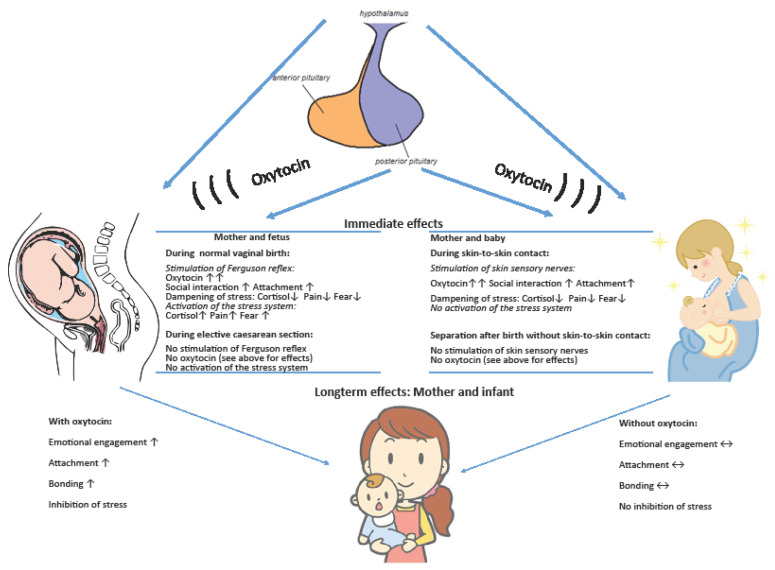
Studies have shown that long-term positive behavioural and physiological changes are induced in connection with vaginal, physiological birth, and skin-to-skin contact after birth in mothers and babies. Some of these effects are consistent with the effect profile of oxytocin. This scoping review explores whether epigenetic changes of the oxytocin gene and of the oxytocin receptor gene (OTR) are involved in these effects.
We searched Pubmed, Medline, BioMed Central, Cochrane Library, OVID, and Web of Science for evidence of epigenetic changes in connection with childbirth in humans, with a particular focus on the oxytocin system.
There were no published studies identified that were related to epigenetic changes of oxytocin and its receptor in connection with labour, birth, and skin-to-skin contact after birth in mothers and babies. However, some studies were identified that showed polymorphisms of the oxytocin receptor influenced the progress of labour. We also identified studies in which the level of global methylation was measured in vaginal birth and caesarean section, with conflicting results. Some studies identified differences in the level of methylation of single genes linked to various effects, for example, immune response, metabolism, and inflammation. In some of these cases, the level of methylation was associated with the duration of labour or mode of birth. We also identified some studies that demonstrated long-term effects of mode of birth and of skin-to-skin contact linked to changes in oxytocin function.
There were no studies identified that showed epigenetic changes of the oxytocin system in connection with physiological birth. The lack of evidence, so far, regarding epigenetic changes did not exclude future demonstrations of such effects, as there was a definite role of oxytocin in creating long-term effects during the perinatal period. Such studies may not have been performed. Alternatively, the oxytocin linked effects might be indirectly mediated via other receptors and signalling systems. We conclude that there is a significant lack of research examining long-term changes of oxytocin function and long-term oxytocin mediated adaptive effects induced during physiological birth and skin-to-skin contact after birth in mothers and their infants.
研究表明,与阴道分娩、出生后母婴皮肤接触相关的长期积极的行为和生理变化会引起母亲和婴儿体内催产素基因和催产素受体基因(OTR)的表观遗传变化。这些影响中的一些与催产素的作用特征一致。本研究旨在探讨与分娩相关的催产素基因和催产素受体基因(OTR)的表观遗传变化是否涉及这些影响。
我们在 Pubmed、Medline、BioMed Central、Cochrane Library、OVID 和 Web of Science 中搜索了与人类分娩相关的催产素系统的表观遗传变化的证据,特别关注了催产素系统。
没有发现与母婴阴道分娩、分娩和出生后皮肤接触相关的催产素及其受体的表观遗传变化的相关研究。然而,我们发现一些研究表明,催产素受体的多态性影响了分娩的进展。我们还发现了一些研究,其中测量了阴道分娩和剖腹产中的全球甲基化水平,结果存在差异。一些研究确定了与各种效应相关的单个基因的甲基化水平的差异,例如免疫反应、代谢和炎症。在这些情况下,甲基化水平与分娩持续时间或分娩方式有关。我们还发现了一些研究表明,分娩方式和皮肤接触的长期影响与催产素功能的变化有关。
没有研究表明与生理分娩相关的催产素系统的表观遗传变化。到目前为止,缺乏关于表观遗传变化的证据并不排除未来对这种影响的证明,因为在围产期期间,催产素在产生长期影响方面确实有作用。可能没有进行这样的研究。或者,催产素相关的作用可能通过其他受体和信号转导系统间接介导。我们得出结论,目前缺乏研究来检验生理分娩期间催产素功能的长期变化以及与母婴皮肤接触相关的长期催产素介导的适应性效应。