Deakin University, Geelong, VIC, Australia.
Murdoch Children's Research Institute, Parkville, VIC, Australia.
J Atten Disord. 2022 Feb;26(4):549-562. doi: 10.1177/1087054720978549. Epub 2020 Dec 17.
To examine the impact of COVID-19 restrictions among children with attention-deficit/hyperactivity disorder (ADHD).
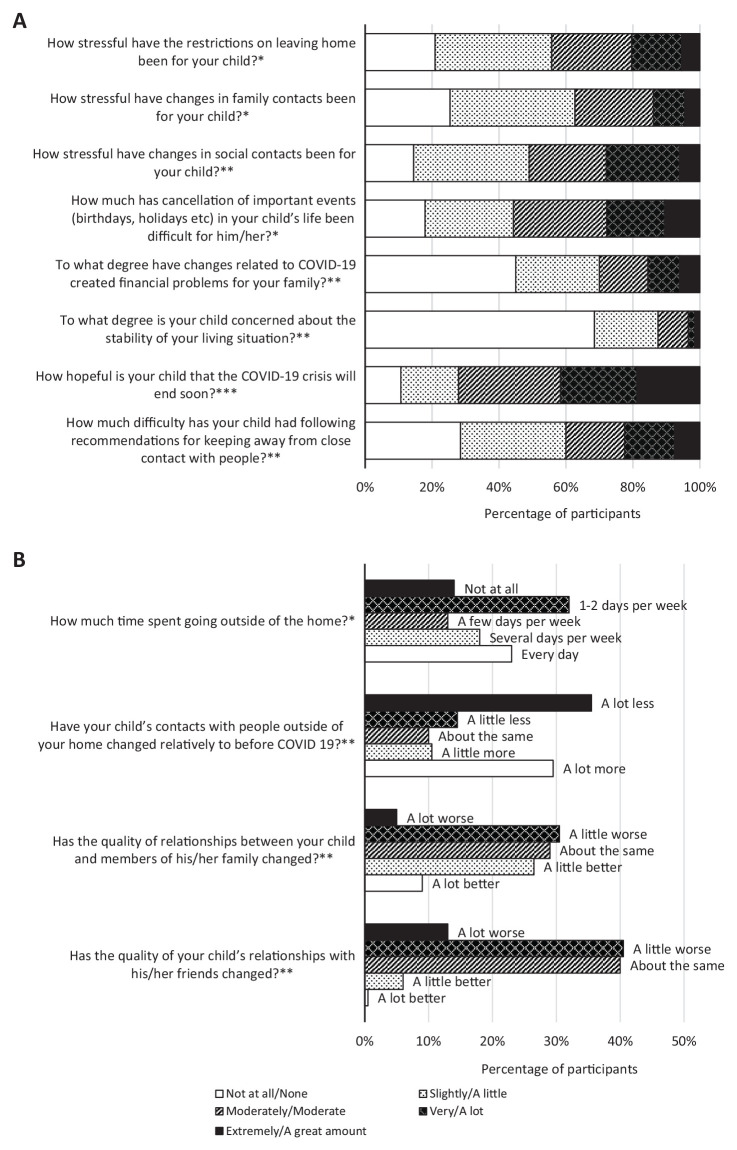
Parents of 213 Australian children (5-17 years) with ADHD completed a survey in May 2020 when COVID-19 restrictions were in place (i.e., requiring citizens to stay at home except for essential reasons).
Compared to pre-pandemic, children had less exercise (Odds Ratio (OR) = 0.4; 95% CI 0.3-0.6), less outdoor time (OR = 0.4; 95% 0.3-0.6), and less enjoyment in activities (OR = 6.5; 95% CI 4.0-10.4), while television (OR = 4.0; 95% CI 2.5-6.5), social media (OR = 2.4; 95% CI 1.3-4.5), gaming (OR = 2.0; 95% CI 1.3-3.0), sad/depressed mood (OR = 1.8; 95% CI 1.2-2.8), and loneliness (OR = 3.6; 95% CI 2.3-5.5) were increased. Child stress about COVID-19 restrictions was associated with poorer functioning across most domains. Most parents (64%) reported positive changes for their child including more family time.
COVID-19 restrictions were associated with both negative and positive impacts among children with ADHD.
研究 COVID-19 限制措施对注意缺陷多动障碍(ADHD)儿童的影响。
2020 年 5 月 COVID-19 限制措施实施期间(即要求公民除必要原因外留在家中),213 名澳大利亚儿童(5-17 岁)的父母完成了一项调查。
与大流行前相比,儿童的运动量减少(优势比(OR)=0.4;95%置信区间 0.3-0.6),户外活动时间减少(OR=0.4;95%CI 0.3-0.6),活动乐趣减少(OR=6.5;95%CI 4.0-10.4),而看电视(OR=4.0;95%CI 2.5-6.5)、社交媒体(OR=2.4;95%CI 1.3-4.5)、游戏(OR=2.0;95%CI 1.3-3.0)、悲伤/抑郁情绪(OR=1.8;95%CI 1.2-2.8)和孤独感(OR=3.6;95%CI 2.3-5.5)增加。儿童对 COVID-19 限制措施的压力与大多数领域的功能障碍有关。大多数家长(64%)报告称,孩子的家庭时间增加,出现了积极的变化。
COVID-19 限制措施对 ADHD 儿童既有负面影响,也有积极影响。