Yang Yuting, Shen Liyan, Gao Huan, Ran Jinming, Li Xian, Jiang Hengxin, Li Xueyan, Cao Zhenhui, Huang Ying, Zhao Sumei, Song Chunlian, Pan Hongbin
Yunnan Provincial Key Laboratory of Animal Nutrition and Feed Science, Faculty of Animal Science and Technology, Yunnan Agricultural University, Kunming 650201, China.
Dazhou Vocational and Technical College, Dazhou 635000, China.
Anim Biosci. 2021 Jul;34(7):1202-1209. doi: 10.5713/ab.20.0681. Epub 2020 Dec 1.
The intestinal microbiota plays an important role in host physiology, metabolism, immunity, and behavior. And host genetics could influence the gut microbiota of hybrid animals. The three-way cross model is commonly utilized in commercial pig production; however, the use of this model to analyse the gut microbial composition is rarely reported.
Two three-way hybrid pigs were selected, with Saba pigs as the starting maternal pig: Duroc× (Berkshire×Saba) (DBS) pig, Berkshire×(Duroc×Saba) (BDS) pig. One hundred pigs of each model were reared from 35 days (d) to 210 d. The body weight or feed consumption of all pigs were recorded and their feed/gain (F/G) ratio was calculated. On day 210, 10 pigs from each three-way cross were selected for slaughter, and cecal chyme samples were collected for 16S rRNA gene sequencing.
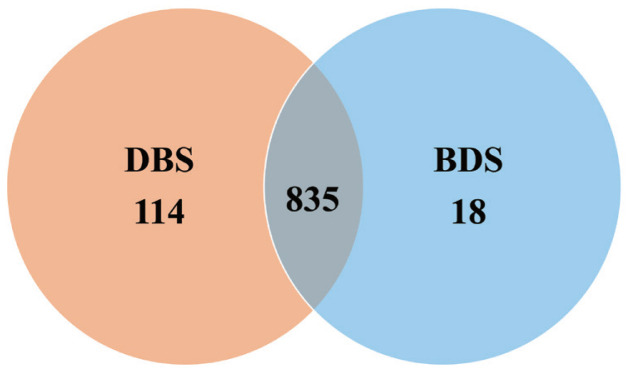
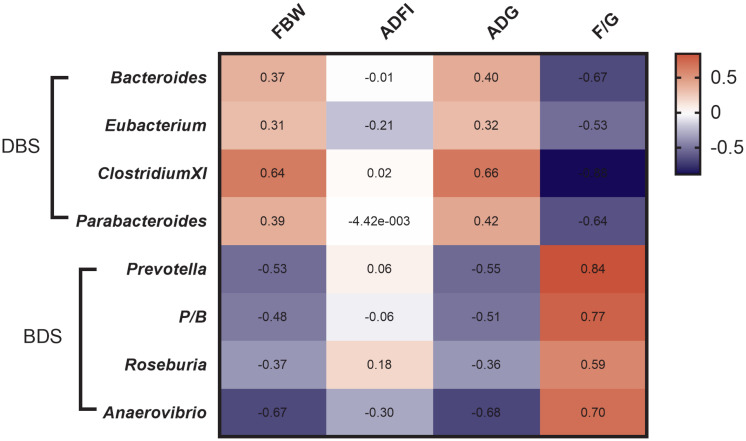
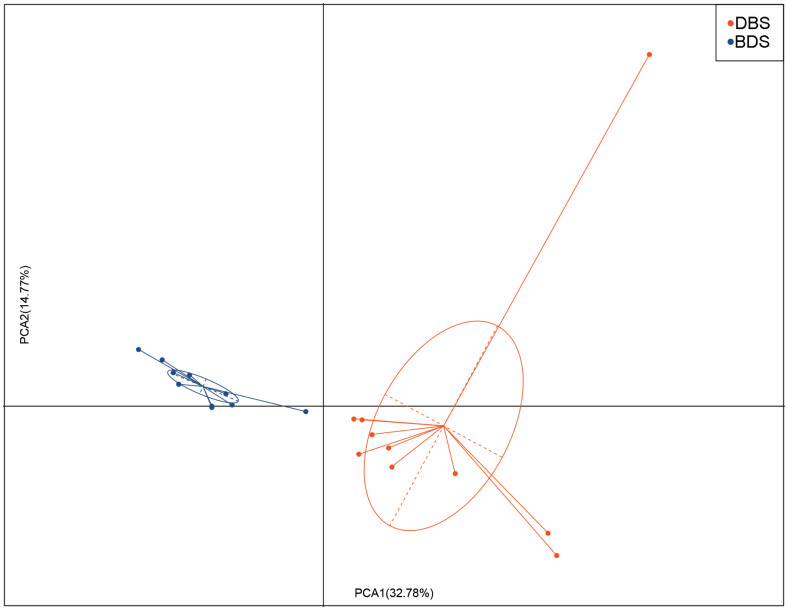
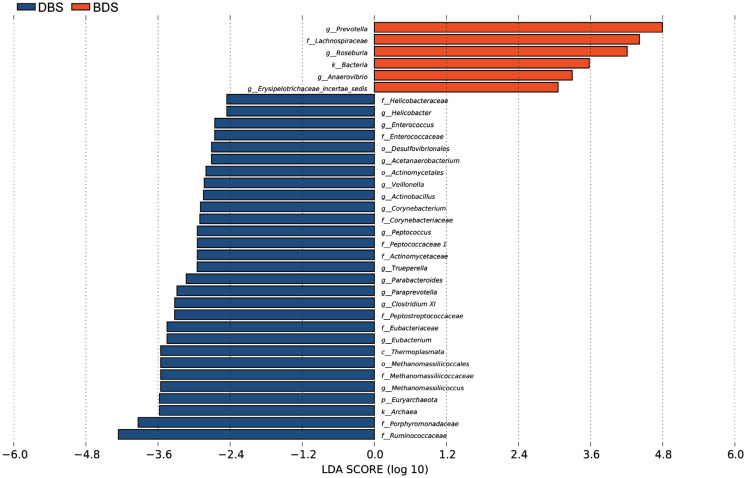
The final body weight (FBW) and average daily gain (ADG) of DBS pigs were significantly higher than those of BDS pigs (p<0.05), while the F/G ratios of DBS pigs were significantly lower than those of BDS pigs (p<0.05). The dominant phyla in DBS and BDS pigs were Bacteroidetes (55.23% vs 59%, respectively) and Firmicutes (36.65% vs 34.86%, respectively) (p>0.05). At the genus level, the abundance of Prevotella, Roseburia, and Anaerovibrio in DBS pigs was significantly lower than in BDS pigs (p<0.01). The abundance of Eubacterium, Clostridium XI, Bacteroides, Methanomassiliicoccus, and Parabacteroides in DBS pigs was significantly higher than in BDS pigs (p<0.05). The FBWs and ADGs were positively correlated with Bacteroides, ClostridiumXI, and Parabacteroides but negatively correlated with the Prevotella, Prevotella/Bacteroides (P/B) ratio, Roseburia, and Anaerovibrio.
These results indicated that host genetics affect the cecal microbiota composition and the porcine gut microbiota is associated with growth performance, thereby suggesting that gut microbiota composition may be a useful biomarker in porcine genetics and breeding.
肠道微生物群在宿主生理、代谢、免疫和行为中发挥着重要作用。宿主遗传学可能会影响杂种动物的肠道微生物群。三元杂交模型常用于商业养猪生产;然而,利用该模型分析肠道微生物组成的报道却很少。
选择两头三元杂交猪,以萨巴猪作为起始母本猪:杜洛克×(伯克夏×萨巴)(DBS)猪、伯克夏×(杜洛克×萨巴)(BDS)猪。每个模型的100头猪从35日龄饲养至210日龄。记录所有猪的体重或采食量,并计算其料重比(F/G)。在210日龄时,从每个三元杂交组中挑选10头猪进行屠宰,采集盲肠食糜样本进行16S rRNA基因测序。
DBS猪的末体重(FBW)和平均日增重(ADG)显著高于BDS猪(p<0.05),而DBS猪의料重比显著低于BDS猪(p<0.05)。DBS猪和BDS猪中占主导地位的菌门分别是拟杆菌门(分别为55.23%和59%)和厚壁菌门(分别为36.65%和34.86%)(p>0.05)。在属水平上,DBS猪中普雷沃氏菌属、罗斯氏菌属和厌氧弧菌属的丰度显著低于BDS猪(p<0.01)。DBS猪中真杆菌属、梭菌属XI、拟杆菌属、甲烷鬃菌属和副拟杆菌属的丰度显著高于BDS猪(p<0.05)。FBW和ADG与拟杆菌属、梭菌属XI和副拟杆菌属呈正相关,但与普雷沃氏菌属、普雷沃氏菌属/拟杆菌属(P/B)比值、罗斯氏菌属和厌氧弧菌属呈负相关。
这些结果表明宿主遗传学影响盲肠微生物群组成,并且猪肠道微生物群与生长性能相关,从而表明肠道微生物群组成可能是猪遗传学和育种中的一个有用生物标志物。