Laboratory of the Mosaics of Autoimmunity, Saint Petersburg State University, Saint-Petersburg, Russian Federation.
Laboratory of the Mosaics of Autoimmunity, Saint Petersburg State University, Saint-Petersburg, Russian Federation; Zabludowicz Center for Autoimmune Diseases, Sheba Medical Center, Affiliated to Tel-Aviv University School of Medicine, Tel-Hashomer, Israel.
Clin Immunol. 2021 Feb;223:108652. doi: 10.1016/j.clim.2020.108652. Epub 2020 Dec 14.
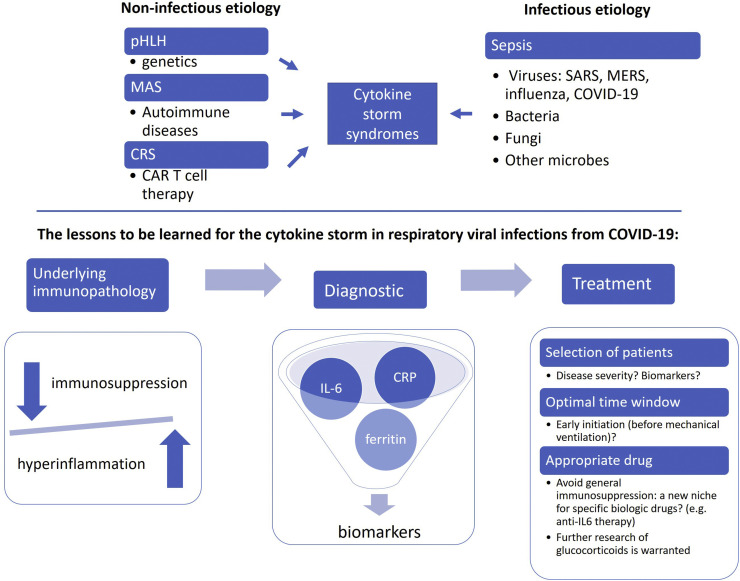
The outbreak of COVID-19 reminds us that the emerging and reemerging respiratory virus infections pose a continuing threat to human life. Cytokine storm syndromes of viral origin seem to have a common pathogenesis of the imbalanced immune response with the exaggerated inflammatory reaction combined with the reduction and functional exhaustion of T cells. Immunomodulatory therapy is gaining interest in COVID-19, but this strategy has received less attention in other respiratory viral infections than it deserved. In this review we suggest that based on the similarities of the immune dysfunction in the severe cases of different respiratory viral infections, some lessons from the immunomodulatory therapy of COVID-19 (particularly regarding the choice of an immunomodulatory drug, the selection of patients and optimal time window for this kind of therapy) could be applied for some cases of severe influenza infection and probably for some future outbreaks of novel severe respiratory viral infections.
COVID-19 的爆发提醒我们,新发和再发的呼吸道病毒感染对人类生命构成持续威胁。病毒性细胞因子风暴综合征似乎具有共同的发病机制,即免疫反应失衡,炎症反应过度,同时 T 细胞减少和功能衰竭。免疫调节治疗在 COVID-19 中的应用受到关注,但在其他呼吸道病毒感染中,这种策略的关注度低于应有的程度。在这篇综述中,我们认为,鉴于不同呼吸道病毒感染的重症病例中免疫功能障碍的相似性,COVID-19 的免疫调节治疗(特别是关于免疫调节药物的选择、患者的选择以及这种治疗的最佳时间窗)中的一些经验教训可以应用于某些严重流感感染的病例中,可能也适用于未来一些新型严重呼吸道病毒感染的爆发。