Pavillon Thomas, Tourny Claire, Ben Aabderrahman Abderraouf, Salhi Iyed, Zouita Sghaeir, Rouissi Mehdi, Hackney Anthony C, Granacher Urs, Zouhal Hassane
Football Academy of Mohamed VI, Rabat, Morocco.
Department of Performance, French Football Federation (FFF), Paris, France.
J Exerc Sci Fit. 2021 Apr;19(2):81-90. doi: 10.1016/j.jesf.2020.10.003. Epub 2020 Nov 13.
The aim of this study was to examine the effects of two different sprint-training regimes on sprint and jump performances according to age in elite young male soccer players over the course of one soccer season.
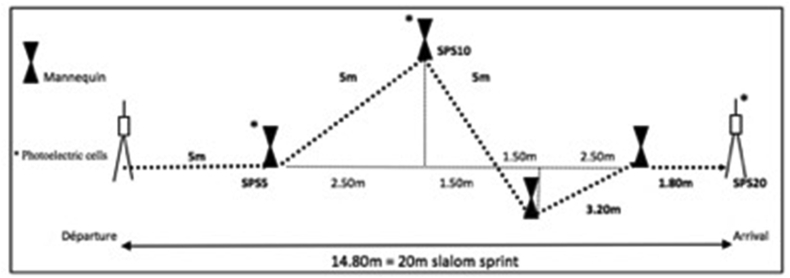
Players were randomly assigned to two training groups. Group 1 performed systematic change-of-direction sprints (CODST, U19 [n = 9], U17 [n = 9], U15 [n = 10]) while group 2 conducted systematic linear sprints (LST, U19 [n = 9], U17 [n = 9], U15 [n = 9]). Training volumes were similar between groups (40 sprints per week x 30 weeks = 1200 sprints per season). Pre and post training, all players performed tests for the assessment of linear and slalom sprint speed (5-m and 10-m), countermovement jump, and maximal aerobic speed performance.
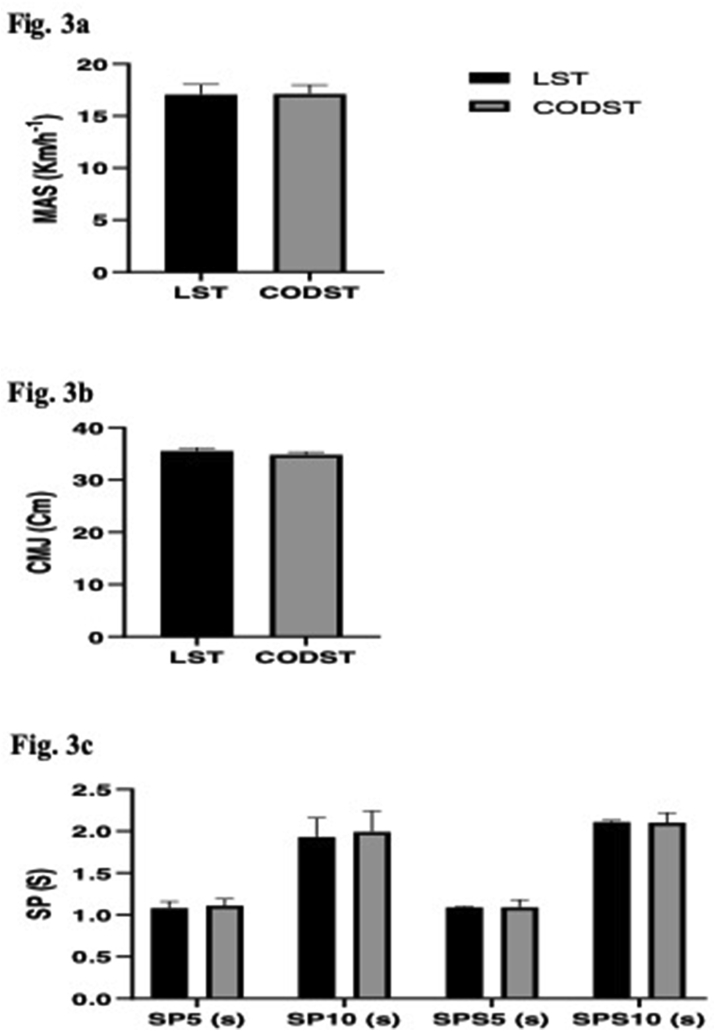
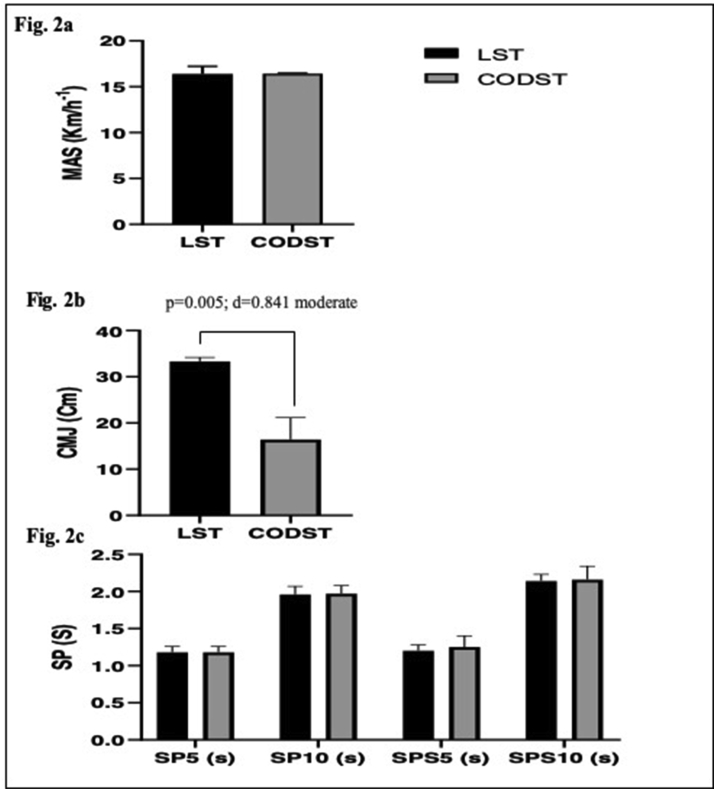
For all physical fitness measures, the baseline-adjusted means data (ANCOVA) across the age groups showed no significant differences between LST and CODST at post (0.061 < p < 0.995; 0.0017 < d < 1.01). The analyses of baseline-adjusted means for all physical fitness measures for U15, U17, and U19 (LST vs. CODST) revealed no significant differences between LST and CODST for U15 (0.213 < p < 0.917; 0.001 < d < 0.087), U17 (0.132 < p < 0.976; 0.001 < d < 0.310), and U19 (0.300 < p < 0.999; 0.001 < d < 0.049) at post.
The results from this study showed that both, LST and CODST induced significant changes in the sprint, lower limbs power, and aerobic performances in young elite soccer players. Since no significant differences were observed between LST and CODST, the observed changes are most likely due to training and/or maturation. Therefore, more research is needed to elucidate whether CODST, LST or a combination of both is beneficial for youth soccer athletes' performance development.
本研究旨在考察在一个足球赛季中,两种不同的短跑训练方案对不同年龄段优秀青年男性足球运动员短跑和跳跃成绩的影响。
球员被随机分为两个训练组。第一组进行系统的变向短跑训练(CODST,U19组[n = 9],U17组[n = 9],U15组[n = 10]),而第二组进行系统的直线短跑训练(LST,U19组[n = 9],U17组[n = 9],U15组[n = 9])。两组的训练量相似(每周40次短跑×30周 = 每个赛季1200次短跑)。在训练前后,所有球员都进行了测试,以评估直线和障碍短跑速度(5米和10米)、反向移动跳跃和最大有氧速度表现。
对于所有身体素质指标,各年龄组经基线调整后的均值数据(协方差分析)显示,训练后LST组和CODST组之间无显著差异(0.061 < p < 0.995;0.0017 < d < 1.01)。对U15、U17和U19组所有身体素质指标经基线调整后的均值分析(LST组与CODST组对比)显示,U15组(0.213 < p < 0.917;0.001 < d < 0.087)、U17组(0.132 < p < 0.976;0.001 < d < 0.310)和U19组(0.300 < p < 0.999;0.001 < d < 0.049)训练后LST组和CODST组之间均无显著差异。
本研究结果表明,LST和CODST训练均能使年轻优秀足球运动员的短跑、下肢力量和有氧能力产生显著变化。由于LST组和CODST组之间未观察到显著差异,观察到的变化很可能是由于训练和/或成熟所致。因此,需要更多研究来阐明CODST、LST或两者结合是否有利于青少年足球运动员的成绩发展。