de Souza Alana Serrano Campelo, Gonçalves Letícia Boslooper, Lepique Ana Paula, de Araujo-Souza Patrícia Savio
Laboratório de Imunogenética e Histocompatibilidade (LIGH), Departamento de Genética, Setor de Ciências Biológicas, Universidade Federal do Paraná (UFPR), Curitiba, Brazil.
Programa de Pós-graduação em Genética, Departamento de Genética, Universidade Federal do Paraná (UFPR), Curitiba, Brazil.
Front Oncol. 2020 Dec 1;10:603661. doi: 10.3389/fonc.2020.603661. eCollection 2020.
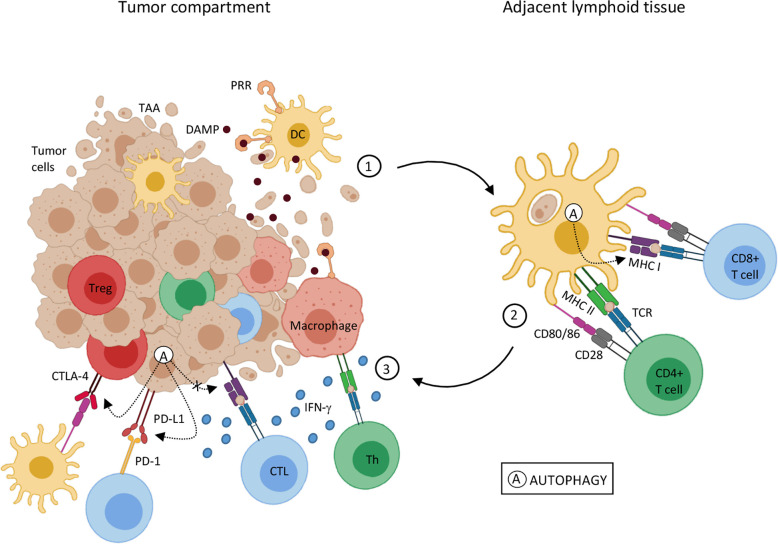
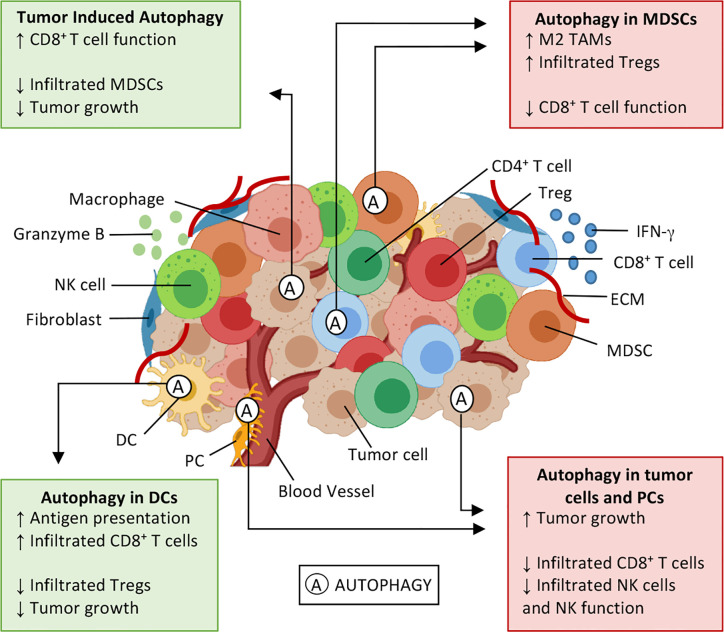
The tumor microenvironment (TME) is complex, and its composition and dynamics determine tumor fate. From tumor cells themselves, with their capacity for unlimited replication, migration, and invasion, to fibroblasts, endothelial cells, and immune cells, which can have pro and/or anti-tumor potential, interaction among these elements determines tumor progression. The understanding of molecular pathways involved in immune escape has permitted the development of cancer immunotherapies. Targeting molecules or biological processes that inhibit antitumor immune responses has allowed a significant improvement in cancer patient's prognosis. Autophagy is a cellular process required to eliminate dysfunctional proteins and organelles, maintaining cellular homeostasis. Usually a process associated with protection against cancer, autophagy associated to cancer cells has been reported in response to hypoxia, nutrient deficiency, and oxidative stress, conditions frequently observed in the TME. Recent studies have shown a paradoxical association between autophagy and tumor immune responses. Tumor cell autophagy increases the expression of inhibitory molecules, such as PD-1 and CTLA-4, which block antitumor cytotoxic responses. Moreover, it can also directly affect antitumor immune responses by, for example, degrading NK cell-derived granzyme B and protecting tumor cells. Interestingly, the activation of autophagy on dendritic cells has the opposite effects, enhancing antigen presentation, triggering CD8 T cells cytotoxic activity, and reducing tumor growth. Therefore, this review will focus on the most recent aspects of autophagy and tumor immune environment. We describe the dual role of autophagy in modulating tumor immune responses and discuss some aspects that must be considered to improve cancer treatment.
肿瘤微环境(TME)很复杂,其组成和动态变化决定肿瘤的命运。从具有无限复制、迁移和侵袭能力的肿瘤细胞本身,到具有促肿瘤和/或抗肿瘤潜力的成纤维细胞、内皮细胞和免疫细胞,这些成分之间的相互作用决定肿瘤的进展。对免疫逃逸所涉及分子途径的了解推动了癌症免疫疗法的发展。靶向抑制抗肿瘤免疫反应的分子或生物学过程已使癌症患者的预后有了显著改善。自噬是清除功能失调的蛋白质和细胞器以维持细胞内稳态所必需的细胞过程。自噬通常是一个与预防癌症相关的过程,但与癌细胞相关的自噬已被报道会在缺氧、营养缺乏和氧化应激等TME中常见的情况下发生。最近的研究表明自噬与肿瘤免疫反应之间存在矛盾的关联。肿瘤细胞自噬会增加抑制性分子如PD-1和CTLA-4的表达,从而阻断抗肿瘤细胞毒性反应。此外,它还可通过例如降解自然杀伤细胞衍生的颗粒酶B和保护肿瘤细胞来直接影响抗肿瘤免疫反应。有趣的是,树突状细胞上自噬的激活则有相反的效果,可增强抗原呈递、触发CD8 T细胞的细胞毒性活性并减少肿瘤生长。因此,本综述将聚焦于自噬和肿瘤免疫环境的最新研究进展。我们描述了自噬在调节肿瘤免疫反应中的双重作用,并讨论了改善癌症治疗时必须考虑的一些方面。