Alzheimer's Disease Research Center, Department of Neurology, School of Medicine, University of Alabama at Birmingham, Birmingham, AL, USA.
Department of Biostatistics, School of Public Health, University of Alabama at Birmingham, Birmingham, AL, USA.
J Alzheimers Dis. 2021;79(2):543-557. doi: 10.3233/JAD-200796.
African Americans are at increased risk for Alzheimer's disease (AD) but barriers to optimal clinical care are unclear.
To comprehensively evaluate potential racial differences in the diagnosis and treatment of AD in an academic medical center.
We used the clinical informatics tool, i2b2, to analyze all patient encounters for AD or mild cognitive impairment (MCI) in the University of Alabama at Birmingham Health System over a three-year period, examining neuroimaging rates and dementia-related medication use by race and clinic site using ratio tests on contingency tables of stratified patient counts.
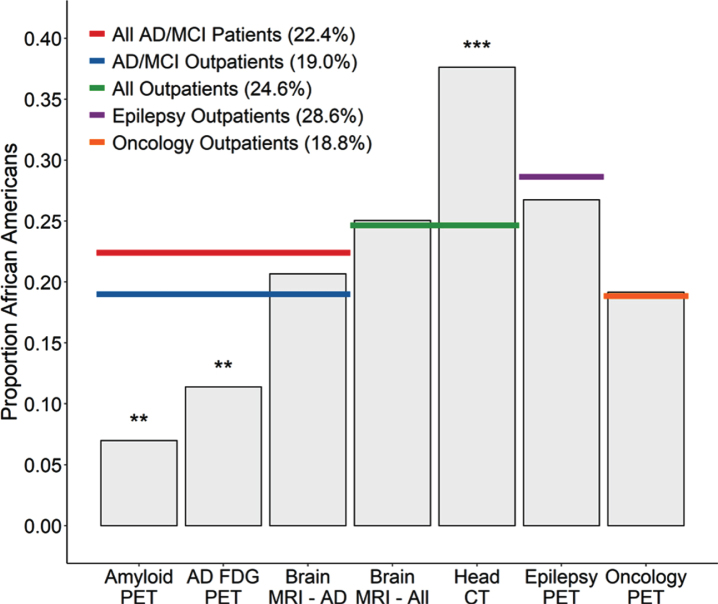
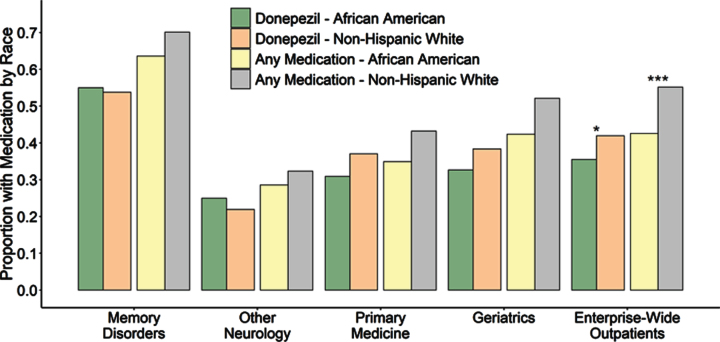
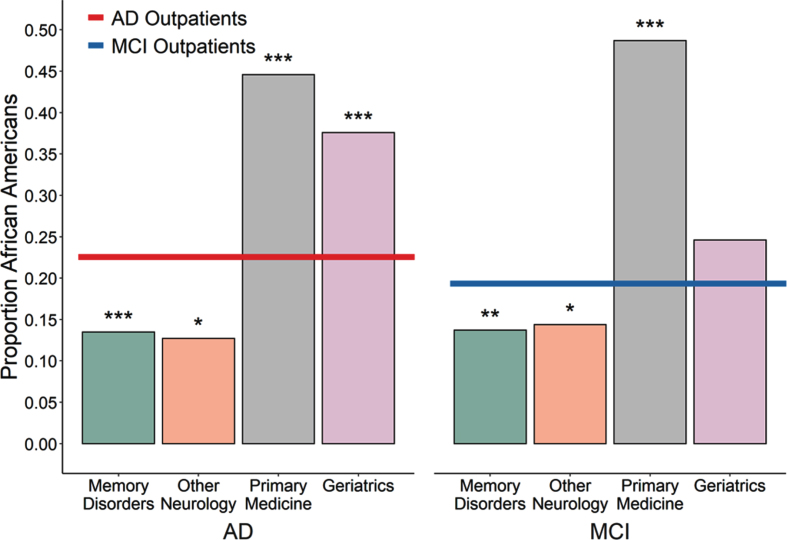
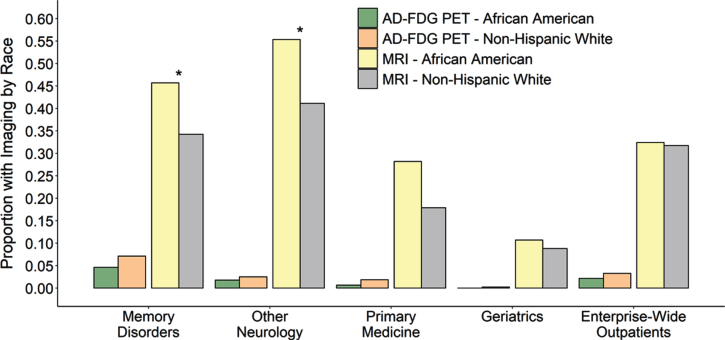
Enterprise-wide, African Americans were not underrepresented among outpatients seen for AD/MCI. However, there were differences in the clinic setting where visits occurred, with African Americans overrepresented in Geriatrics and primary care clinics and underrepresented in Memory Disorders specialty clinics. There were no racial differences in the rates at which any clinic ordered PET neuroimaging tests or dementia-related medications. However, unsurprisingly, specialty clinics ordered both PET neuroimaging and dementia-related medications at a higher rate than primary care clinics, and overall across the medical enterprise, African Americans were statistically less likely to have PET neuroimaging or dementia-related medications ordered.
African Americans with AD/MCI were not underrepresented at this academic medical center but were somewhat less likely to have PET neuroimaging or to be on dementia-related medications, potentially in part from underrepresentation in the specialty clinics where these orders are more likely. The reasons for this underrepresentation in specialty clinics are likely multifactorial and important to better understand.
非裔美国人患阿尔茨海默病(AD)的风险增加,但对最佳临床护理的障碍尚不清楚。
全面评估在学术医疗中心中 AD 诊断和治疗方面潜在的种族差异。
我们使用临床信息学工具 i2b2 分析了阿拉巴马大学伯明翰卫生系统三年内所有 AD 或轻度认知障碍(MCI)患者的就诊情况,通过分层患者计数的列联表比率检验,按种族和诊所检查神经影像学检查率和与痴呆相关的药物使用情况。
从整个企业的角度来看,接受 AD/MCI 门诊治疗的非裔美国人并不代表代表性不足。然而,就诊的诊所环境存在差异,非裔美国人在老年病学和初级保健诊所的就诊率较高,而在记忆障碍专科诊所的就诊率较低。任何诊所进行 PET 神经影像学检查或与痴呆相关的药物治疗的比率均无种族差异。然而,不出所料,专科诊所比初级保健诊所更有可能开 PET 神经影像学检查和与痴呆相关的药物治疗,并且在整个医疗企业中,非裔美国人进行 PET 神经影像学检查或与痴呆相关的药物治疗的可能性统计学上较低。
在这家学术医疗中心,患有 AD/MCI 的非裔美国人并不代表代表性不足,但他们进行 PET 神经影像学检查或接受与痴呆相关的药物治疗的可能性略低,这可能部分是由于他们在更有可能开出这些检查和药物的专科诊所中代表性不足。在专科诊所中代表性不足的原因可能是多方面的,需要进一步了解。