Meza José S, Bourtzis Kostas, Zacharopoulou Antigone, Gariou-Papalexiou Angeliki, Cáceres Carlos
Programa Moscafrut, AGRICULTURA/SENASICA-IICA, Metapa de Domínguez, Chiapas, Mexico.
Insect Pest Control Laboratory, Joint FAO/IAEA Division of Nuclear Techniques in Food and Agriculture, Seibersdorf, Vienna, Austria.
BMC Genet. 2020 Dec 18;21(Suppl 2):134. doi: 10.1186/s12863-020-00932-5.
Area-wide integrated pest management programs (AW-IPM) incorporating sterile insect technique (SIT) have been successful in suppressing populations of different fruit fly species during the last six decades. In addition, the development of genetic sexing strains (GSS) for different fruit fly species has allowed for sterile male-only releases and has significantly improved the efficacy and cost effectiveness of the SIT applications. The South American Fruit Fly Anastrepha fraterculus (Diptera: Tephritidae) is a major agricultural pest attacking several fruit commodities. This impedes international trade and has a significant negative impact on the local economies. Given the importance of sterile male-only releases, the development of a GSS for A. fraterculus would facilitate the implementation of an efficient and cost-effective SIT operational program against this insect pest species.
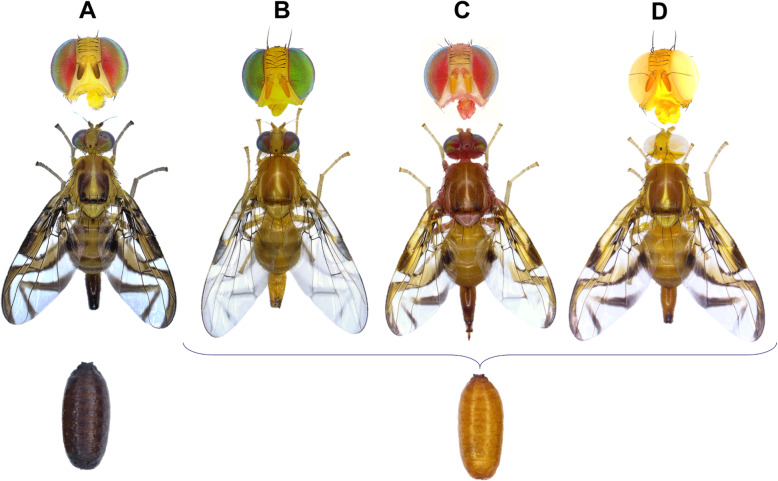
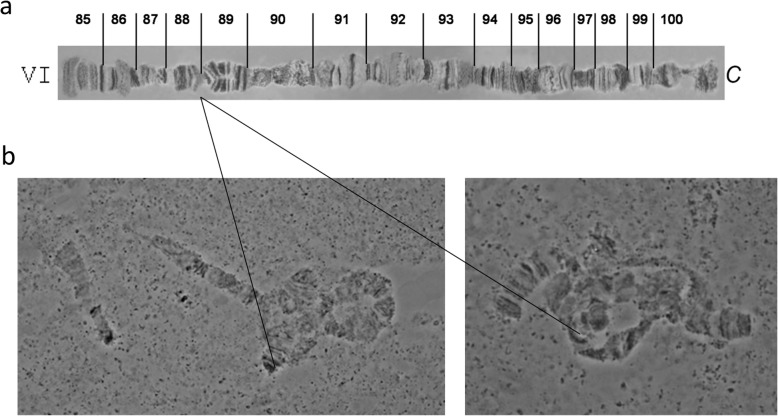
For potential use in a GSS, three new morphological markers (mutants) were isolated in a laboratory strain of A. fraterculus sp. 1, including the black pupae (bp) gene located on chromosome VI. The black pupa phenotype was used as a selectable marker to develop genetic sexing strains by linking the wild type allele (bp) to the Y-chromosome -via irradiation to induce a reciprocal Y-autosome translocation. Four GSS were established and one of them, namely GSS-89, showed the best genetic stability and the highest fertility. This strain was selected for further characterization and cytogenetic analysis.
We herein report the development of the first genetic sexing strain of a major agricultural pest, A. fraterculus sp. 1, using as a selectable marker the black pupae genetic locus.
在过去的六十年里,结合不育昆虫技术(SIT)的区域综合害虫管理计划(AW-IPM)已成功抑制了不同果蝇种类的种群数量。此外,针对不同果蝇种类的遗传性别品系(GSS)的开发使得仅释放不育雄蝇成为可能,并显著提高了SIT应用的效果和成本效益。南美果蝇Anastrepha fraterculus(双翅目:实蝇科)是一种主要的农业害虫,侵袭多种水果。这阻碍了国际贸易,并对当地经济产生了重大负面影响。鉴于仅释放不育雄蝇的重要性,开发A. fraterculus的遗传性别品系将有助于实施针对这种害虫的高效且具成本效益的SIT操作计划。
为了在遗传性别品系中潜在应用,在A. fraterculus sp. 1的一个实验室品系中分离出了三个新的形态学标记(突变体),包括位于第六条染色体上的黑蛹(bp)基因。黑蛹表型被用作选择标记,通过将野生型等位基因(bp)与Y染色体相连——通过辐射诱导相互的Y - 常染色体易位,来开发遗传性别品系。建立了四个遗传性别品系,其中一个名为GSS - 89,表现出最佳的遗传稳定性和最高的育性。该品系被选用于进一步的特性鉴定和细胞遗传学分析。
我们在此报告了首个主要农业害虫A. fraterculus sp. 1的遗传性别品系的开发,使用黑蛹遗传位点作为选择标记。