Universidade Federal de São João Del Rei, Divinópolis, MG, Brazil.
The University of Queensland Diamantina Institute, The University of Queensland, Translational Research Institute, Brisbane, Australia.
Braz J Otorhinolaryngol. 2021 May-Jun;87(3):346-352. doi: 10.1016/j.bjorl.2020.10.017. Epub 2020 Nov 29.
The association between uterine cervix and anogenital carcinomas and human papillomavirus, HPV, is well established, however the involvement of this virus in the development of oral squamous cell carcinomas remains controversial.
To evaluate the relationship between HPV infection and oral squamous cell carcinomas, and to estimate the incidence of this infection in these patients.
Four electronic databases were searched to find studies that met the following inclusion criteria: i) performed in humans; ii) were cohort, case-control or cross-sectional; iii) assessed the HPV oncogenic activity by the E6 and E7 mRNA; iv) included primary oral squamous cell carcinomas which; v) diagnosis had been confirmed by biopsy. Information about the country; study period; sample obtainment; sites of oral squamous cell carcinomas; number, gender and age range of the population; the prevalence of HPV infection and subtypes detected; use of tobacco or alcohol and oral sex practice were extracted. The methodological quality of included articles was assessed using 14 criteria.
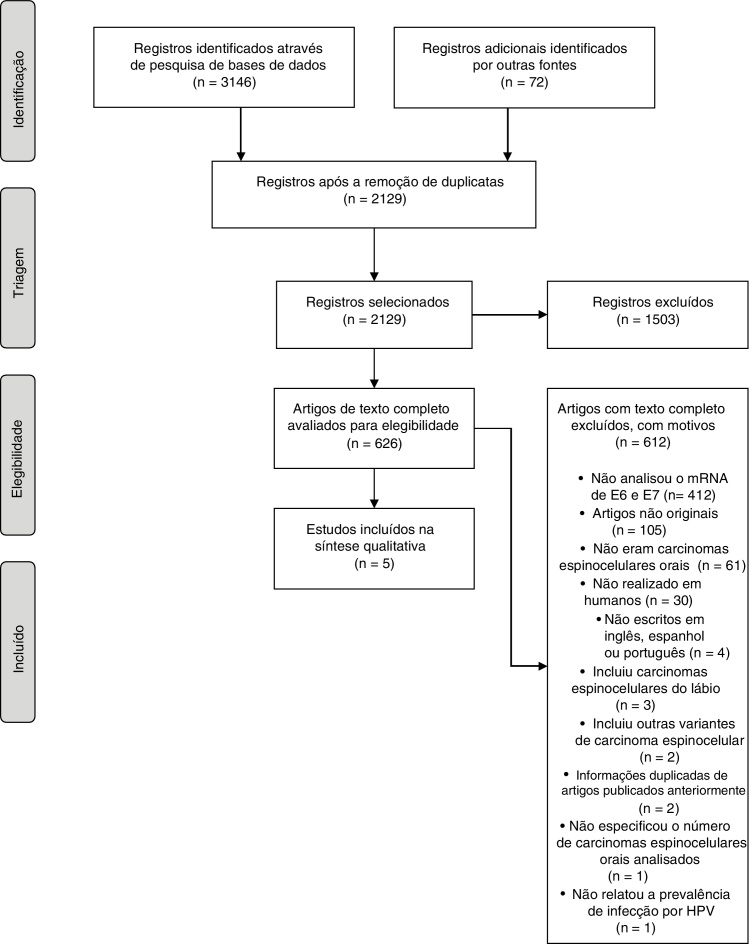
The search strategy retrieved 2129 articles. Assessment of the full text was done for 626 articles, but five were included. The total of participants included was 383, most of them male with mean age between 51.0 and 63.5 years old. Seventeen patients were HPV/mRNA-positive, being the subtypes 16 and 18 detected more frequently. Nine of the HPV/mRNA-positive oral squamous cell carcinomas occurred on the tongue. The quality score average of included articles was five points.
Among the 383 oral squamous cell carcinoma patients included, 17 (4.4%) were HPV/mRNA-positive, nevertheless it was not possible to assess if HPV infection was associated with oral squamous cell carcinomas because none of the studies included was longitudinal and cross-sectional investigations do not have control group.
人乳头瘤病毒(HPV)与子宫颈和肛门生殖器癌之间的关联已得到充分证实,然而,该病毒在口腔鳞状细胞癌发展中的作用仍存在争议。
评估 HPV 感染与口腔鳞状细胞癌之间的关系,并估计该感染在这些患者中的发生率。
检索了四个电子数据库,以寻找符合以下纳入标准的研究:i)在人类中进行;ii)为队列、病例对照或横断面研究;iii)通过 E6 和 E7 mRNA 评估 HPV 致癌活性;iv)纳入原发性口腔鳞状细胞癌;v)通过活检确诊。提取有关国家、研究期间、样本采集、口腔鳞状细胞癌部位、人群数量、性别和年龄范围、HPV 感染和检测到的亚型的流行率、烟草或酒精使用以及口交习惯的信息。使用 14 项标准评估纳入文章的方法学质量。
搜索策略共检索到 2129 篇文章。对 626 篇全文进行了评估,但仅纳入了 5 篇。共纳入 383 名参与者,其中大多数为男性,平均年龄在 51.0 至 63.5 岁之间。17 名患者 HPV/mRNA 阳性,检测到的亚型为 16 和 18。9 例 HPV/mRNA 阳性口腔鳞状细胞癌发生在舌头上。纳入文章的平均质量评分为 5 分。
在纳入的 383 例口腔鳞状细胞癌患者中,17 例(4.4%)HPV/mRNA 阳性,但由于没有一项研究是纵向的,且横断面研究没有对照组,因此无法评估 HPV 感染是否与口腔鳞状细胞癌有关。