Huang Shuanglong, Zhang Xuehua, Fernando W G Dilantha
Department of Plant Science, University of Manitoba, Winnipeg, MB, Canada.
Front Plant Sci. 2020 Dec 3;11:600063. doi: 10.3389/fpls.2020.600063. eCollection 2020.
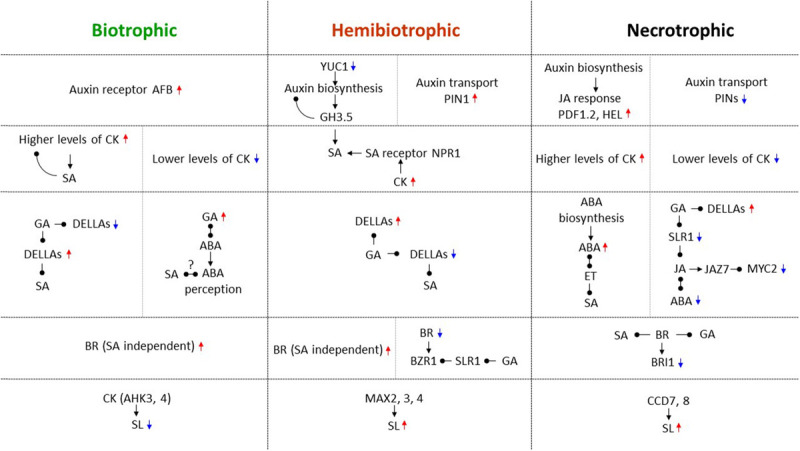
A fundamental process culminating in the mechanisms of plant-pathogen interactions is the regulation of trophic divergence into biotrophic, hemibiotrophic, and necrotrophic interactions. Plant hormones, of almost all types, play significant roles in this regulatory apparatus. In plant-pathogen interactions, two classical mechanisms underlying hormone-dependent trophic divergence are long recognized. While salicylic acid dominates in the execution of host defense response against biotrophic and early-stage hemibiotrophic pathogens, jasmonic acid, and ethylene are key players facilitating host defense response against necrotrophic and later-stage hemibiotrophic pathogens. Evidence increasingly suggests that trophic divergence appears to be modulated by more complex signaling networks. Acting antagonistically or agonistically, other hormones such as auxins, cytokinins, abscisic acid, gibberellins, brassinosteroids, and strigolactones, as well as nitric oxide, are emerging candidates in the regulation of trophic divergence. In this review, the latest advances in the dynamic regulation of trophic divergence are summarized, emphasizing common and contrasting hormonal and nitric oxide signaling strategies deployed in plant-pathogen interactions.
植物与病原体相互作用机制的一个基本过程是营养分化调控,其最终导致生物营养型、半活体营养型和坏死营养型相互作用。几乎所有类型的植物激素在这一调控机制中都发挥着重要作用。在植物与病原体的相互作用中,激素依赖性营养分化的两个经典机制早已为人所知。水杨酸在宿主针对生物营养型和早期半活体营养型病原体的防御反应中起主导作用,而茉莉酸和乙烯则是促进宿主针对坏死营养型和后期半活体营养型病原体防御反应的关键因素。越来越多的证据表明,营养分化似乎受到更复杂的信号网络调控。生长素、细胞分裂素、脱落酸、赤霉素、油菜素内酯和独脚金内酯等其他激素,以及一氧化氮,通过拮抗或协同作用,正在成为营养分化调控中的新兴候选因素。在这篇综述中,总结了营养分化动态调控的最新进展,重点强调了植物与病原体相互作用中所采用的常见和不同的激素及一氧化氮信号策略。