School of Public Health, Fudan University, Shanghai, China.
Key Lab of Health Technology Assessment (National Health Commission), Fudan University, Shanghai, China.
J Med Internet Res. 2021 Jan 18;23(1):e18722. doi: 10.2196/18722.
China was the first country in the world to experience a large-scale COVID-19 outbreak. The rapid spread of the disease and enforcement of public health measures has caused distress among vulnerable populations such as pregnant women. With a limited understanding of the novel, emerging infectious disease, pregnant women have sought ways to access timely and trusted health care information. The mental health status of pregnant women during this public health emergency, as well as how they responded to the situation and where and how they obtained antenatal care information, remain to be understood.
This study aimed to evaluate the mental health status of pregnant women during the COVID-19 epidemic in China by measuring their perceived stress, anxiety, and depression levels; explore the approaches used by them to access antenatal health care information; and determine their associations with maternal mental health status.
We conducted a web-based, cross-sectional survey to assess the mental health status of Chinese pregnant women by using the validated, Chinese version of Perceived Stress Scale, Self-Rating Anxiety Scale, and Edinburgh Depression Scale. We also collected information on the various approaches these women used to access antenatal care information during the early stage of the COVID-19 epidemic, from February 5 to 28, 2020.
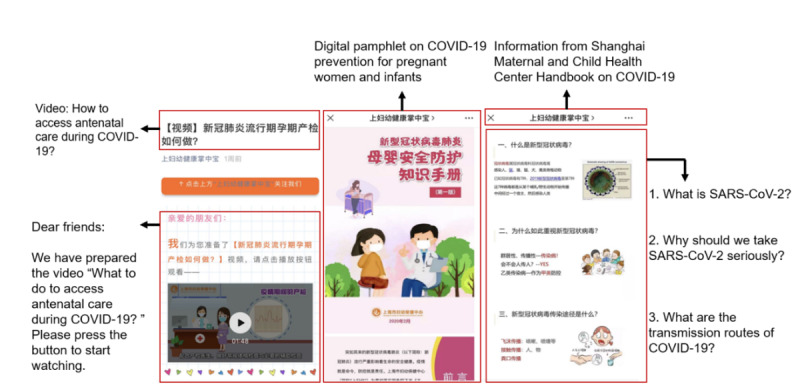
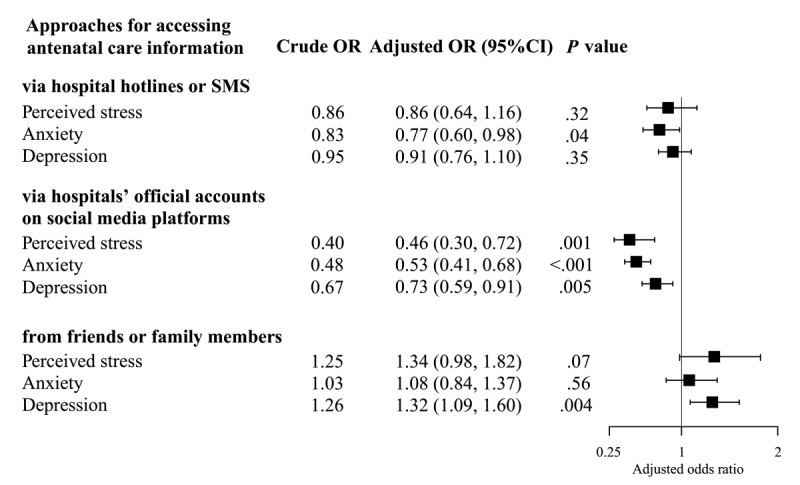
A total of 1873 pregnant women from 22 provinces or regions of China participated in the survey. The prevalence of perceived stress, anxiety, and depression among these participants was 89.1% (1668/1873; 95% CI 87.6%, 90.4%), 18.1% (339/1873; 95% CI 16.4%, 19.9%), and 45.9% (859/1873; 95% CI 43.6%, 48.1%), respectively. Hospitals' official accounts on the Chinese social media platforms WeChat and Weibo were the most popular channels among these pregnant women to obtain antenatal care information during the COVID-19 outbreak. Access to antenatal care information via the hospitals' official social media accounts was found to be associated with a significantly lower risk of perceived stress (adjusted odds ratio [aOR] 0.46, 95% CI 0.30-0.72; P=.001), anxiety (aOR 0.53, 95% CI 0.41-0.68; P<.001), and depression (aOR 0.73, 95% CI 0.59-0.91; P=.005). Access to health care information via hospital hotlines or SMS was found to be significantly associated with a lower risk of anxiety only (OR 0.77, 95% CI 0.60-0.98; P=.04).
During the COVID-19 outbreak in China, pregnant women experienced high levels of perceived stress, anxiety, and depression. During such public health emergencies, mental health care services should be strengthened to reassure and support pregnant women. Specific information targeted at pregnant women, including information on how to cope in an emergency or major disease outbreak, developed and disseminated by health care institutions via social media platforms could be an effective way to mitigate mental health challenges and ensure epidemic preparedness and response in the future.
中国是世界上第一个经历大规模 COVID-19 疫情爆发的国家。疾病的迅速传播和公共卫生措施的实施给孕妇等弱势群体带来了困扰。由于对这种新型传染病了解有限,孕妇一直在寻求及时和可信的保健信息。在这种公共卫生紧急情况下,孕妇的心理健康状况,以及她们如何应对这种情况,以及从何处和如何获得产前保健信息,仍有待了解。
本研究旨在通过测量中国孕妇的感知压力、焦虑和抑郁水平,评估 COVID-19 疫情期间孕妇的心理健康状况;探讨她们获取产前保健信息的途径;并确定与产妇心理健康状况的关系。
我们于 2020 年 2 月 5 日至 28 日,采用经过验证的中文版感知压力量表、自评焦虑量表和爱丁堡抑郁量表,进行了一项基于网络的横断面调查,以评估中国孕妇的心理健康状况。我们还收集了这些孕妇在 COVID-19 疫情早期通过各种途径获取产前保健信息的信息。
共有来自中国 22 个省或地区的 1873 名孕妇参加了调查。这些参与者中,感知压力、焦虑和抑郁的患病率分别为 89.1%(1668/1873;95%CI 87.6%,90.4%)、18.1%(339/1873;95%CI 16.4%,19.9%)和 45.9%(859/1873;95%CI 43.6%,48.1%)。在这些孕妇中,医院在中文社交媒体平台微信和微博上的官方账号是获取 COVID-19 爆发期间产前保健信息的最受欢迎渠道。通过医院官方社交媒体账号获取产前保健信息与感知压力(调整后的优势比[OR]0.46,95%CI 0.30-0.72;P=.001)、焦虑(调整后的 OR 0.53,95%CI 0.41-0.68;P<.001)和抑郁(调整后的 OR 0.73,95%CI 0.59-0.91;P=.005)的风险显著降低相关。通过医院热线或短信获取保健信息仅与焦虑风险降低显著相关(OR 0.77,95%CI 0.60-0.98;P=.04)。
在中国 COVID-19 疫情期间,孕妇经历了较高水平的感知压力、焦虑和抑郁。在这种公共卫生紧急情况下,应加强心理健康保健服务,以安抚和支持孕妇。医疗机构通过社交媒体平台为孕妇专门开发和传播的特定信息,包括在紧急情况或重大疾病爆发时如何应对的信息,可能是减轻心理健康挑战并确保未来疫情防范和应对的有效途径。