Center for Advanced Systems Understanding (CASUS), Goerlitz, Germany; Dept. of Biology, University of Maryland, College Park, MD, USA.
Dept. of Biology, University of Maryland, College Park, MD, USA.
J Theor Biol. 2022 Apr 7;538:111017. doi: 10.1016/j.jtbi.2022.111017. Epub 2022 Jan 24.
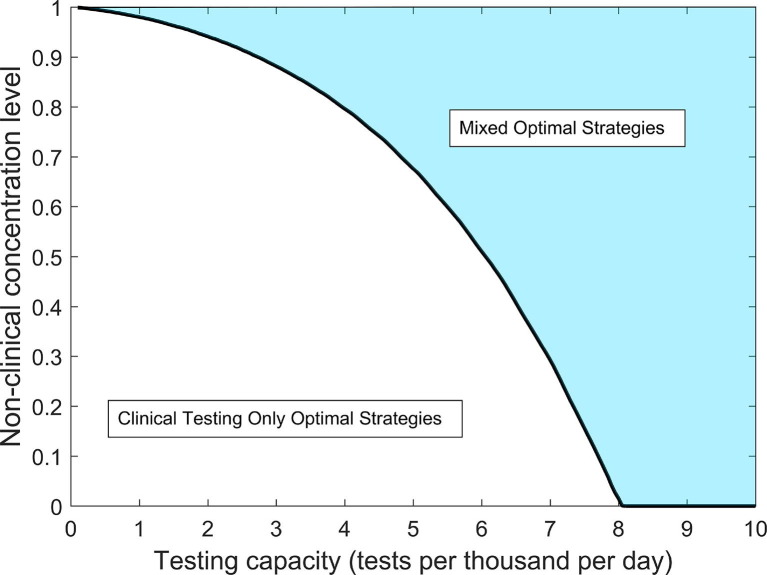
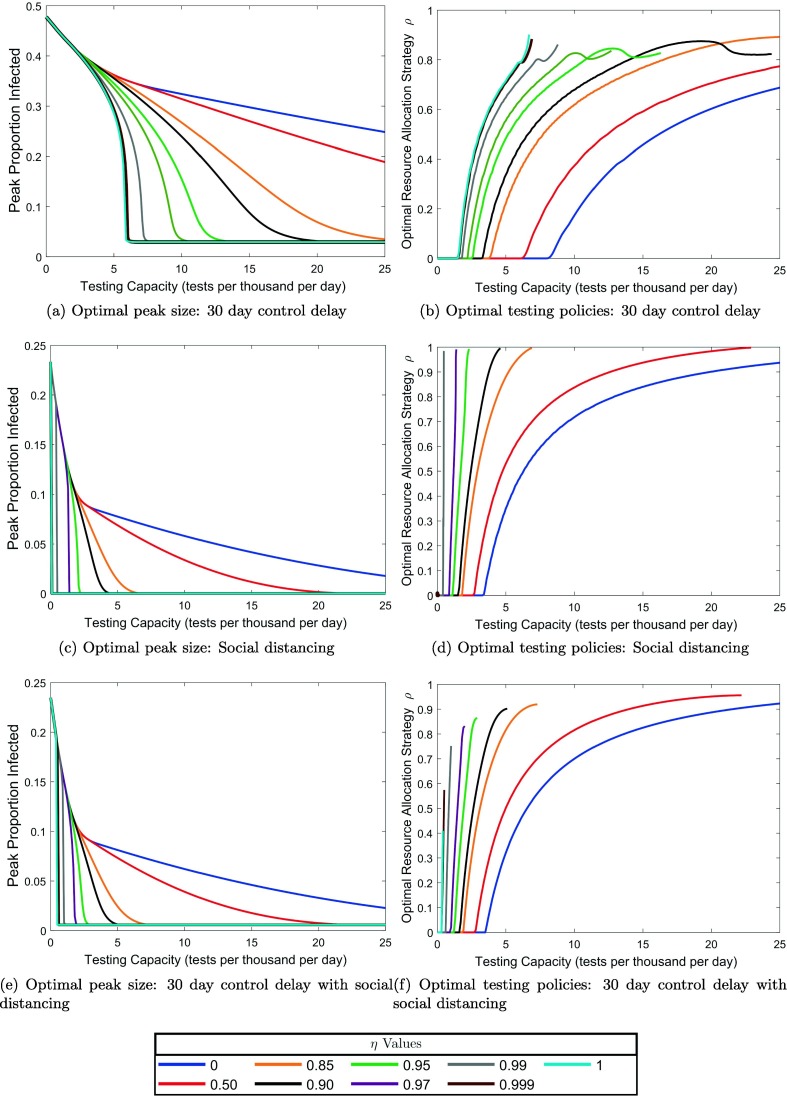
Insufficient testing capacity has been a critical bottleneck in the worldwide fight against COVID-19. Optimizing the deployment of limited testing resources has therefore emerged as a keystone problem in pandemic response planning. Here, we use a modified SEIR model to optimize testing strategies under a constraint of limited testing capacity. We define pre-symptomatic, asymptomatic, and symptomatic infected classes, and assume that positively tested individuals are immediately moved into quarantine. We further define two types of testing. Clinical testing focuses only on the symptomatic class. Non-clinical testing detects pre- and asymptomatic individuals from the general population, and a concentration parameter governs the degree to which such testing can be focused on high infection risk individuals. We then solve for the optimal mix of clinical and non-clinical testing as a function of both testing capacity and the concentration parameter. We find that purely clinical testing is optimal at very low testing capacities, supporting early guidance to ration tests for the sickest patients. Additionally, we find that a mix of clinical and non-clinical testing becomes optimal as testing capacity increases. At high but empirically observed testing capacities, a mix of clinical testing and non-clinical testing, even if extremely unfocused, becomes optimal. We further highlight the advantages of early implementation of testing programs, and of combining optimized testing with contact reduction interventions such as lockdowns, social distancing, and masking.
检测能力不足一直是全球抗击 COVID-19 的一个关键瓶颈。因此,优化有限检测资源的部署已成为大流行应对规划中的一个关键问题。在这里,我们使用改进的 SEIR 模型,在检测能力有限的约束下优化检测策略。我们定义了有症状前、无症状和有症状的感染人群,并假设经检测呈阳性的个体将立即被隔离。我们进一步定义了两种类型的检测。临床检测仅针对有症状的人群。非临床检测从一般人群中检测出有症状前和无症状的个体,并且集中参数决定了这种检测能够在多大程度上集中在高感染风险的个体上。然后,我们根据检测能力和集中参数,求解出临床和非临床检测的最优组合。我们发现,在检测能力非常低的情况下,纯粹的临床检测是最优的,这支持了对最严重患者进行测试的早期指导。此外,我们发现随着检测能力的提高,临床和非临床检测的混合检测变得最优。在高但经验上观察到的检测能力下,即使是非常不集中的临床检测和非临床检测的混合也变得最优。我们进一步强调了早期实施检测计划以及将优化检测与封锁、社交距离和戴口罩等接触减少干预措施相结合的优势。