University of Alabama, Information Systems, Statistics, and Management Science, Blacksburg, VA, United States of America.
Virginia Tech, Industrial and Systems Engineering, Blacksburg, VA, United States of America.
PLoS One. 2021 Feb 8;16(2):e0246285. doi: 10.1371/journal.pone.0246285. eCollection 2021.
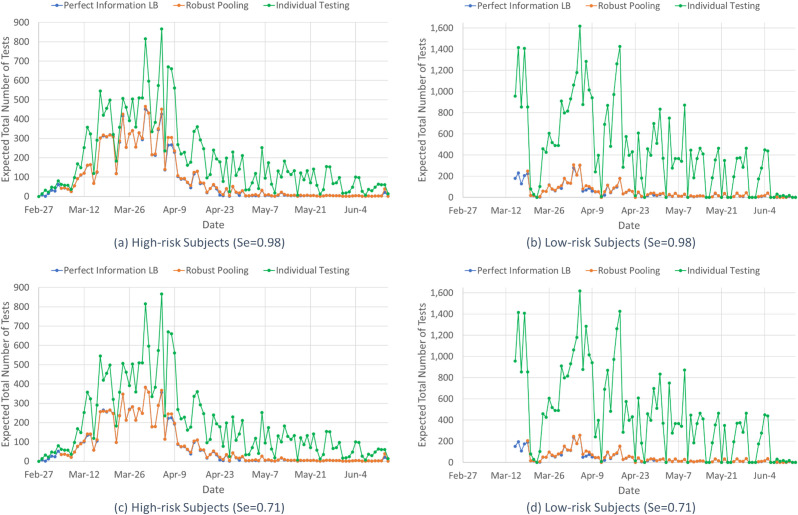
Limited testing capacity for COVID-19 has hampered the pandemic response. Pooling is a testing method wherein samples from specimens (e.g., swabs) from multiple subjects are combined into a pool and screened with a single test. If the pool tests positive, then new samples from the collected specimens are individually tested, while if the pool tests negative, the subjects are classified as negative for the disease. Pooling can substantially expand COVID-19 testing capacity and throughput, without requiring additional resources. We develop a mathematical model to determine the best pool size for different risk groups, based on each group's estimated COVID-19 prevalence. Our approach takes into consideration the sensitivity and specificity of the test, and a dynamic and uncertain prevalence, and provides a robust pool size for each group. For practical relevance, we also develop a companion COVID-19 pooling design tool (through a spread sheet). To demonstrate the potential value of pooling, we study COVID-19 screening using testing data from Iceland for the period, February-28-2020 to June-14-2020, for subjects stratified into high- and low-risk groups. We implement the robust pooling strategy within a sequential framework, which updates pool sizes each week, for each risk group, based on prior week's testing data. Robust pooling reduces the number of tests, over individual testing, by 88.5% to 90.2%, and 54.2% to 61.9%, respectively, for the low-risk and high-risk groups (based on test sensitivity values in the range [0.71, 0.98] as reported in the literature). This results in much shorter times, on average, to get the test results compared to individual testing (due to the higher testing throughput), and also allows for expanded screening to cover more individuals. Thus, robust pooling can potentially be a valuable strategy for COVID-19 screening.
用于 COVID-19 的有限检测能力阻碍了大流行应对。合并检测是一种检测方法,其中来自多个受检者的样本(例如拭子)被合并到一个池中,并使用单个测试进行筛查。如果池检测呈阳性,则从采集的样本中单独测试新的样本,而如果池检测呈阴性,则将受检者归类为该疾病的阴性。合并检测可以在不增加额外资源的情况下大幅扩大 COVID-19 的检测能力和通量。我们开发了一种数学模型,根据每个群体的 COVID-19 估计流行率,确定不同风险群体的最佳池大小。我们的方法考虑了测试的灵敏度和特异性,以及动态和不确定的流行率,并为每个群体提供了稳健的池大小。为了实际相关性,我们还通过电子表格开发了一个配套的 COVID-19 合并检测设计工具。为了证明合并检测的潜在价值,我们使用 2 月 28 日至 6 月 14 日期间冰岛对高风险和低风险群体进行 COVID-19 筛查的检测数据进行研究。我们在一个序贯框架内实施稳健的合并策略,该策略根据前一周的测试数据,每周为每个风险群体更新池大小。对于低风险和高风险群体(基于文献中报告的测试灵敏度值 [0.71,0.98]),稳健合并分别将测试数量减少 88.5%至 90.2%和 54.2%至 61.9%,相比个体检测。这导致与个体检测相比,平均获得测试结果的时间大大缩短(由于更高的测试通量),并且还可以进行扩展筛查以覆盖更多的个体。因此,稳健合并检测可能是 COVID-19 筛查的一种有价值的策略。