Tsinghua-Berkeley Shenzhen Institute (TBSI), Tsinghua University, Shenzhen, China.
Department of Civil and Environmental Engineering, University of California Berkeley, Berkeley, CA, USA.
Sci Rep. 2021 Nov 2;11(1):21460. doi: 10.1038/s41598-021-01065-0.
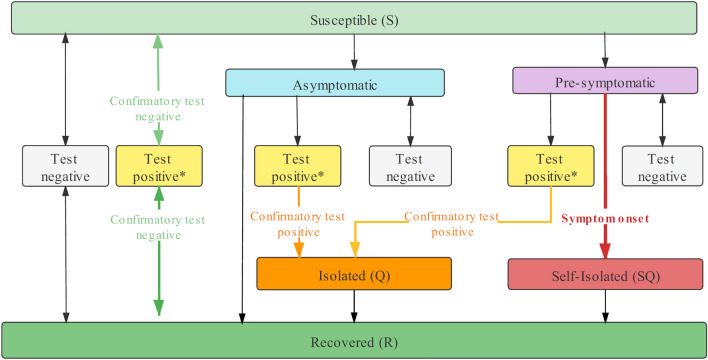
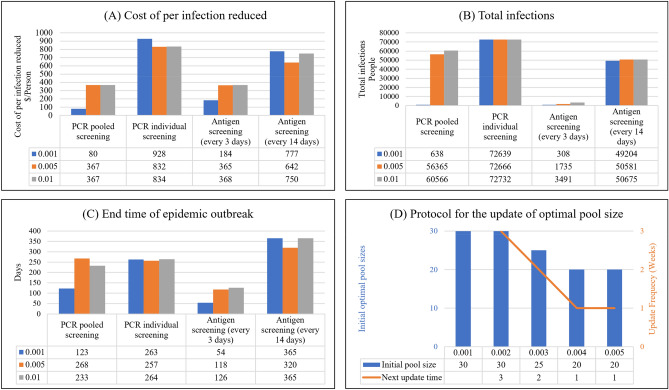
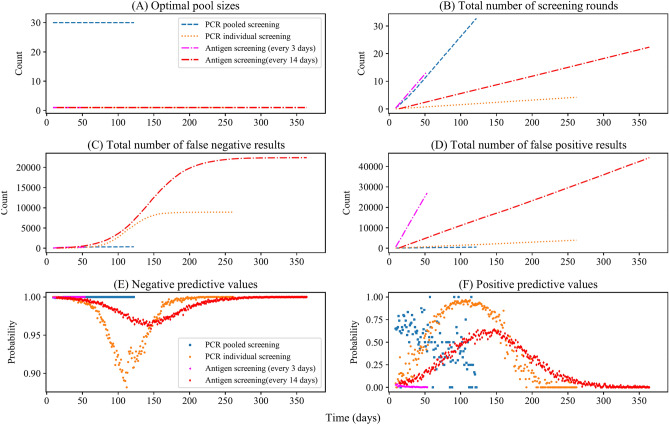
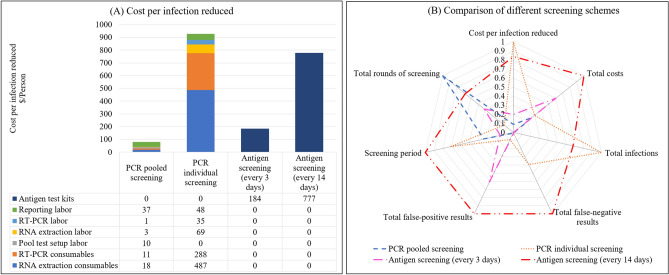
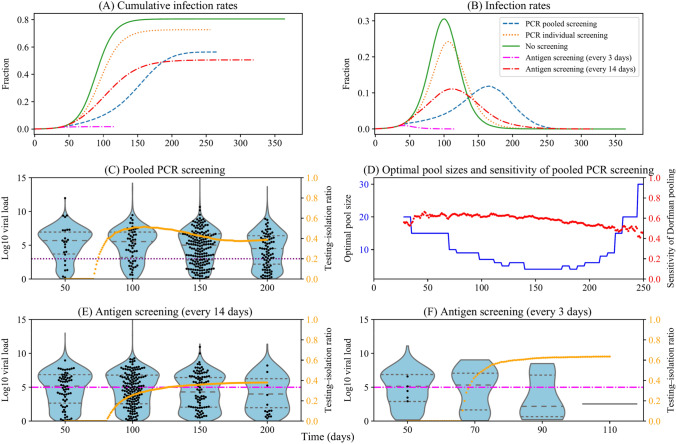
Population screening played a substantial role in safely reopening the economy and avoiding new outbreaks of COVID-19. PCR-based pooled screening makes it possible to test the population with limited resources by pooling multiple individual samples. Our study compared different population-wide screening methods as transmission-mitigating interventions, including pooled PCR, individual PCR, and antigen screening. Incorporating testing-isolation process and individual-level viral load trajectories into an epidemic model, we further studied the impacts of testing-isolation on test sensitivities. Results show that the testing-isolation process could maintain a stable test sensitivity during the outbreak by removing most infected individuals, especially during the epidemic decline. Moreover, we compared the efficiency, accuracy, and cost of different screening methods during the pandemic. Our results show that PCR-based pooled screening is cost-effective in reversing the pandemic at low prevalence. When the prevalence is high, PCR-based pooled screening may not stop the outbreak. In contrast, antigen screening with sufficient frequency could reverse the epidemic, despite the high cost and the large numbers of false positives in the screening process.
人群筛查在安全重启经济和避免 COVID-19 新爆发方面发挥了重要作用。基于 PCR 的混合筛查使我们能够通过混合多个个体样本,利用有限的资源对人群进行检测。我们的研究比较了不同的全人群筛查方法作为传播缓解干预措施,包括混合 PCR、个体 PCR 和抗原筛查。我们将测试-隔离过程和个体水平的病毒载量轨迹纳入到传染病模型中,进一步研究了测试-隔离对测试敏感性的影响。结果表明,通过清除大多数感染者,特别是在疫情下降期间,测试-隔离过程可以在疫情爆发期间保持稳定的测试敏感性。此外,我们还比较了不同筛查方法在大流行期间的效率、准确性和成本。我们的研究结果表明,基于 PCR 的混合筛查在低流行率下具有成本效益,可以逆转大流行。当流行率较高时,基于 PCR 的混合筛查可能无法阻止疫情爆发。相比之下,抗原筛查具有足够的频率,可以逆转疫情,尽管在筛查过程中成本高且假阳性数量多。