Department of Palliative Medicine, Tohoku University School of Medicine, Sendai, Japan.
Division of Biostatistics, Tohoku University School of Medicine, Sendai, Japan.
Cancer Med. 2021 Feb;10(3):1018-1026. doi: 10.1002/cam4.3689. Epub 2020 Dec 21.
The study aimed to clarify the efficacy of the "3-Day Surprise Question (3DSQ)" in predicting the prognosis for advanced cancer patients with impending death.
This study was a part of multicenter prospective observational study which investigated the dying process in advanced cancer patients in Japan. For patients with a Palliative Performance Scale ≤20, the 3DSQ "Would I be surprised if this patient died in the next 3 days?" was answered by their physicians. In addition to the sensitivity and specificity of the 3DSQ, the characteristics of patients who survived longer than expected were examined via multivariate analysis.
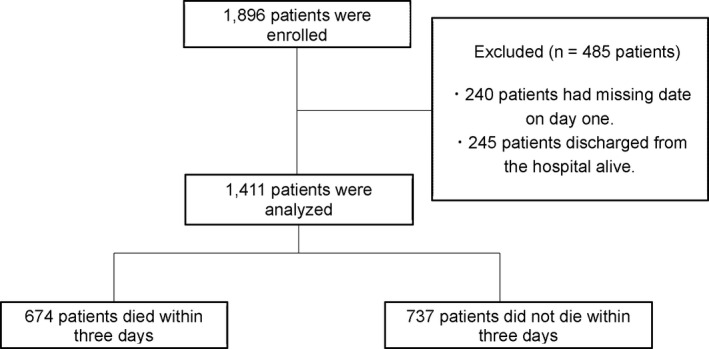
Among the 1896 patients enrolled, 1411 were evaluated. Among 1179 (83.6%) patients who were classified into the "Not surprised" group, 636 patients died within 3 days. Among 232 (16.4%) patients of "Yes surprised" group, 194 patients lived longer than 3 days. The sensitivity, specificity, positive predictive value, and negative predictive value of the 3DSQ were 94.3% (95% confidence interval [CI]: 92.7% to 95.8%), 26.3% (95% CI: 24.8% to 27.6%), 53.9% (95% CI: 53.0% to 54.7%), and 83.6% (95% CI: 78.7% to 87.7%), respectively. Multivariate analysis showed palpable radial artery, absent respiration with mandibular movement, SpO ≥ 90%, opioid administration, and no continuous deep sedation as characteristics of patients who lived longer than expected.
The 3-Day Surprise Question can be a useful screening tool to identify advanced cancer patients with impending death.
本研究旨在阐明“3 天惊奇问题(3DSQ)”在预测即将死亡的晚期癌症患者预后中的作用。
这是一项多中心前瞻性观察研究的一部分,该研究调查了日本晚期癌症患者的临终过程。对于姑息治疗表现量表(Palliative Performance Scale)≤20 的患者,由其医生回答 3DSQ“如果这位患者在接下来的 3 天内死亡,我会感到惊讶吗?”。除了 3DSQ 的灵敏度和特异性外,还通过多变量分析检查了存活时间超过预期的患者的特征。
在纳入的 1896 名患者中,有 1411 名患者进行了评估。在被归类为“不惊讶”组的 1179 名(83.6%)患者中,有 636 名患者在 3 天内死亡。在“惊讶”组的 232 名(16.4%)患者中,有 194 名患者存活时间超过 3 天。3DSQ 的灵敏度、特异性、阳性预测值和阴性预测值分别为 94.3%(95%置信区间[CI]:92.7%至 95.8%)、26.3%(95% CI:24.8%至 27.6%)、53.9%(95% CI:53.0%至 54.7%)和 83.6%(95% CI:78.7%至 87.7%)。多变量分析显示,可触及的桡动脉、下颌运动时无呼吸、SpO2≥90%、阿片类药物的使用以及无持续深度镇静是患者存活时间超过预期的特征。
3 天惊奇问题可以作为一种有用的筛查工具,用于识别即将死亡的晚期癌症患者。