Cellini Nicola, Conte Francesca, De Rosa Oreste, Giganti Fiorenza, Malloggi Serena, Reyt Mathilde, Guillemin Camille, Schmidt Christina, Muto Vincenzo, Ficca Gianluca
Department of General Psychology, University of Padova, Padova, Italy; Department of Biomedical Sciences, University of Padova, Padova, Italy; Padova Neuroscience Center, University of Padova, Padova, Italy; Human Inspired Technology Center, University of Padova, Padova, Italy.
Department of Psychology, University of Campania "L. Vanvitelli", Caserta, Italy.
Sleep Med. 2021 Jan;77:112-119. doi: 10.1016/j.sleep.2020.11.027. Epub 2020 Dec 3.
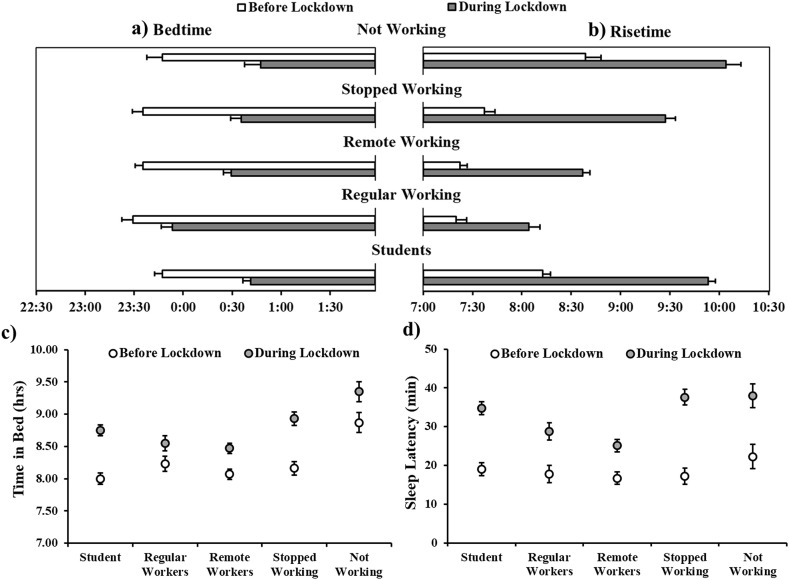
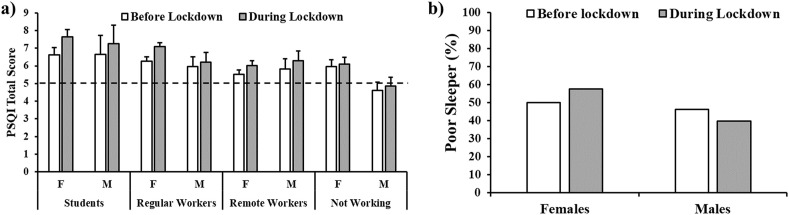
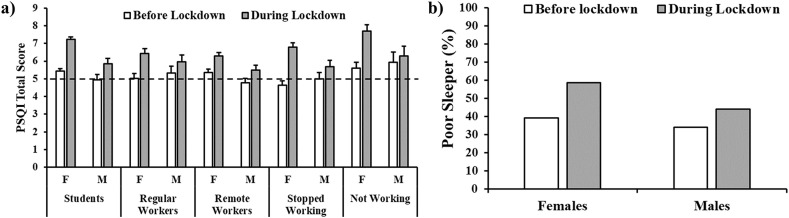
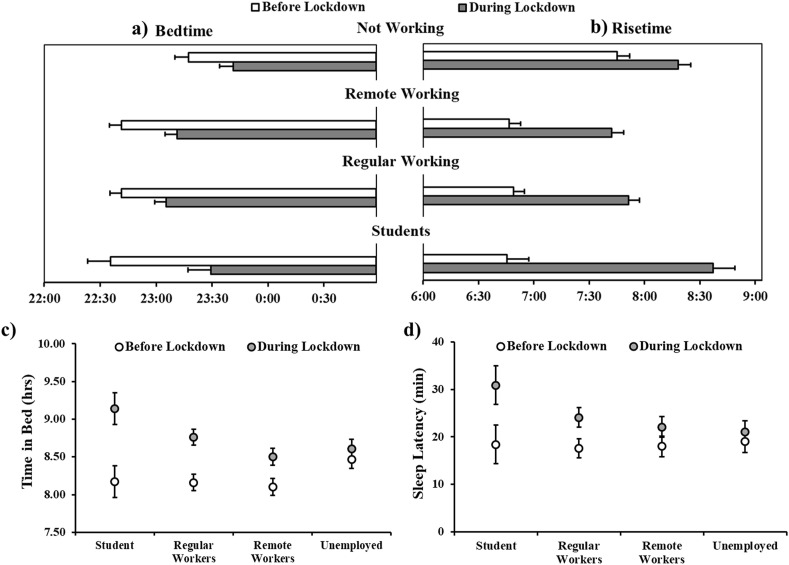
Italy and Belgium have been among the first western countries to face the Coronavirus disease 2019 (COVID-19) emergency, imposing a total lockdown over the entire national territories. These limitations have proven effective in slowing down the spread of the infection. However, the benefits obtained in public health have come with huge costs in terms of social, economic, and psychological well-being. In the current study, we aimed to investigate how the period of home confinement affected self-reported sleep characteristics in Italians and Belgians, with special regard to sleep timing and subjective quality. Using an online survey we collected data from 2272 participants, 1622 Italians (Mage = 34.1 ± 13.6 years, 1171 F), and 650 Belgian (Mage = 43.0 ± 16.8 years, 509 F). Participants reported their sleep pattern (eg, bedtime, risetime) and perceived sleep quality during and, retrospectively, before the lockdown. During the lockdown, sleep timing was significantly delayed, time spent in bed increased, and sleep quality was markedly impaired in both Italians and Belgians. The most vulnerable individuals appeared to be women, subjects experiencing a more negative mood, and those perceiving the pandemic situation as highly stressful. However, the two samples differed in the subgroups most affected by the changes, possibly because of the different welfare systems of the two countries. In fact, in the Italian sample sleep quality and timing underwent significant modifications especially in unemployed participants, whereas in the Belgian sample this category was the one who suffered less from the restrictions. Considering that the novel coronavirus has spread across the whole globe, involving countries with different types of health and welfare systems, understanding which policy measures have the most effective protective role on physical and mental health is of primary importance.
意大利和比利时是最早面临2019年冠状病毒病(COVID-19)紧急情况的西方国家之一,对整个国家领土实施了全面封锁。这些限制措施已被证明在减缓感染传播方面是有效的。然而,在公共卫生方面取得的成果是以社会、经济和心理健康方面的巨大代价换来的。在当前的研究中,我们旨在调查居家隔离期如何影响意大利人和比利时人的自我报告睡眠特征,特别关注睡眠时间和主观睡眠质量。我们通过在线调查收集了2272名参与者的数据,其中1622名意大利人(年龄中位数=34.1±13.6岁,女性1171名)和650名比利时人(年龄中位数=43.0±16.8岁,女性509名)。参与者报告了他们在封锁期间以及回顾封锁前的睡眠模式(如就寝时间、起床时间)和感知到的睡眠质量。在封锁期间,意大利人和比利时人的睡眠时间都显著推迟,卧床时间增加,睡眠质量明显受损。最易受影响的人群似乎是女性、情绪较为消极的人以及那些认为疫情形势压力极大的人。然而,两个样本中受这些变化影响最大的亚组有所不同,这可能是由于两国不同的福利体系所致。事实上,在意大利样本中,睡眠质量和时间安排发生了显著变化,尤其是失业参与者;而在比利时样本中,这一群体受限制的影响较小。鉴于新型冠状病毒已在全球传播,涉及不同类型卫生和福利体系的国家,了解哪些政策措施对身心健康具有最有效的保护作用至关重要。