Parker H A, Hasheminassab S, Crounse J D, Roehl C M, Wennberg P O
Division of Geological and Planetary Sciences California Institute of Technology Pasadena CA USA.
South Coast Air Quality Management District Diamond Bar CA USA.
Geophys Res Lett. 2020 Dec 16;47(23):e2020GL090164. doi: 10.1029/2020GL090164. Epub 2020 Dec 1.
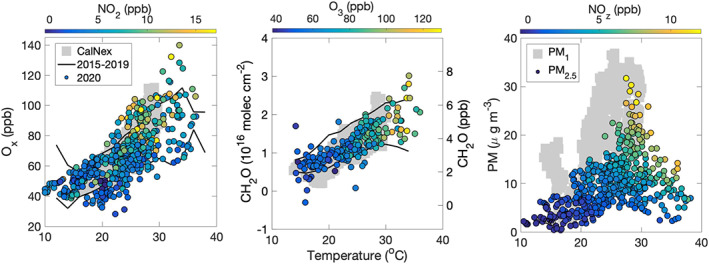
On 19 March 2020, California put in place Stay-At-Home orders to reduce the spread of SARS-CoV-2. As a result, decreases up to 50% in traffic occurred across the South Coast Air Basin (SoCAB). We report that, compared to the 19 March to 30 June period of the last 5 years, the 2020 concentrations of PM and NO showed an overall reduction across the basin. O concentrations decreased in the western part of the basin and generally increased in the downwind areas. The NO decline in 2020 (approximately 27% basin-wide) is in addition to ongoing declines over the last two decades (on average 4% less than the -6.8% per year afternoon NO concentration decrease) and provides insight into how air quality may respond over the next few years of continued vehicular reductions. The modest changes in O suggests additional mitigation will be necessary to comply with air quality standards.
2020年3月19日,加利福尼亚州发布居家令以减少严重急性呼吸综合征冠状病毒2(SARS-CoV-2)的传播。结果,南海岸空气盆地(SoCAB)的交通流量下降了50%。我们报告称,与过去5年3月19日至6月30日期间相比,2020年该盆地的颗粒物(PM)和氮氧化物(NO)浓度总体下降。臭氧(O)浓度在盆地西部下降,在下风区域总体上升。2020年氮氧化物的下降(全盆地约27%)是在过去二十年持续下降的基础上(平均每年下午氮氧化物浓度下降比-6.8%少4%),并为未来几年持续减少车辆排放情况下空气质量的反应提供了见解。臭氧的适度变化表明,有必要采取更多缓解措施以符合空气质量标准。