Physical Intelligence Department, Max Planck Institute for Intelligent Systems, 70569 Stuttgart, Germany.
Lab Chip. 2021 Feb 9;21(3):582-596. doi: 10.1039/d0lc00865f.
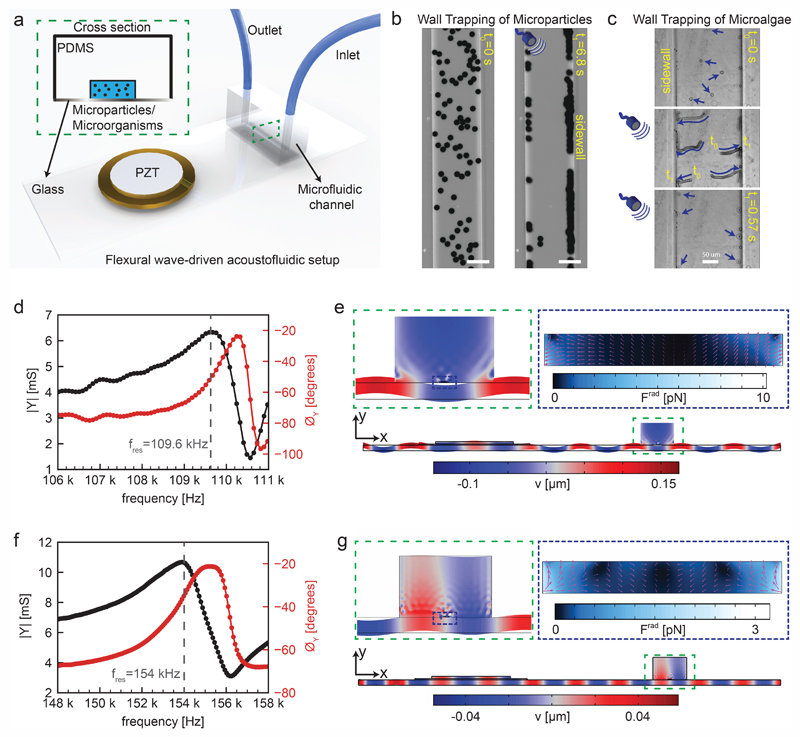
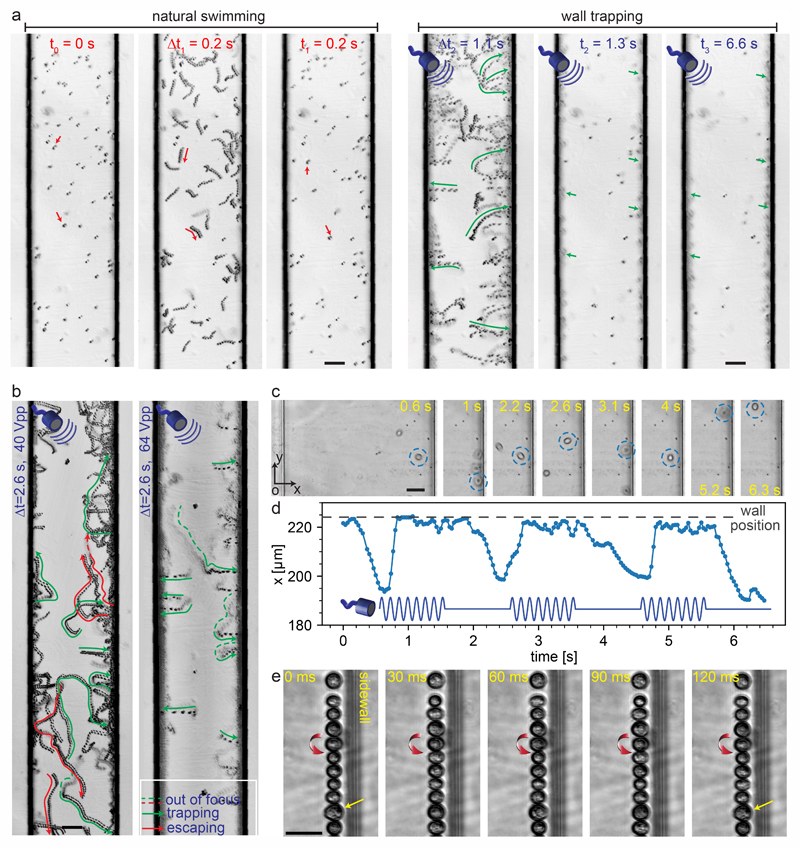
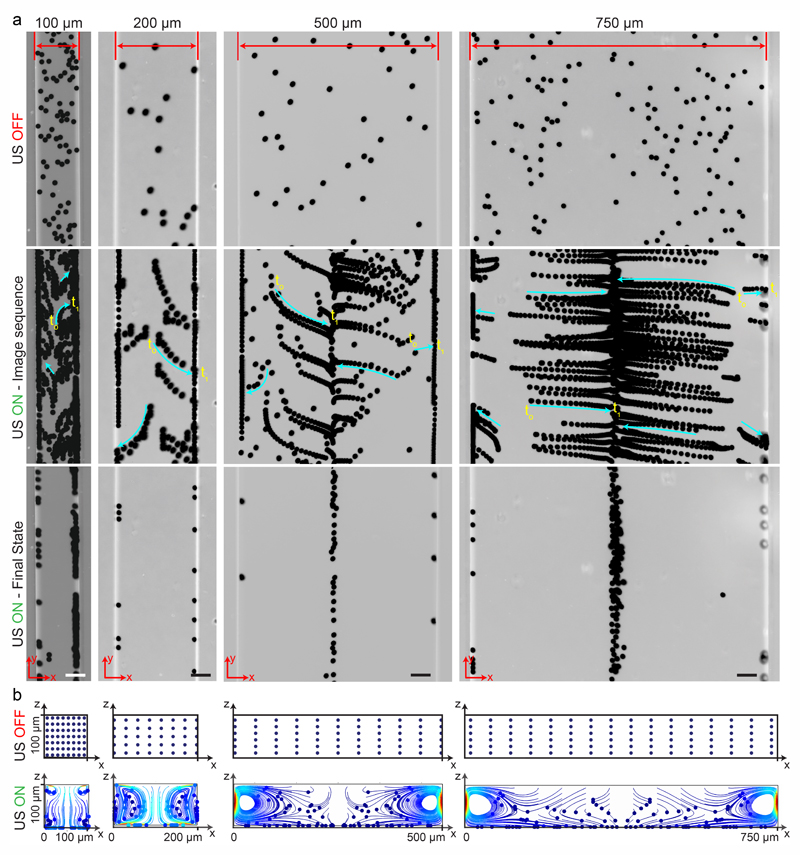
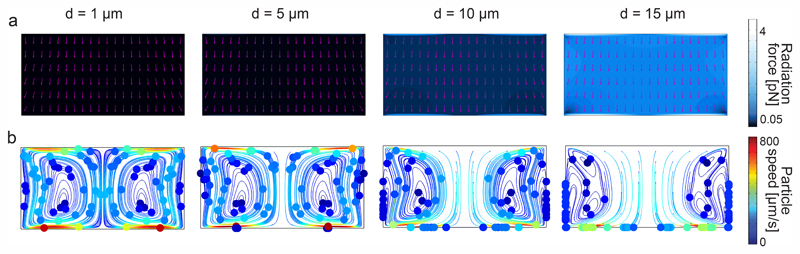
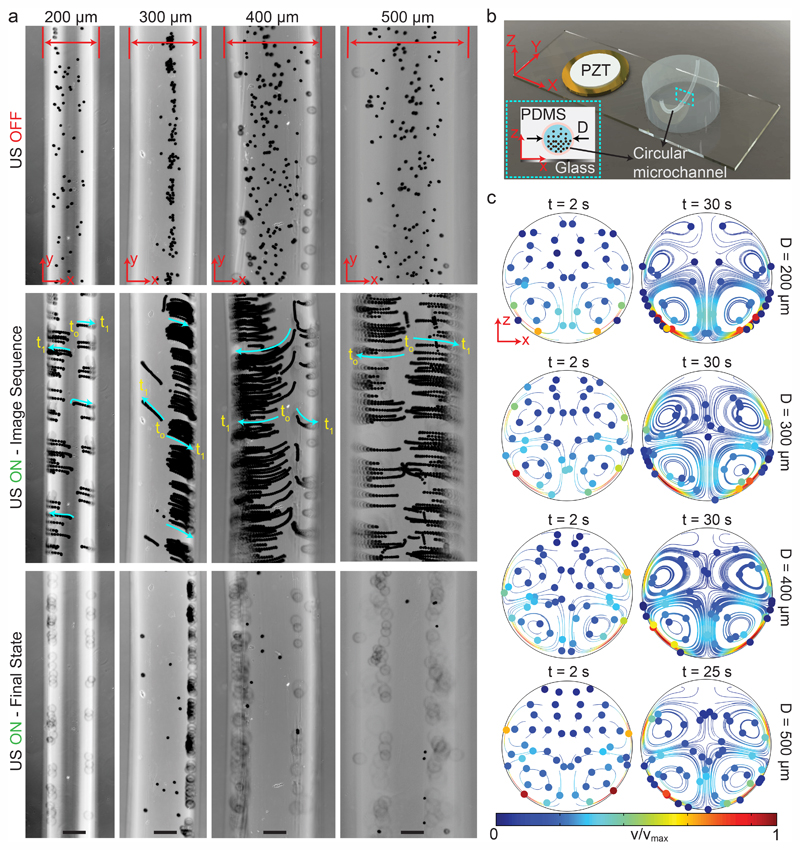
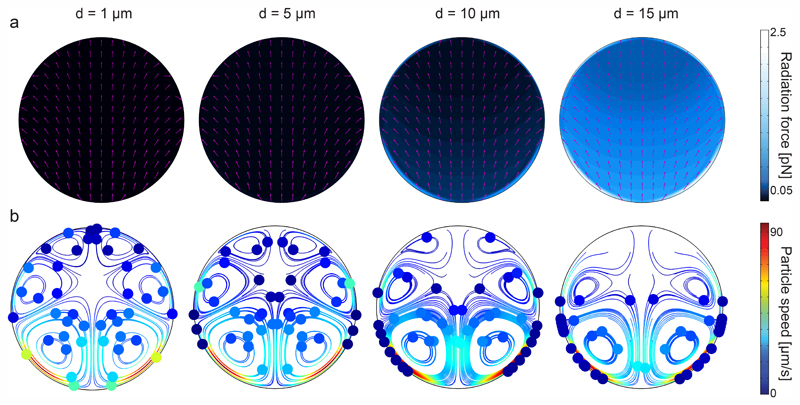
Acoustic manipulation of microparticles and cells, called acoustophoresis, inside microfluidic systems has significant potential in biomedical applications. In particular, using acoustic radiation force to push microscopic objects toward the wall surfaces has an important role in enhancing immunoassays, particle sensors, and recently microrobotics. In this paper, we report a flexural-wave based acoustofluidic system for trapping micron-sized particles and cells at the soft wall boundaries. By exciting a standard microscope glass slide (1 mm thick) at its resonance frequencies <200 kHz, we show the wall-trapping action in sub-millimeter-size rectangular and circular cross-sectional channels. For such low-frequency excitation, the acoustic wavelength can range from 10-150 times the microchannel width, enabling a wide design space for choosing the channel width and position on the substrate. Using the system-level acousto-structural simulations, we confirm the acoustophoretic motion of particles near the walls, which is governed by the competing acoustic radiation and streaming forces. Finally, we investigate the performance of the wall-trapping acoustofluidic setup in attracting the motile cells, such as Chlamydomonas reinhardtii microalgae, toward the soft boundaries. Furthermore, the rotation of microalgae at the sidewalls and trap-escape events under pulsed ultrasound are demonstrated. The flexural-wave driven acoustofluidic system described here provides a biocompatible, versatile, and label-free approach to attract particles and cells toward the soft walls.
在微流控系统中,对微粒子和细胞的声学操纵,称为声操控,在生物医学应用中有很大的潜力。特别是,利用声辐射力将微小物体推向壁面,在增强免疫测定、粒子传感器以及最近的微机器人方面发挥着重要作用。在本文中,我们报告了一种基于弯曲波的声流控系统,用于在软壁边界处捕获微米级大小的粒子和细胞。通过在其共振频率<200 kHz 下激发标准显微镜载玻片(1 毫米厚),我们在亚毫米尺寸的矩形和圆形横截面通道中展示了壁面捕获作用。对于如此低频的激励,声波波长可以从 10-150 倍于微通道宽度,为选择通道宽度和基片上的位置提供了广泛的设计空间。使用系统级的声结构模拟,我们证实了粒子在壁附近的声操控运动,这是由竞争的声辐射和流体力决定的。最后,我们研究了壁捕获声流控装置在吸引运动细胞(如莱茵衣藻微藻)向软边界移动方面的性能。此外,还演示了微藻在侧壁的旋转和在脉冲超声下的逃脱事件。这里描述的弯曲波驱动的声流控系统提供了一种对粒子和细胞具有生物相容性、多功能性和无标记吸引力的方法,使其向软壁移动。