Physical Intelligence Department, Max Planck Institute for Intelligent Systems, 70569 Stuttgart, Germany.
Physical Intelligence Department, Max Planck Institute for Intelligent Systems, 70569 Stuttgart, Germany;
Proc Natl Acad Sci U S A. 2020 Feb 18;117(7):3469-3477. doi: 10.1073/pnas.1920099117. Epub 2020 Feb 3.
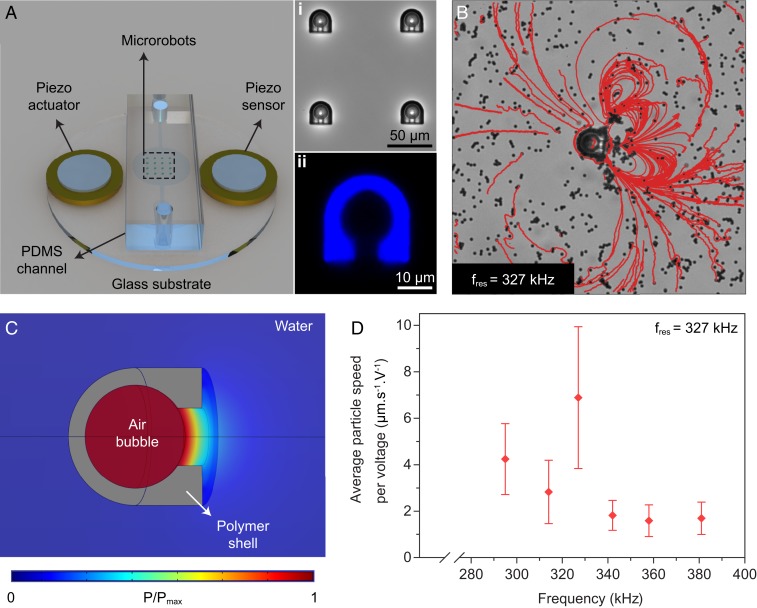
Untethered synthetic microrobots have significant potential to revolutionize minimally invasive medical interventions in the future. However, their relatively slow speed and low controllability near surfaces typically are some of the barriers standing in the way of their medical applications. Here, we introduce acoustically powered microrobots with a fast, unidirectional surface-slipping locomotion on both flat and curved surfaces. The proposed three-dimensionally printed, bullet-shaped microrobot contains a spherical air bubble trapped inside its internal body cavity, where the bubble is resonated using acoustic waves. The net fluidic flow due to the bubble oscillation orients the microrobot's axisymmetric axis perpendicular to the wall and then propels it laterally at very high speeds (up to 90 body lengths per second with a body length of 25 µm) while inducing an attractive force toward the wall. To achieve unidirectional locomotion, a small fin is added to the microrobot's cylindrical body surface, which biases the propulsion direction. For motion direction control, the microrobots are coated anisotropically with a soft magnetic nanofilm layer, allowing steering under a uniform magnetic field. Finally, surface locomotion capability of the microrobots is demonstrated inside a three-dimensional circular cross-sectional microchannel under acoustic actuation. Overall, the combination of acoustic powering and magnetic steering can be effectively utilized to actuate and navigate these microrobots in confined and hard-to-reach body location areas in a minimally invasive fashion.
无缆绳的合成微型机器人在未来有可能彻底改变微创医疗干预手段。然而,它们在靠近表面时速度相对较慢且可控性较低,这通常是它们在医学应用中面临的一些障碍。在这里,我们介绍了一种在平面和曲面上具有快速单向表面滑动运动的声控微机器人。所提出的三维打印的子弹形微机器人在其内部体腔中包含一个被困的球形气泡,通过声波对气泡进行共振。由于气泡的振荡产生的净流体流动使微机器人的轴对称轴垂直于壁面,然后以非常高的速度(在 25 µm 的体长下,最高可达 90 个体长/秒)将其侧向推进,同时产生朝向壁面的吸引力。为了实现单向运动,在微机器人的圆柱形本体表面上添加了一个小鳍片,从而改变推进方向。为了控制运动方向,微机器人的表面被各向异性地涂覆有软磁纳米薄膜层,允许在均匀磁场下进行转向。最后,在声激励下,在三维圆形横截面微通道内演示了微机器人的表面运动能力。总的来说,声能驱动和磁场导向的结合可以有效地用于微创方式在受限和难以到达的身体部位区域中驱动和导航这些微机器人。