Wang Jiao, Zheng Chenfei, Shao Xiangqi, Hu Zhangjian, Li Jianxin, Wang Ping, Wang Anran, Yu Jingquan, Shi Kai
Department of Horticulture, Zhejiang University, 866 Yuhangtang Road, 310058, Hangzhou, People's Republic of China.
Hortic Res. 2020 Dec 25;7(1):209. doi: 10.1038/s41438-020-00442-6.
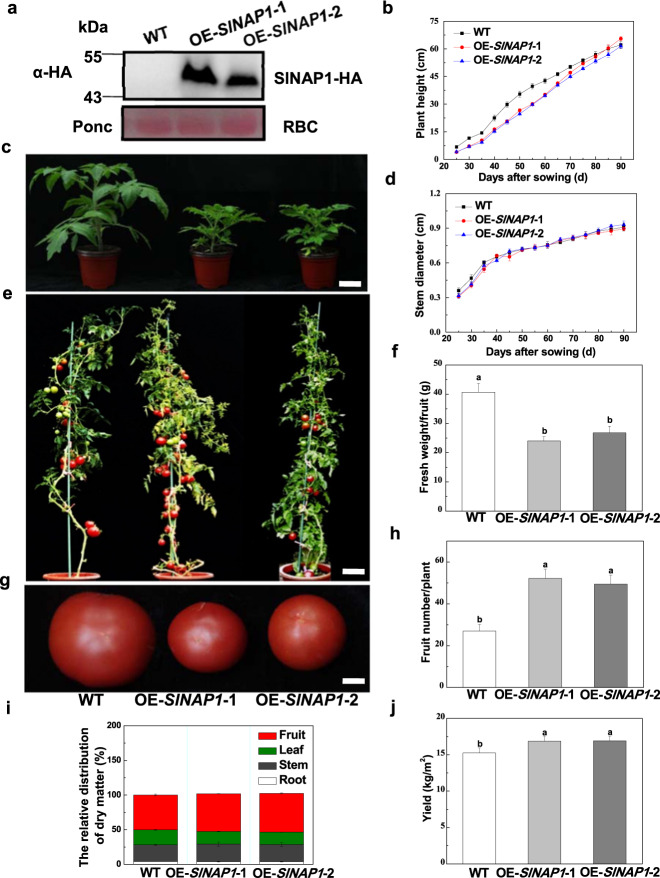
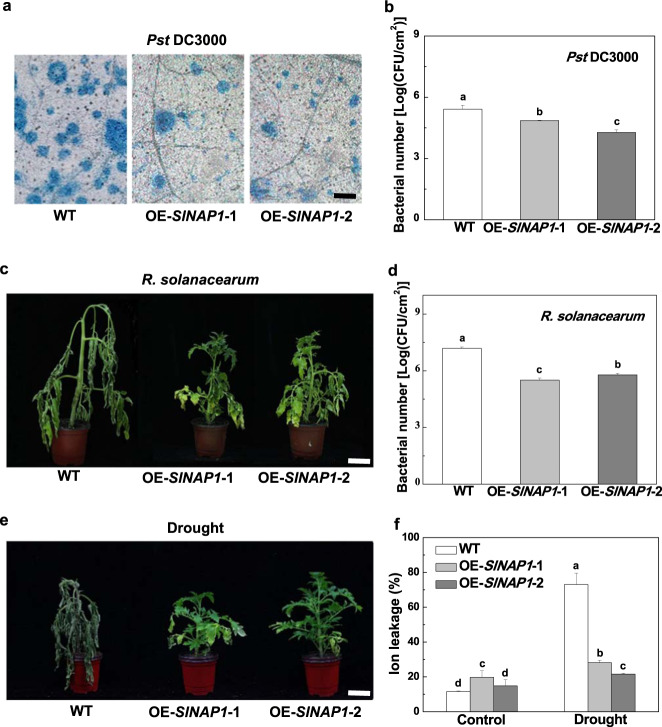
With global climate change, plants are frequently being exposed to various stresses, such as pathogen attack, drought, and extreme temperatures. Transcription factors (TFs) play crucial roles in numerous plant biological processes; however, the functions of many tomato (Solanum lycopersicum L.) TFs that regulate plant responses to multiple stresses are largely unknown. Here, using an RNA-seq approach, we identified SlNAP1, a NAC TF-encoding gene, which was strongly induced by various stresses. By generating SlNAP1 transgenic lines and evaluating their responses to biotic and abiotic stresses in tomato, we found that SlNAP1-overexpressing plants showed significantly enhanced defense against two widespread bacterial diseases, leaf speck disease, caused by Pseudomonas syringae pv. tomato (Pst) DC3000, and root-borne bacterial wilt disease, caused by Ralstonia solanacearum. In addition, SlNAP1 overexpression dramatically improved drought tolerance in tomato. Although the SlNAP1-overexpressing plants were shorter than the wild-type plants during the early vegetative stage, eventually, their fruit yield increased by 10.7%. Analysis of different hormone contents revealed a reduced level of physiologically active gibberellins (GAs) and an increased level of salicylic acid (SA) and abscisic acid (ABA) in the SlNAP1-overexpressing plants. Moreover, EMSAs and ChIP-qPCR assays showed that SlNAP1 directly activated the transcription of multiple genes involved in GA deactivation and both SA and ABA biosynthesis. Our findings reveal that SlNAP1 is a positive regulator of the tomato defense response against multiple stresses and thus may be a potential breeding target for improving crop yield and stress resistance.
随着全球气候变化,植物经常面临各种胁迫,如病原体攻击、干旱和极端温度。转录因子(TFs)在众多植物生物学过程中发挥着关键作用;然而,许多调控植物对多种胁迫反应的番茄(Solanum lycopersicum L.)TFs的功能在很大程度上尚不清楚。在这里,我们采用RNA测序方法,鉴定了一个编码NAC TF的基因SlNAP1,它在各种胁迫下被强烈诱导。通过构建SlNAP1转基因株系并评估它们对番茄生物和非生物胁迫的反应,我们发现过表达SlNAP1的植株对两种广泛流行的细菌性病害——由丁香假单胞菌番茄致病变种(Pst)DC3000引起的叶斑病和由青枯雷尔氏菌引起的根际细菌性枯萎病——的防御能力显著增强。此外,SlNAP1过表达显著提高了番茄的耐旱性。虽然在营养生长早期,过表达SlNAP1的植株比野生型植株矮,但最终它们的果实产量增加了10.7%。对不同激素含量的分析表明,过表达SlNAP1的植株中生理活性赤霉素(GAs)水平降低,水杨酸(SA)和脱落酸(ABA)水平升高。此外,电泳迁移率变动分析(EMSA)和染色质免疫沉淀定量PCR(ChIP-qPCR)分析表明,SlNAP1直接激活了多个参与GA失活以及SA和ABA生物合成的基因的转录。我们的研究结果表明,SlNAP1是番茄对多种胁迫防御反应的正调控因子,因此可能是提高作物产量和抗逆性的潜在育种目标。