Akhtar Javed, Garcia Abner Luna, Saenz Leonardo, Kuravi Sarada, Shu Fangjun, Kota Krishna
Consortium for Particulate Suspensions, Department of Mechanical and Aerospace Engineering, New Mexico State University, Las Cruces, New Mexico 88003-8001, USA.
Phys Fluids (1994). 2020 Dec 1;32(12):127112. doi: 10.1063/5.0035072.
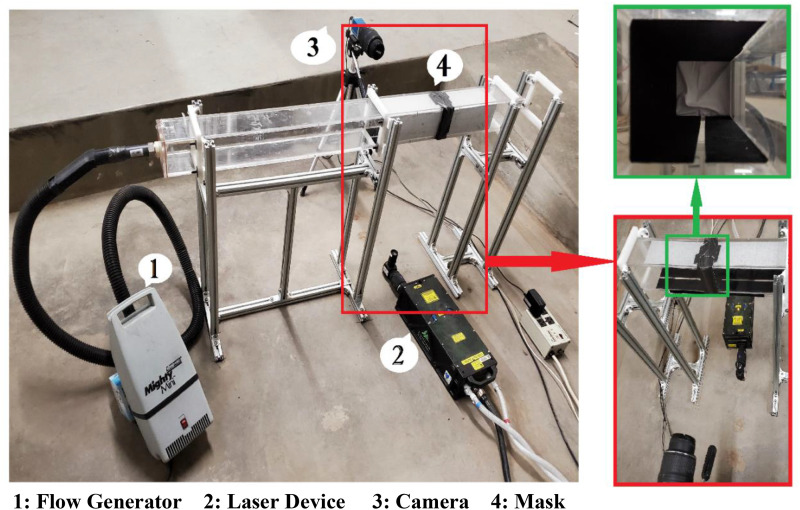
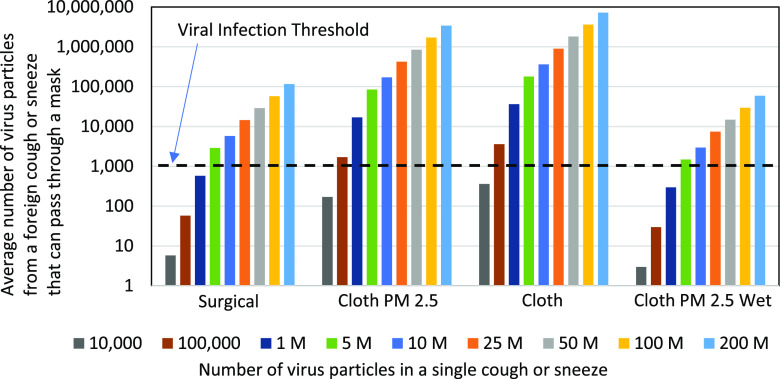
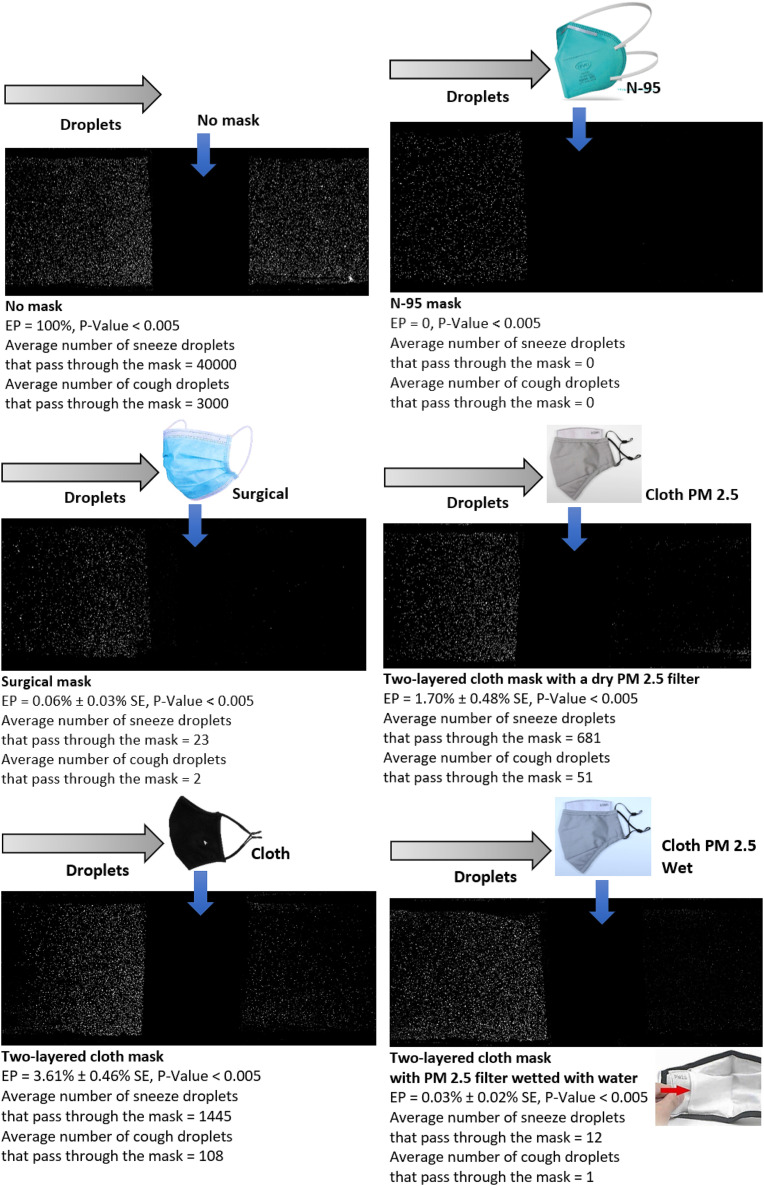
Day-to-day observations reveal numerous medical and social situations where maintaining physical distancing is either not feasible or not practiced during the time of a viral pandemic, such as, the coronavirus disease 2019 (COVID-19). During these close-up, face-to-face interactions, a common belief is that a susceptible person wearing a face mask is safe, at least to a large extent, from foreign airborne sneeze and cough droplets. This study, for the first time, quantitatively verifies this notion. Droplet flow visualization experiments of a simulated face-to-face interaction with a mask in place were conducted using the particle image velocimetry setup. Five masks were tested in a snug-fit configuration (i.e., with no leakage around the edges): N-95, surgical, cloth PM 2.5, cloth, and wetted cloth PM 2.5. Except for the N-95 mask, the findings showed leakage of airborne droplets through all the face masks in both the configurations of (1) a susceptible person wearing a mask for protection and (2) a virus carrier wearing a mask to prevent the spreading of the virus. When the leakage percentages of these airborne droplets were expressed in terms of the number of virus particles, it was found that masks would not offer complete protection to a susceptible person from a viral infection in close (e.g., <6 ft) face-to-face or frontal human interactions. Therefore, consideration must be given to minimize or avoid such interactions, if possible. This study lends quantitative support to the social distancing and mask-wearing guidelines proposed by the medical research community.
日常观察发现,在病毒性大流行期间,如2019年冠状病毒病(COVID-19)期间,存在许多医疗和社会场景,在这些场景中保持身体距离要么不可行,要么未得到践行。在这些近距离的面对面互动中,一种普遍的看法是,佩戴口罩的易感人群至少在很大程度上能免受外来空气传播的喷嚏和咳嗽飞沫的影响。本研究首次对这一观点进行了定量验证。使用粒子图像测速装置对佩戴口罩的模拟面对面互动进行了液滴流动可视化实验。对五种口罩在贴合状态(即边缘无泄漏)下进行了测试:N-95口罩、外科口罩、布质PM2.5口罩、布口罩和湿布质PM2.5口罩。研究结果显示,除了N-95口罩外,在以下两种情况下,所有口罩都会出现空气传播液滴泄漏:(1)易感人群佩戴口罩进行防护;(2)病毒携带者佩戴口罩以防止病毒传播。当这些空气传播液滴的泄漏百分比以病毒颗粒数量表示时,发现口罩无法在近距离(如<6英尺)的面对面或正面人际互动中为易感人群提供完全的病毒感染防护。因此,如果可能的话,必须考虑尽量减少或避免此类互动。本研究为医学研究界提出的社交距离和佩戴口罩指南提供了定量支持。