Koçak Ulucaköy Rezan, Yurdakul Fatma Gül, Bodur Hatice
Department of Physical Medicine and Rehabilitation, Ankara Numune Training and Research Hospital, Ankara, Turkey.
Turk J Phys Med Rehabil. 2020 Nov 9;66(4):388-397. doi: 10.5606/tftrd.2020.3956. eCollection 2020 Dec.
This study aims to evaluate the efficacy of extracorporeal shock wave therapy (ESWT) in carpal tunnel syndrome (CTS) compared to the wrist splint treatment.
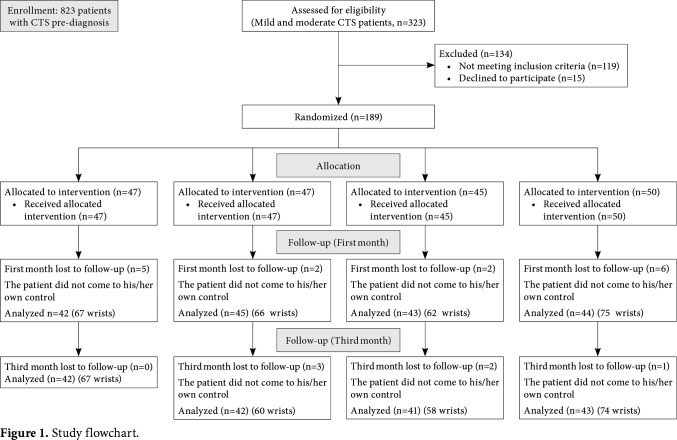
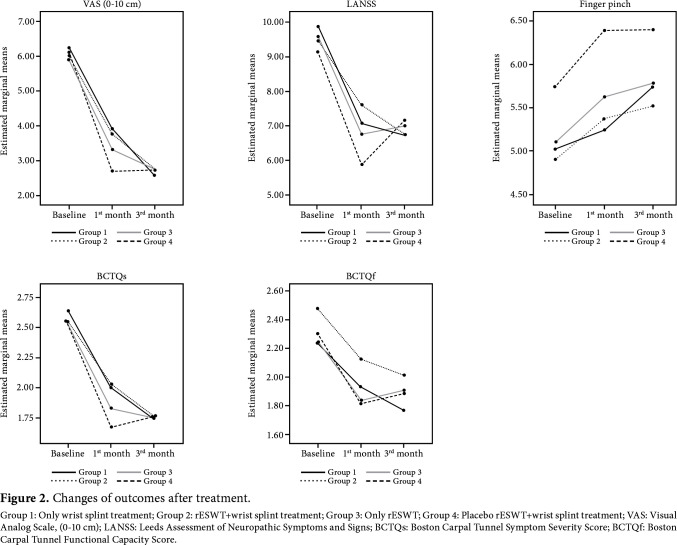
Between April 2016 and March 2017, a total of 189 patients (22 males, 167 females, mean age 48.8±9.5 years, range, 24 to 70 years) with mild-to-moderate CTS were included in this double-blind, prospective, randomized, placebo-controlled study. The patients were divided into four treatment groups using stratified randomization: splint group (Group 1, n=47), splint+ESWT (Group 2, n=47), ESWT (Group 3, n=45), and splint+placebo ESWT (Group 4, n=50). All patients were evaluated at baseline, and one and three months. Pain using the Visual Analog Scale (VAS), finger pinch strength, Boston Carpal Tunnel Questionnaire (BCTQ), Leeds Assessment of Neuropathic Symptoms and Signs (LANSS), and electrophysiological examination were assessed.
A total of 168 patients completed the study. There was no significant difference among the four groups in terms of age, sex, comorbid diseases, symptom duration, VAS-pain, BCTQ, and LANSS scores (p>0.05). Pain and functionality significantly improved in all groups (p<0.05). In the group with ESWT and using wrist splint combined, a greater improvement of the hand function and electrophysiological measures was observed.
Our study results show that ESWT is a valuable and reliable treatment modality for mild-to-moderate CTS.
本研究旨在评估体外冲击波疗法(ESWT)与腕部夹板治疗相比,在腕管综合征(CTS)中的疗效。
在2016年4月至2017年3月期间,共有189例轻至中度CTS患者(22例男性,167例女性,平均年龄48.8±9.5岁,范围24至70岁)纳入这项双盲、前瞻性、随机、安慰剂对照研究。采用分层随机化将患者分为四个治疗组:夹板组(第1组,n = 47)、夹板+ESWT组(第2组,n = 47)、ESWT组(第3组,n = 45)和夹板+安慰剂ESWT组(第4组,n = 50)。所有患者在基线、1个月和3个月时进行评估。采用视觉模拟量表(VAS)评估疼痛、手指捏力、波士顿腕管问卷(BCTQ)、利兹神经病理性症状和体征评估(LANSS),并进行电生理检查。
共有168例患者完成研究。四组在年龄、性别、合并疾病、症状持续时间、VAS疼痛评分、BCTQ和LANSS评分方面无显著差异(p>0.05)。所有组的疼痛和功能均有显著改善(p<0.05)。在联合使用ESWT和腕部夹板的组中,观察到手部功能和电生理指标有更大改善。
我们的研究结果表明,ESWT是治疗轻至中度CTS的一种有价值且可靠的治疗方式。