McKay Orthopaedic Research Laboratory, University of Pennsylvania, Philadelphia, Pennsylvania, USA.
Translational Musculoskeletal Research Center, Philadelphia VA Medical Center, Philadelphia, Pennsylvania, USA.
J Orthop Res. 2021 Nov;39(11):2323-2332. doi: 10.1002/jor.24969. Epub 2021 Jan 14.
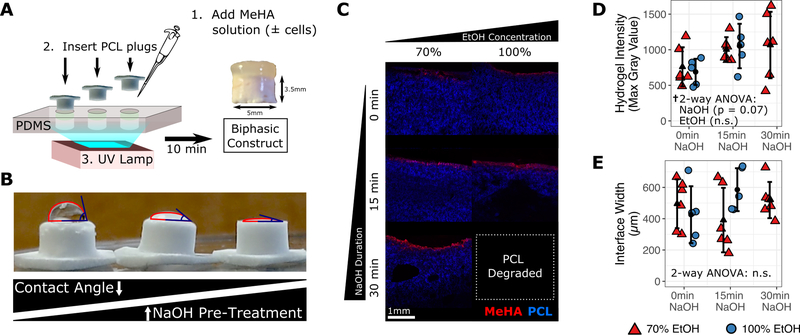
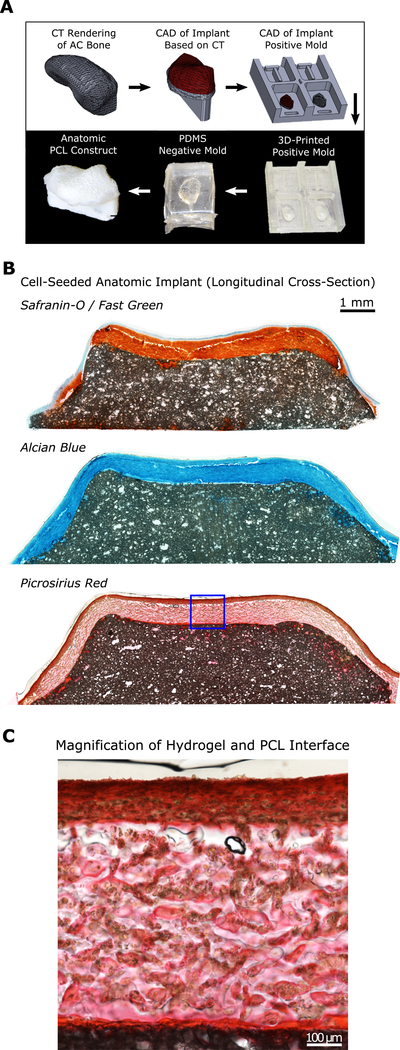
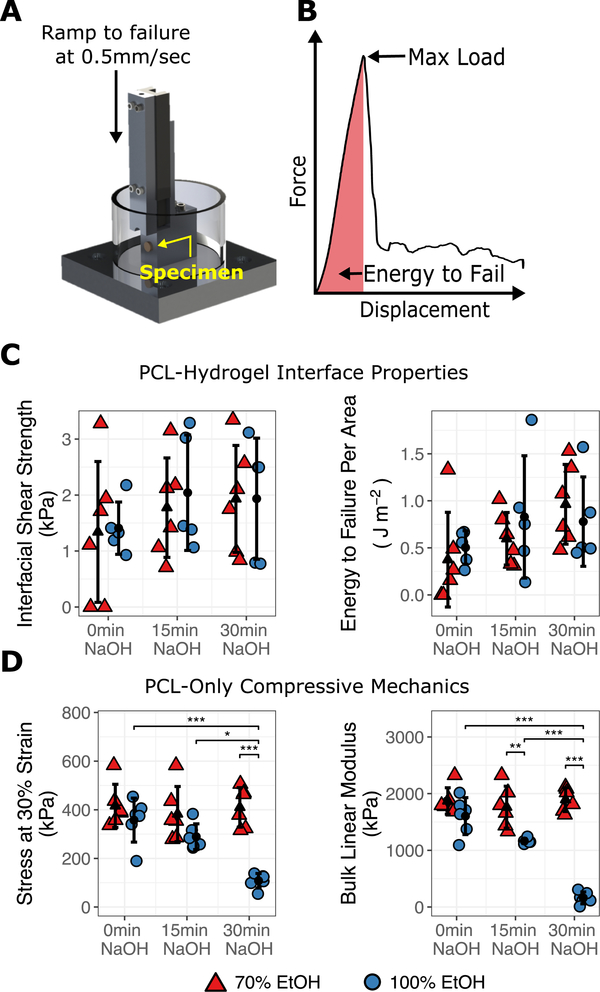
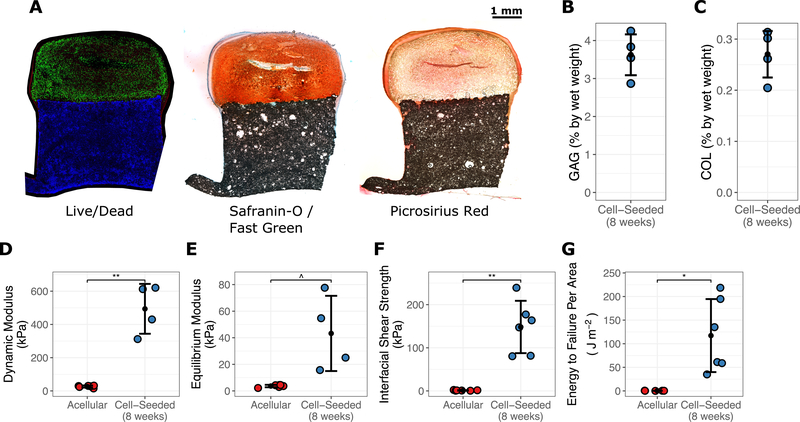
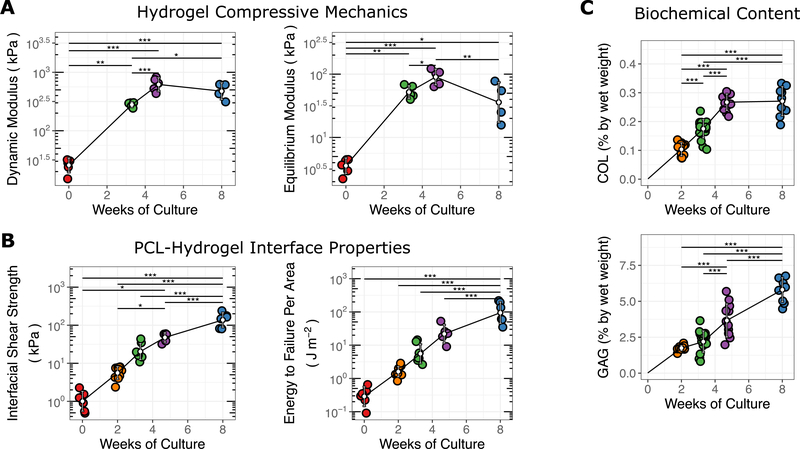
Articular cartilage injury can lead to joint-wide erosion and the early onset of osteoarthritis. To address this, we recently developed a rapid fabrication method to produce patient-specific engineered cartilage tissues to replace an entire articular surface. Here, we extended that work by coupling a mesenchymal stromal cell-laden hydrogel (methacrylated hyaluronic acid) with the porous polycaprolactone (PCL) bone integrating phase and assessed the composition and mechanical performance of these constructs over time. To improve initial construct stability, PCL/hydrogel interface parameters were first optimized by varying PCL pretreatment (with sodium hydroxide before ethanol) before hydrogel infusion. Next, cylindrical osteochondral constructs were formed and cultured in media containing transforming growth factor β3 for up to 8 weeks, with constructs evaluated for viability, histological features, and biochemical content. Mechanical properties were also assessed in axial compression and via an interface shear strength assay. Results showed that the fabrication process was compatible with cell viability, and that construct biochemical content and mechanical properties increased with time. Interestingly, compressive properties peaked at 5 weeks, while interfacial shear properties continued to improve beyond this time point. Finally, these fabrication methods were combined with a custom mold developed from limb-specific computed tomography imaging data to create an anatomic implantable cell-seeded biologic joint surface, which showedmaturation similar to the osteochondral cylinders. Future work will apply these advances in large animal models of critically sized osteochondral defects to study repair and whole joint resurfacing.
关节软骨损伤可导致关节广泛侵蚀和骨关节炎的早期发作。为了解决这个问题,我们最近开发了一种快速制造方法,以生产个性化的工程软骨组织来替代整个关节表面。在这里,我们通过将富含间充质基质细胞的水凝胶(甲基丙烯酰化透明质酸)与多孔聚己内酯(PCL)骨整合相耦合,扩展了这项工作,并评估了这些构建体随时间的组成和机械性能。为了提高初始构建体的稳定性,首先通过改变 PCL 预处理(在乙醇前用氢氧化钠处理)来优化 PCL/水凝胶界面参数,然后进行水凝胶灌注。接下来,形成圆柱形的骨软骨构建体,并在含有转化生长因子 β3 的培养基中培养长达 8 周,对构建体进行活力、组织学特征和生化含量的评估。还通过轴向压缩和界面剪切强度测定评估了机械性能。结果表明,制造过程与细胞活力兼容,并且构建体的生化含量和机械性能随时间增加。有趣的是,压缩性能在 5 周时达到峰值,而界面剪切性能在该时间点之后继续提高。最后,这些制造方法与从肢体特定的计算机断层扫描成像数据开发的定制模具相结合,创建了可植入细胞的生物关节表面,其成熟度类似于骨软骨圆柱体。未来的工作将在大动物临界尺寸骨软骨缺损模型中应用这些进展,以研究修复和整个关节表面置换。