Vieira Elaine, Mirizio Gerardo Gabriel, Barin Geovana Reichert, de Andrade Rosângela Vieira, Nimer Nidah Fawzi Said, La Sala Lucia
Postgraduate Program on Physical Education, Universidade Católica de Brasília, DF, Taguatinga 71966-700, Brazil.
Muscle Cell Physiology Laboratory, Center of Molecular Studies of the Cell, Institute of Biomedical Sciences, Faculty of Medicine, Universidad de Chile, 8330015 Santiago, Chile.
Int J Mol Sci. 2020 Dec 21;21(24):9743. doi: 10.3390/ijms21249743.
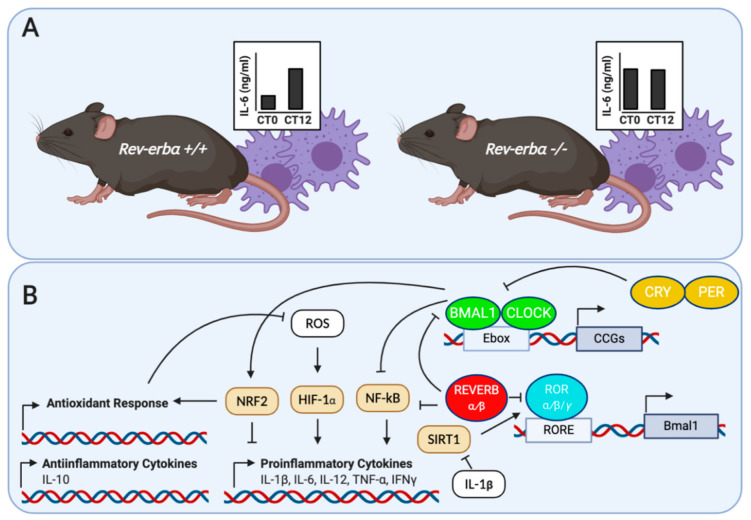
Inflammation is a common feature of several diseases, including obesity, diabetes and neurodegenerative disorders. Circadian clock genes are expressed and oscillate in many cell types such as macrophages, neurons and pancreatic β cells. During inflammation, these endogenous clocks control the temporal gating of cytokine production, the antioxidant response, chemokine attraction and insulin secretion, among other processes. Deletion of clock genes in macrophages or brain-resident cells induces a higher production of inflammatory cytokines and chemokines, and this is often accompanied by an increased oxidative stress. In the context of obesity and diabetes, a high-fat diet disrupts the function of clock genes in macrophages and in pancreatic β cells, contributing to inflammation and systemic insulin resistance. Recently, it has been shown that the administration of natural and synthetic ligands or pharmacological enhancers of the circadian clock function can selectively regulate the production and release of pro-inflammatory cytokines and improve the metabolic function in vitro and in vivo. Thus, a better understanding of the circadian regulation of the immune system could have important implications for the management of metabolic and neurodegenerative diseases.
炎症是包括肥胖症、糖尿病和神经退行性疾病在内的多种疾病的共同特征。昼夜节律时钟基因在许多细胞类型中表达并振荡,如巨噬细胞、神经元和胰腺β细胞。在炎症过程中,这些内源性时钟控制细胞因子产生的时间门控、抗氧化反应、趋化因子吸引和胰岛素分泌等过程。巨噬细胞或脑驻留细胞中时钟基因的缺失会诱导炎症细胞因子和趋化因子的更高产生,并且这通常伴随着氧化应激的增加。在肥胖症和糖尿病的背景下,高脂饮食会破坏巨噬细胞和胰腺β细胞中时钟基因的功能,导致炎症和全身性胰岛素抵抗。最近,研究表明,给予昼夜节律时钟功能的天然和合成配体或药理学增强剂可以选择性地调节促炎细胞因子的产生和释放,并在体外和体内改善代谢功能。因此,更好地理解免疫系统的昼夜节律调节可能对代谢和神经退行性疾病的管理具有重要意义。