Berryman Nicolas, Mujika Iñigo, Bosquet Laurent
Département des Sciences de l'activité Physique, Université du Québec à Montréal, 141 Avenue du Président Kennedy, Montréal, QC H2X 1Y4, Canada.
Institut National du Sport du Québec, 4141 Avenue Pierre-de-Coubertin, Montréal, QC H1V 3N7, Canada.
Sports (Basel). 2020 Dec 22;9(1):1. doi: 10.3390/sports9010001.
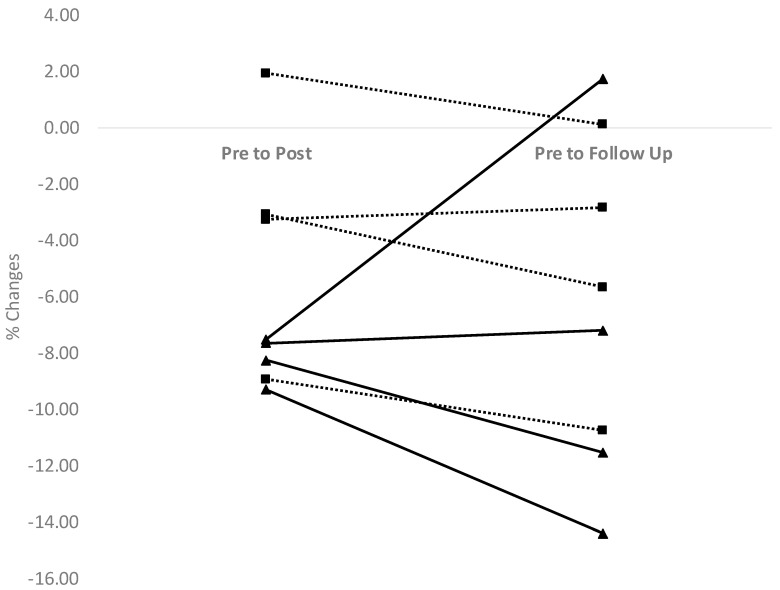
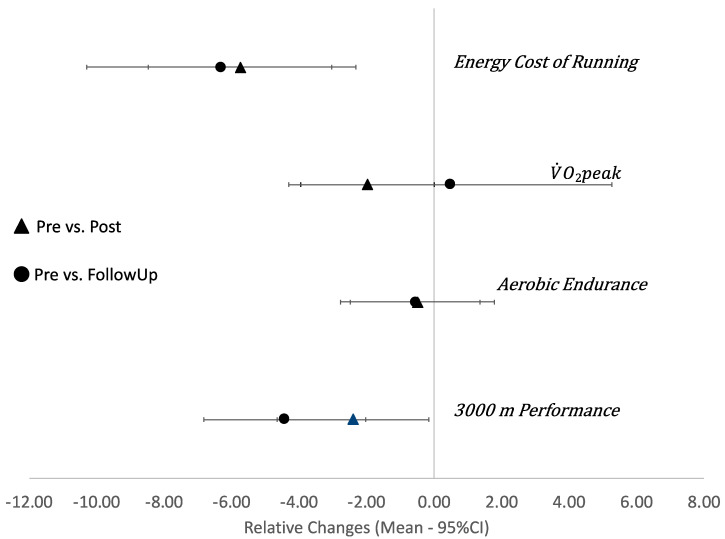
Evidence supports the implementation of concurrent strength and running training, within the same mesocycle, to improve performances in middle- and long-distance events. However, very little is known about the effects of concurrent training cessation. The purpose of this investigation was to describe the effects of 4 weeks of explosive strength training cessation after an 8-week concurrent training protocol. Eight runners completed this study, which first included either plyometric ( = 4) or dynamic weight training ( = 4) in addition to the usual running regimen. Explosive strength training was thereafter interrupted for 4 weeks, during which running sessions were maintained. Participants were tested at baseline, after concurrent training and after concurrent training cessation. The results suggest that the energy cost of running improvements observed after the intervention (-5.75%; 95% CI = -8.47 to -3.03) were maintained once explosive strength training was interrupted (-6.31%; 95% CI = -10.30 to -2.32). The results also suggest that neuromuscular performances were maintained after 4 weeks of concurrent training cessation, especially when tests were specific to the training intervention. Furthermore, a 3000m time trial revealed a similar pattern, with improvements after the concurrent mesocycle (-2.40%; 95% CI = -4.65 to -0.16) and after concurrent training cessation (-4.43%; 95% CI = -6.83 to -2.03). Overall, only trivial changes were observed for aerobic endurance and V˙O2peak. Together, these results suggest that short-term explosive strength training cessation might be beneficial and could be considered as a taper strategy for middle-distance runners. However, coaches and athletes must interpret these results cautiously considering the study's low sample size and the very limited available literature in this domain.
有证据支持在同一个中周期内同时进行力量训练和跑步训练,以提高中长跑项目的成绩。然而,对于同时训练停止后的影响却知之甚少。本研究的目的是描述在进行8周的同时训练方案后,停止4周爆发性力量训练的影响。8名跑步运动员完成了这项研究,该研究首先除了常规跑步训练外,还包括了增强式训练(n = 4)或动态重量训练(n = 4)。此后爆发性力量训练中断4周,在此期间跑步训练保持不变。参与者在基线、同时训练后和同时训练停止后进行测试。结果表明,干预后观察到的跑步能量消耗改善(-5.75%;95%CI = -8.47至-3.03)在爆发性力量训练中断后得以维持(-6.31%;95%CI = -10.30至-2.32)。结果还表明,在同时训练停止4周后,神经肌肉表现得以维持,尤其是当测试特定于训练干预时。此外,3000米计时赛显示出类似的模式,在同时训练中周期后有所改善(-2.40%;95%CI = -4.65至-0.16),在同时训练停止后也有所改善(-4.43%;95%CI = -6.83至-2.03)。总体而言,有氧耐力和最大摄氧量仅观察到微小变化。综合来看,这些结果表明短期停止爆发性力量训练可能是有益的,并且可以被视为中距离跑步运动员的一种减量策略。然而,考虑到该研究的样本量较小以及该领域现有文献非常有限,教练和运动员必须谨慎解读这些结果。