Department of Radiology, The Johns Hopkins University School of Medicine, Baltimore, Maryland, USA.
Department of Biostatistics, Indiana University, School of Medicine, Indianapolis, Indiana, USA.
Hum Brain Mapp. 2021 Mar;42(4):1034-1053. doi: 10.1002/hbm.25276. Epub 2020 Dec 30.
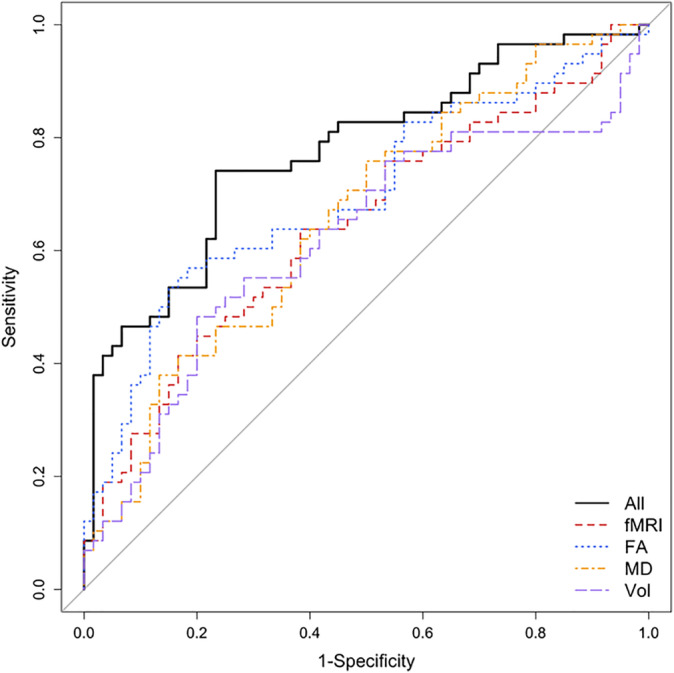
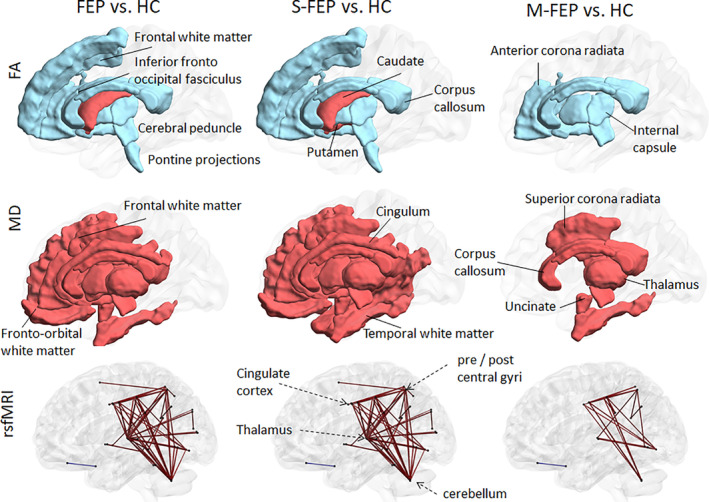
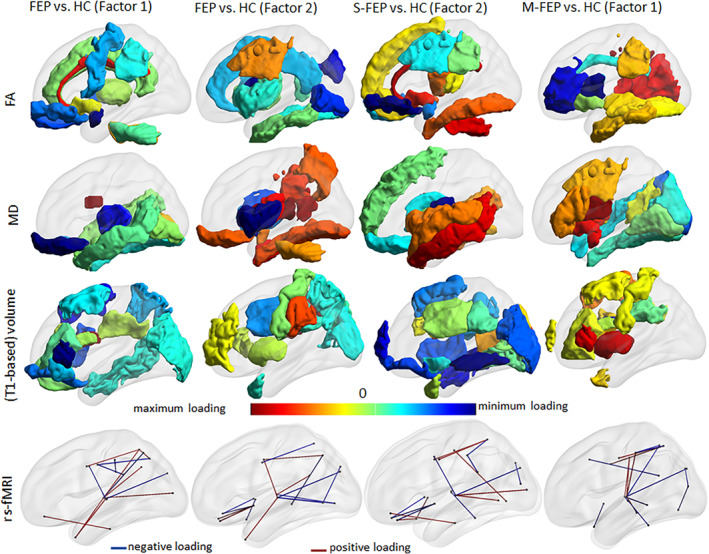
Multi-institutional brain imaging studies have emerged to resolve conflicting results among individual studies. However, adjusting multiple variables at the technical and cohort levels is challenging. Therefore, it is important to explore approaches that provide meaningful results from relatively small samples at institutional levels. We studied 87 first episode psychosis (FEP) patients and 62 healthy subjects by combining supervised integrated factor analysis (SIFA) with a novel pipeline for automated structure-based analysis, an efficient and comprehensive method for dimensional data reduction that our group recently established. We integrated multiple MRI features (volume, DTI indices, resting state fMRI-rsfMRI) in the whole brain of each participant in an unbiased manner. The automated structure-based analysis showed widespread DTI abnormalities in FEP and rs-fMRI differences between FEP and healthy subjects mostly centered in thalamus. The combination of multiple modalities with SIFA was more efficient than the use of single modalities to stratify a subgroup of FEP (individuals with schizophrenia or schizoaffective disorder) that had more robust deficits from the overall FEP group. The information from multiple MRI modalities and analytical methods highlighted the thalamus as significantly abnormal in FEP. This study serves as a proof-of-concept for the potential of this methodology to reveal disease underpins and to stratify populations into more homogeneous sub-groups.
多机构脑成像研究的出现是为了解决个体研究之间存在冲突的结果。然而,在技术和队列层面上调整多个变量具有挑战性。因此,探索从机构层面的相对较小样本中获得有意义结果的方法非常重要。我们通过将监督集成因子分析(SIFA)与我们小组最近建立的一种新的自动化结构基础分析流水线相结合,对 87 名首发精神病(FEP)患者和 62 名健康受试者进行了研究。我们以无偏置的方式整合了每个参与者的全脑的多个 MRI 特征(体积、DTI 指数、静息状态 fMRI-rsfMRI)。自动化结构基础分析显示 FEP 存在广泛的 DTI 异常,FEP 与健康受试者之间的 rs-fMRI 差异主要集中在丘脑。与使用单一模态相比,SIFA 与多种模态的结合能够更有效地对 FEP 的亚组(患有精神分裂症或分裂情感障碍的个体)进行分层,该亚组与总体 FEP 群体相比具有更显著的缺陷。来自多个 MRI 模态和分析方法的信息突出了 FEP 中丘脑的异常。这项研究为该方法揭示疾病基础和将人群分层为更同质的亚组的潜力提供了概念验证。