Jung Yoon-Sun, Kim Young-Eun, Go Dun-Sol, Yoon Seok-Jun
Department of Public Health, Graduate School, Korea University, Seoul, Korea (the Republic of).
Big Data Department, National Health Insurance Service, Wonju, Korea (the Republic of).
BMJ Open. 2020 Dec 30;10(12):e037629. doi: 10.1136/bmjopen-2020-037629.
To project the prevalence of obesity in 2040 among individuals 19 years and older in South Korea.
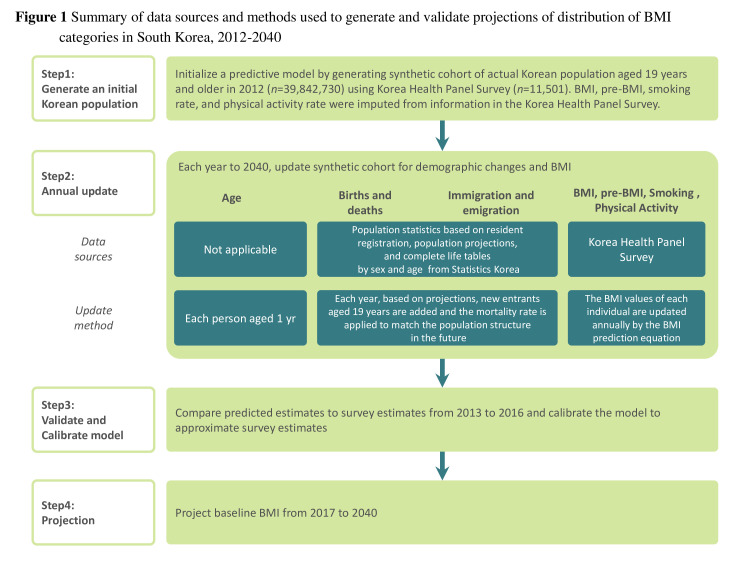
DESIGN, SETTING, AND PARTICIPANTS: Using the 'Population Health Model-body mass index' (BMI) microsimulation model, the prevalence of obesity in Korean adults 19 years and older was projected until 2040. The model integrated individual survey data from the Korea Health Panel Survey of 2011 and 2012, population statistics based on resident registration, population projections and complete life tables categorised by sex and age. Birth rate, life expectancy and international migration were based on a medium growth scenario. The base population of Korean adults in 2012, devised through data aggregation, was 39 842 730. The prediction equations were formulated using BMI as the dependent variable; the individual's sex, age, smoking status, physical activity and preceding year's BMI were used as predictive factors.
BMI categorised by sex.
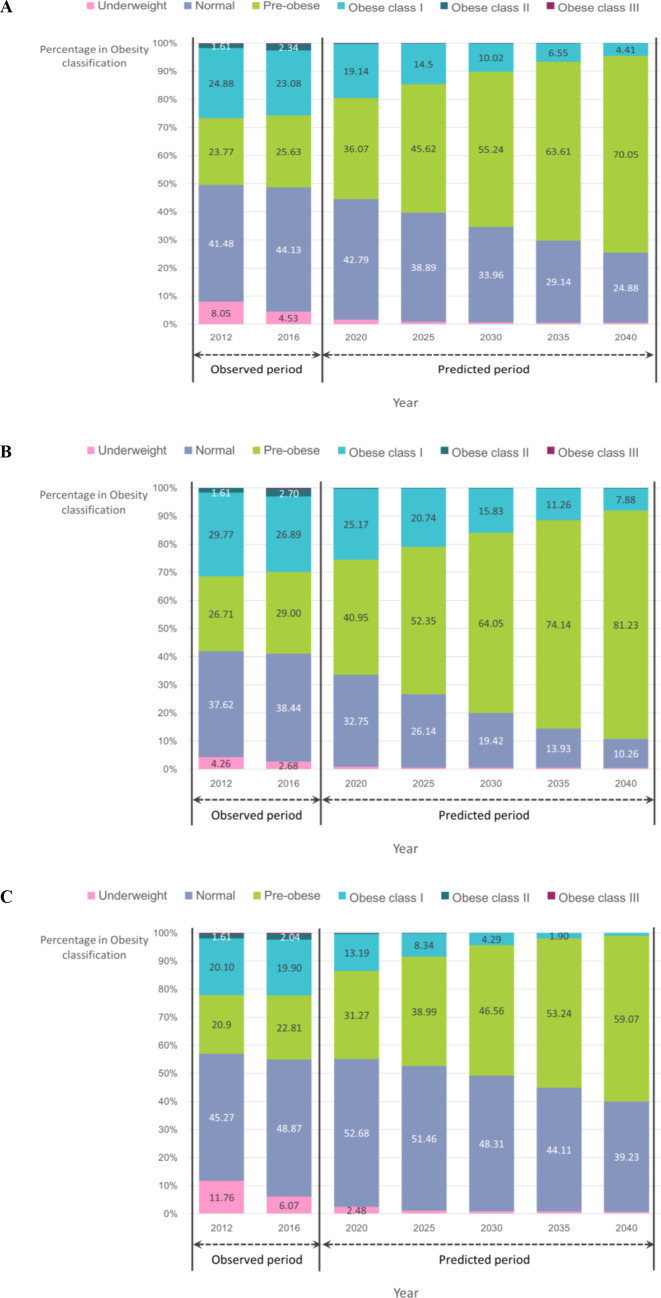
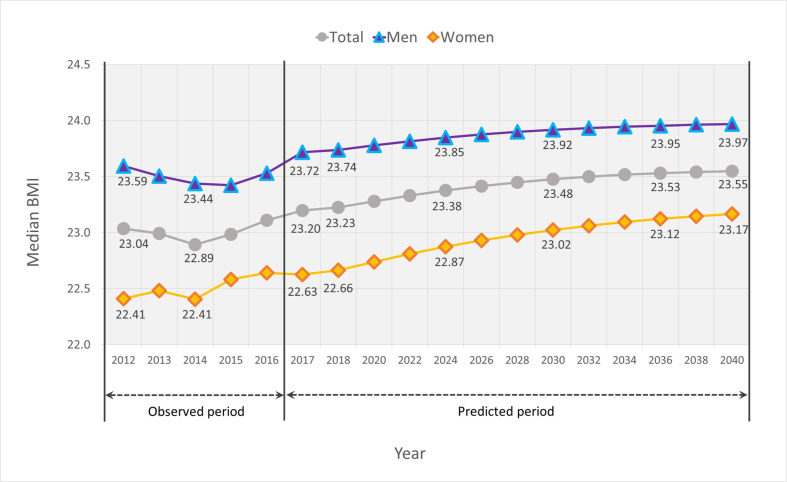
The median BMI for Korean adults in 2040 was expected to be 23.55 kg/m (23.97 and 23.17 kg/m for men and women, respectively). According to the Korean BMI classification, 70.05% of all adults were expected to be 'preobese' (ie, have BMIs 23-24.9 kg/m) by 2040 (81.23% of men and 59.07% of women) and 24.88% to be 'normal'.
We explored the possibility of applying and expanding on the concept of microsimulation in the field of healthcare by combining data sources available in Korea and found that more than half of the adults in this study population will be preobese, and the proportions of 'obesity' and 'normal' will decrease compared with those in 2012. The results of our study will aid in devising healthy strategies and spreading public awareness for preventing this condition.
预测2040年韩国19岁及以上人群的肥胖患病率。
设计、背景和参与者:使用“人口健康模型 - 体重指数”(BMI)微观模拟模型,预测了韩国19岁及以上成年人到2040年的肥胖患病率。该模型整合了2011年和2012年韩国健康面板调查的个人调查数据、基于居民登记的人口统计数据、人口预测以及按性别和年龄分类的完整生命表。出生率、预期寿命和国际移民基于中等增长情景。通过数据汇总得出的2012年韩国成年人群体基数为39842730人。以BMI作为因变量制定预测方程;将个人的性别、年龄、吸烟状况、身体活动水平和上一年的BMI用作预测因素。
按性别分类的BMI。
预计2040年韩国成年人的BMI中位数为23.55kg/m²(男性为23.97kg/m²,女性为23.17kg/m²)。根据韩国的BMI分类,到2040年,预计所有成年人中有70.05%将处于“肥胖前期”(即BMI为23 - 24.9kg/m²)(男性为81.23%,女性为59.07%),24.88%为“正常”。
我们通过整合韩国现有的数据源,探索了在医疗保健领域应用和扩展微观模拟概念的可能性,发现本研究人群中超过一半的成年人将处于肥胖前期,与2012年相比,“肥胖”和“正常”的比例将下降。我们的研究结果将有助于制定健康策略并提高公众对预防这种情况的认识。