Department of Emergency Radiology, Careggi University Hospital, Largo Brambilla 3, 50134, Florence, Italy.
Department of Clinical and Experimental Medicine, Institute of Diagnostic Imaging 2, University of Sassari, Sassari, Italy.
Radiol Med. 2021 May;126(5):661-668. doi: 10.1007/s11547-020-01327-3. Epub 2021 Jan 4.
The aims of our study are: (1) to estimate admission chest X-ray (CXR) accuracy during the descending phase of pandemic; (2) to identify specific CXR findings strictly associated with COVID-19 infection; and (3) to correlate lung involvement of admission CXR with patients' outcome.
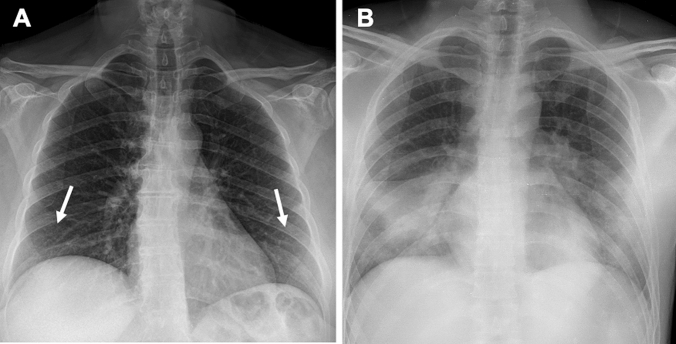
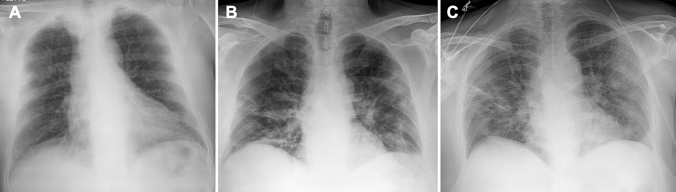
We prospectively evaluated the admission CXR of 327 patients accessed to our institute during the Italian pandemic descending phase (April 2020). For each CXR were searched ground glass opacification (GGO), consolidation (CO), reticular-nodular opacities (RNO), nodules, excavations, pneumothorax, pleural effusion, vascular congestion and cardiac enlargement. For lung alterations was defined the predominance (upper or basal, focal or diffuse, central or peripheric, etc.). Then radiologists assessed whether CXRs were suggestive or not for COVID-19 infection. For COVID-19 patients, a prognostic score was applied and correlated with the patients' outcome.
CXR showed 83% of specificity and 60% of sensitivity. GGO, CO, RNO and a peripheric, diffuse and basal prevalence showed good correlation with COVID-19 diagnosis. A logistic regression analysis pointed out GGO and a basal or diffuse distribution as independent predictors of COVID-19 diagnosis. The prognostic score showed good correlation with the patients' outcome.
In our study, admission CXR showed a fair specificity and a good correlation with patients' outcome. GGO and others CXR findings showed a good correlation with COVID-19 diagnosis; besides GGO a diffuse or bibasal distribution resulted in independent variables highly suggestive for COVID-19 infection thus enabling radiologists to signal to clinicians radiologically suspect patients during the pandemic descending phase.
我们研究的目的是:(1)评估大流行下降阶段入院时胸部 X 线(CXR)的准确性;(2)确定与 COVID-19 感染密切相关的特定 CXR 表现;(3)将入院 CXR 的肺部受累与患者的预后相关联。
我们前瞻性评估了意大利大流行下降阶段(2020 年 4 月)我院收治的 327 例患者的入院 CXR。对每一张 CXR 均寻找磨玻璃影(GGO)、实变(CO)、网状-结节状混浊(RNO)、结节、空洞、气胸、胸腔积液、血管充血和心脏增大。对于肺部改变,定义了优势(上或下,局灶或弥漫,中央或外周等)。然后,放射科医生评估 CXR 是否提示 COVID-19 感染。对于 COVID-19 患者,应用预后评分并与患者预后相关联。
CXR 的特异性为 83%,敏感性为 60%。GGO、CO、RNO 和外周性、弥漫性和基底性优势与 COVID-19 诊断具有良好的相关性。逻辑回归分析指出,GGO 和基底或弥漫性分布是 COVID-19 诊断的独立预测因素。预后评分与患者的预后具有良好的相关性。
在我们的研究中,入院 CXR 的特异性较高,与患者的预后相关性较好。GGO 和其他 CXR 表现与 COVID-19 诊断具有良好的相关性;除 GGO 外,弥漫性或双基底分布也是 COVID-19 感染的高度提示性独立变量,从而使放射科医生能够在大流行下降阶段向临床医生提示放射学可疑患者。