Sydney School of Public Health, The University of Sydney, Sydney, New South Wales, Australia.
Centre for Kidney Research, Children's Hospital at Westmead, Westmead, New South Wales, Australia.
BMJ Open. 2021 Jan 4;11(1):e039670. doi: 10.1136/bmjopen-2020-039670.
To describe the experiences, priorities, and needs of patients with rheumatic disease and their parents during transition from paediatric to adult healthcare.
Face-to-face and telephone semistructured interviews were conducted from December 2018 to September 2019 recruited from five hospital centres in Australia.
Fourteen young people and 16 parents were interviewed. Young people were included if they were English speaking, aged 14-25 years, diagnosed with an inflammatory rheumatic disease (eg, juvenile idiopathic arthritis, juvenile dermatomyositis, systemic lupus erythematosus, panniculitis, familial Mediterranean fever) before 18 years of age. Young people were not included if they were diagnosed in the adult setting.
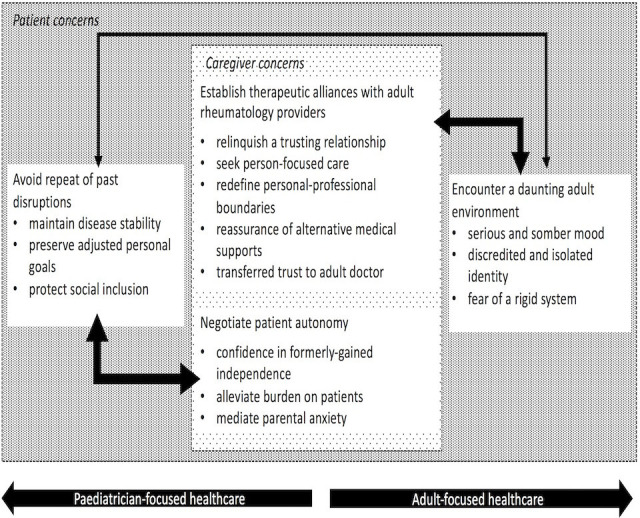
We identified four themes with respective subthemes: avoid repeat of past disruption (maintain disease stability, preserve adjusted personal goals, protect social inclusion); encounter a daunting adult environment (serious and sombre mood, discredited and isolated identity, fear of a rigid system); establish therapeutic alliances with adult rheumatology providers (relinquish a trusting relationship, seek person-focused care, redefine personal-professional boundaries, reassurance of alternative medical supports, transferred trust to adult doctor) and negotiate patient autonomy (confidence in formerly gained independence, alleviate burden on patients, mediate parental anxiety).
During transition, patients want to maintain disease stability, develop a relationship with their adult provider centralised on personal goals and access support networks. Strategies to comprehensively communicate information between providers, support self-management, and negotiate individualised goals for independence during transition planning may improve satisfaction, and health and treatment outcomes.
描述风湿性疾病患者及其父母在从儿科向成人医疗过渡期间的经历、优先事项和需求。
2018 年 12 月至 2019 年 9 月,在澳大利亚的 5 家医院中心进行了面对面和电话半结构化访谈。
共纳入 14 名年轻人和 16 名家长。年轻人纳入标准为:英语流利,年龄 14-25 岁,18 岁之前被诊断为炎症性风湿性疾病(如幼年特发性关节炎、幼年皮肌炎、系统性红斑狼疮、脂膜炎、家族性地中海热)。如果在成人环境中被诊断,则不包括年轻人。
我们确定了四个主题,每个主题都有相应的子主题:避免重复过去的中断(保持疾病稳定、保持调整后的个人目标、保护社会包容);面对令人生畏的成人环境(严肃和忧郁的情绪、被怀疑和孤立的身份、对僵化系统的恐惧);与成人风湿病提供者建立治疗联盟(放弃信任关系、寻求以人为本的护理、重新定义个人-专业界限、保证替代医疗支持、将信任转移给成年医生)和协商患者自主权(对以前获得的独立性的信心、减轻患者负担、调解父母的焦虑)。
在过渡期间,患者希望保持疾病稳定,与他们的成人提供者建立以个人目标为中心的关系,并获得支持网络。在过渡规划期间,全面沟通提供者之间的信息、支持自我管理以及协商个性化独立目标的策略可能会提高满意度和健康及治疗结果。