Department of Genetics, Yale University School of Medicine, New Haven, CT, USA.
Systems Biology Institute, Yale University, West Haven, CT, USA.
Nat Commun. 2021 Jan 4;12(1):4. doi: 10.1038/s41467-020-20323-9.
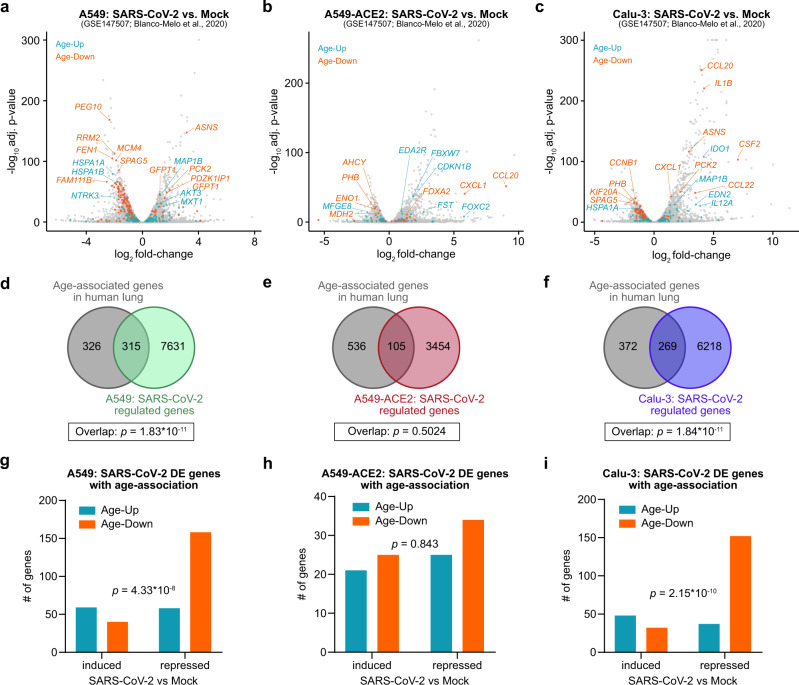
Age is a major risk factor for severe coronavirus disease-2019 (COVID-19). Here, we interrogate the transcriptional features and cellular landscape of the aging human lung. By intersecting these age-associated changes with experimental data on SARS-CoV-2, we identify several factors that may contribute to the heightened severity of COVID-19 in older populations. The aging lung is transcriptionally characterized by increased cell adhesion and stress responses, with reduced mitochondria and cellular replication. Deconvolution analysis reveals that the proportions of alveolar type 2 cells, proliferating basal cells, goblet cells, and proliferating natural killer/T cells decrease with age, whereas alveolar fibroblasts, pericytes, airway smooth muscle cells, endothelial cells and IGSF21 dendritic cells increase with age. Several age-associated genes directly interact with the SARS-CoV-2 proteome. Age-associated genes are also dysregulated by SARS-CoV-2 infection in vitro and in patients with severe COVID-19. These analyses illuminate avenues for further studies on the relationship between age and COVID-19.
年龄是导致严重 2019 冠状病毒病(COVID-19)的主要危险因素。在这里,我们探究了衰老的人类肺部的转录特征和细胞景观。通过将这些与年龄相关的变化与 SARS-CoV-2 的实验数据交叉,我们确定了几个可能导致 COVID-19 在老年人群中更为严重的因素。衰老的肺部在转录上表现为细胞黏附和应激反应增加,线粒体和细胞复制减少。去卷积分析显示,肺泡 2 型细胞、增殖基底细胞、杯状细胞和增殖自然杀伤/T 细胞的比例随年龄增长而下降,而肺泡成纤维细胞、周细胞、气道平滑肌细胞、内皮细胞和 IGSF21 树突状细胞随年龄增长而增加。一些与年龄相关的基因直接与 SARS-CoV-2 蛋白质组相互作用。SARS-CoV-2 感染也会导致与年龄相关的基因在体外和严重 COVID-19 患者中失调。这些分析为进一步研究年龄与 COVID-19 之间的关系提供了途径。