Institute of Military Veterinary Medicine, Academy of Military Medical Sciences, Changchun, People's Republic of China.
School of Life Sciences, Northeast Normal University, Changchun, People's Republic of China.
J Virol. 2021 Aug 25;95(18):e0060021. doi: 10.1128/JVI.00600-21.
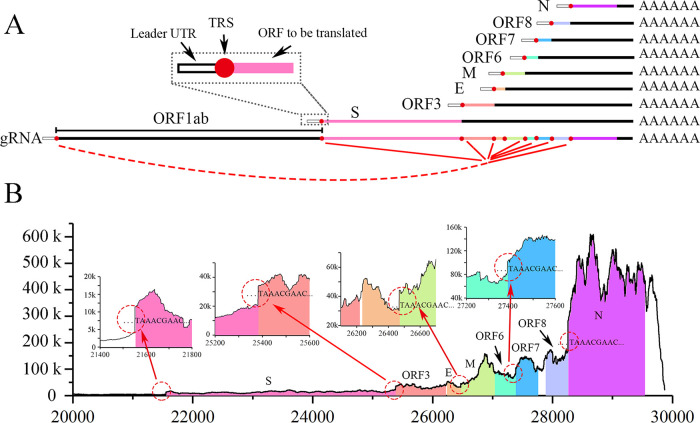
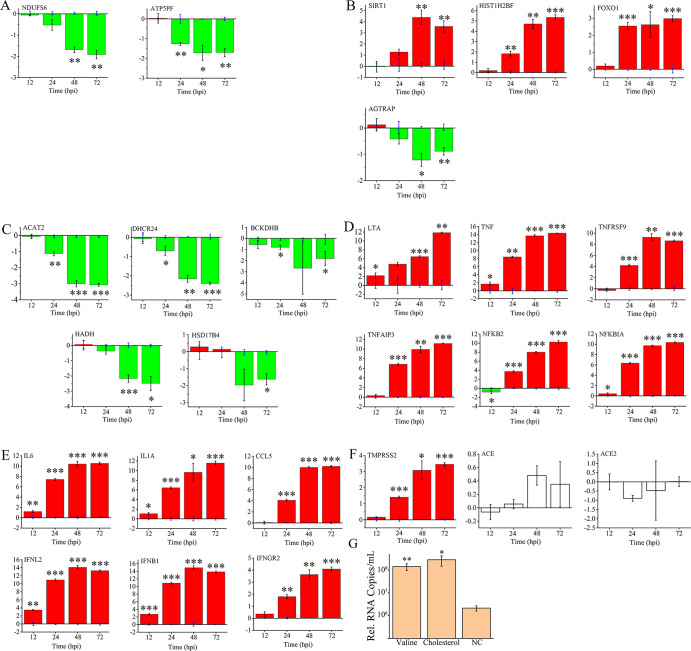
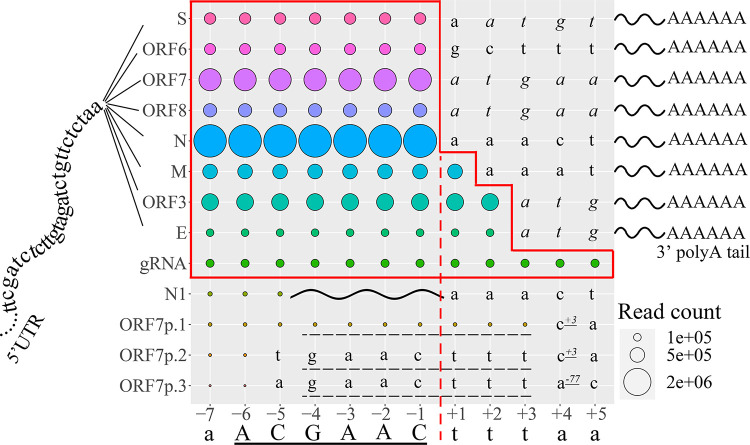
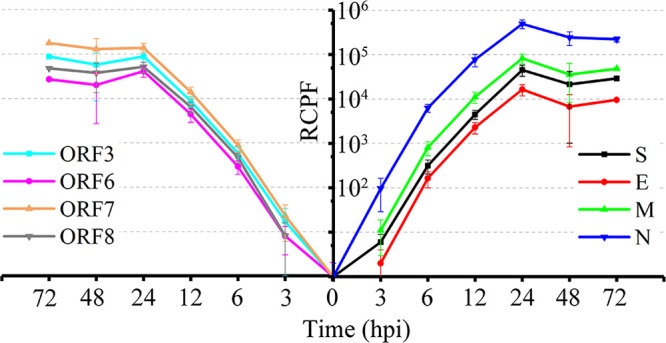
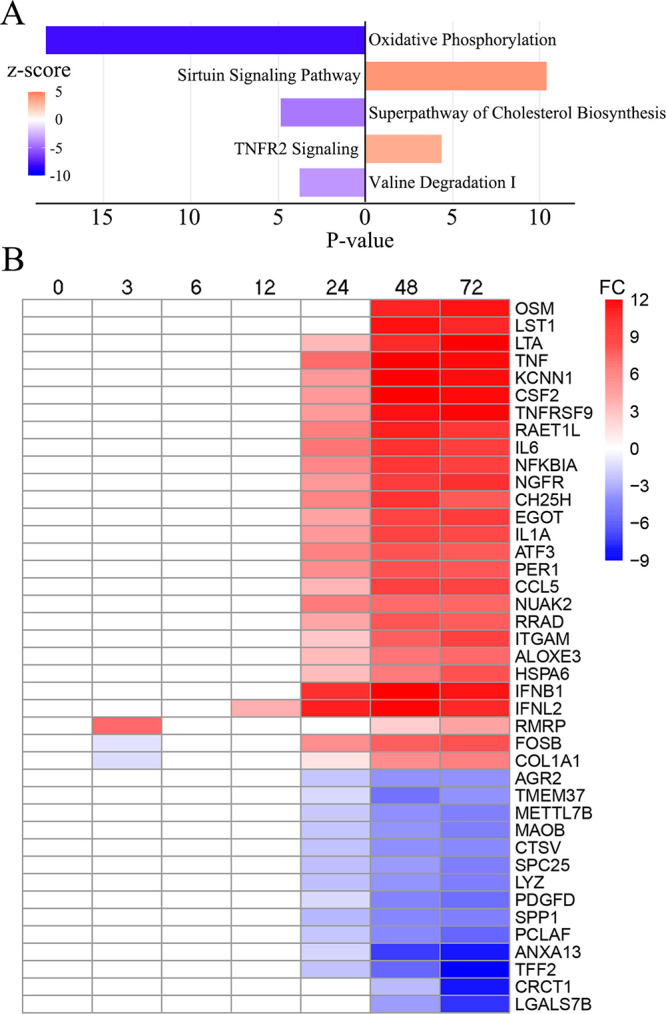
Coronaviruses are commonly characterized by a unique discontinuous RNA transcriptional synthesis strategy guided by transcription-regulating sequences (TRSs). However, the details of RNA synthesis in severe acute respiratory syndrome coronavirus 2 (SARS-CoV-2) have not been fully elucidated. Here, we present a time-scaled, gene-comparable transcriptome of SARS-CoV-2, demonstrating that ACGAAC functions as a core TRS guiding the discontinuous RNA synthesis of SARS-CoV-2 from a holistic perspective. During infection, viral transcription, rather than genome replication, dominates all viral RNA synthesis activities. The most highly expressed viral gene is the nucleocapsid gene, followed by ORF7 and ORF3 genes, while the envelope gene shows the lowest expression. Host transcription dysregulation keeps exacerbating after viral RNA synthesis reaches a maximum. The most enriched host pathways are metabolism related. Two of them (cholesterol and valine metabolism) affect viral replication in reverse. Furthermore, the activation of numerous cytokines emerges before large-scale viral RNA synthesis. SARS-CoV-2 is responsible for the current severe global health emergency that began at the end of 2019. Although the universal transcriptional strategies of coronaviruses are preliminarily understood, the details of RNA synthesis, especially the time-matched transcription level of each SARS-CoV-2 gene and the principles of subgenomic mRNA synthesis, are not clear. The coterminal subgenomic mRNAs of SARS-CoV-2 present obstacles in identifying the expression of most genes by PCR-based methods, which are exacerbated by the lack of related antibodies. Moreover, SARS-CoV-2-related metabolic imbalance and cytokine storm are receiving increasing attention from both clinical and mechanistic perspectives. Our transcriptomic research provides information on both viral RNA synthesis and host responses, in which the transcription-regulating sequences and transcription levels of viral genes are demonstrated, and the metabolic dysregulation and cytokine levels identified at the host cellular level support the development of novel medical treatment strategies.
冠状病毒通常具有独特的不连续 RNA 转录合成策略,该策略由转录调节序列 (TRS) 指导。然而,严重急性呼吸综合征冠状病毒 2 (SARS-CoV-2) 的 RNA 合成细节尚未完全阐明。在这里,我们展示了 SARS-CoV-2 的一个按时间顺序排列、基因可比的转录组,证明 ACGAAC 作为一个核心 TRS,从整体上指导 SARS-CoV-2 的不连续 RNA 合成。在感染过程中,病毒转录而不是基因组复制主导所有病毒 RNA 合成活动。表达量最高的病毒基因是核衣壳基因,其次是 ORF7 和 ORF3 基因,而包膜基因的表达量最低。宿主转录失调在病毒 RNA 合成达到最大值后仍在加剧。最富集的宿主途径与代谢有关。其中两个(胆固醇和缬氨酸代谢)以相反的方式影响病毒复制。此外,大量细胞因子的激活出现在大规模病毒 RNA 合成之前。SARS-CoV-2 是导致 2019 年底开始的当前全球严重卫生紧急情况的罪魁祸首。尽管冠状病毒的普遍转录策略已初步了解,但 RNA 合成的细节,特别是每个 SARS-CoV-2 基因的时间匹配转录水平和亚基因组 mRNA 合成的原理尚不清楚。SARS-CoV-2 的共末端亚基因组 mRNA 使得通过基于 PCR 的方法识别大多数基因的表达变得困难,这因缺乏相关抗体而加剧。此外,SARS-CoV-2 相关的代谢失衡和细胞因子风暴正受到临床和机制方面的越来越多的关注。我们的转录组研究提供了病毒 RNA 合成和宿主反应的信息,其中展示了病毒基因的转录调节序列和转录水平,在宿主细胞水平上确定的代谢失调和细胞因子水平支持了新的治疗策略的发展。