Lopez-Beltran Antonio, Cimadamore Alessia, Blanca Ana, Massari Francesco, Vau Nuno, Scarpelli Marina, Cheng Liang, Montironi Rodolfo
Unit of Anatomic Pathology, Department of Morphological Sciences, Cordoba University Medical School, 14004 Cordoba, Spain.
Pathological Anatomy, School of Medicine, United Hospitals, Polytechnic University of the Marche Region, 60126 Ancona, Italy.
Cancers (Basel). 2021 Jan 3;13(1):131. doi: 10.3390/cancers13010131.
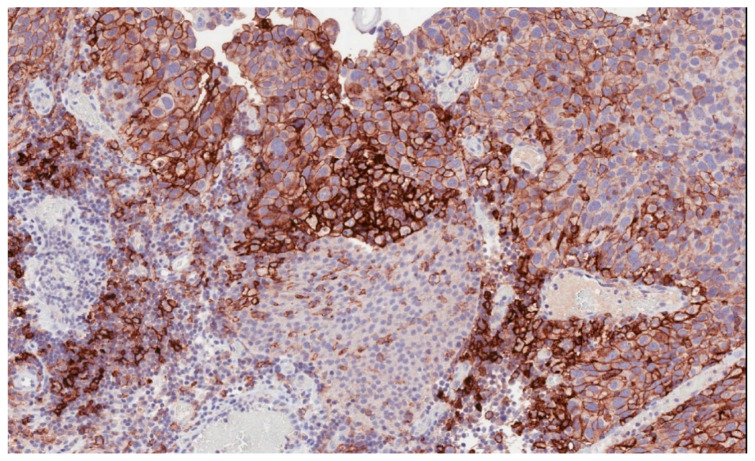
A number of immune checkpoint inhibitors (ICIs) have been approved as first-line therapy in case of cisplatin-ineligible patients or as second-line therapy for patients with metastatic urothelial carcinoma (mUC) of the bladder. About 30% of patients with mUC will respond to ICIs immunotherapy. Programmed death-ligand 1 (PD-L1) expression detected by immunohistochemistry seems to predict response to immune checkpoint inhibitors in patients with mUC as supported by the objective response rate (ORR) and overall survival (OS) associated with the response observed in most clinical trials. Pembrolizumab, an anti-PD-1 antibody, demonstrated better OS respective to chemotherapy in a randomized phase 3 study for second-line treatment of mUC. Nivolumab, a PD-1 antibody, also demonstrated an OS benefit when compared to controls. Atezolizumab, Durvalumab, and Avelumab antibodies targeting PD-L1 have also received approval as second-line treatments for mUC with durable response for more than 1 year in selected patients. Atezolizumab and Pembrolizumab also received approval for first-line treatment of patients that are ineligible for cisplatin. A focus on the utility of ICIs in the adjuvant or neoadjuvant setting, or as combination with chemotherapy, is the basis of some ongoing trials. The identification of a clinically useful biomarker, single or in association, to determine the optimal ICIs treatment for patients with mUC is very much needed as emphasized by the current literature. In this review, we examined relevant clinical trial results with ICIs in patients with mUC alone or as part of drug combinations; emphasis is also placed on the adjuvant and neoadjuvant setting. The current landscape of selected biomarkers of response to ICIs including anti-PD-L1 immunohistochemistry is also briefly reviewed.
多种免疫检查点抑制剂(ICI)已被批准用于顺铂不耐受患者的一线治疗,或作为膀胱转移性尿路上皮癌(mUC)患者的二线治疗。约30%的mUC患者对ICI免疫疗法有反应。免疫组化检测的程序性死亡配体1(PD-L1)表达似乎可预测mUC患者对免疫检查点抑制剂的反应,这在大多数临床试验中观察到的客观缓解率(ORR)和总生存期(OS)与反应的相关性中得到了支持。帕博利珠单抗,一种抗PD-1抗体,在一项用于mUC二线治疗的随机3期研究中,相对于化疗显示出更好的OS。纳武利尤单抗,一种PD-1抗体,与对照组相比也显示出OS获益。阿替利珠单抗、度伐利尤单抗和阿维鲁单抗等靶向PD-L1的抗体也已获批作为mUC的二线治疗药物,在部分患者中具有超过1年的持久反应。阿替利珠单抗和帕博利珠单抗也获批用于顺铂不耐受患者的一线治疗。关注ICI在辅助或新辅助治疗中的效用,或与化疗联合使用,是一些正在进行的试验的基础。正如当前文献所强调的,非常需要确定一种临床有用的生物标志物,单独或联合使用,以确定mUC患者的最佳ICI治疗方案。在本综述中,我们研究了ICI在mUC患者中单独使用或作为药物组合一部分的相关临床试验结果;同时也强调了辅助和新辅助治疗情况。还简要回顾了包括抗PD-L1免疫组化在内的ICI反应的选定生物标志物的当前情况。