St. Anna Children's Cancer Research Institute, Zimmermannplatz 10, 1090, Vienna, Austria.
Cancer Metastasis Rev. 2021 Mar;40(1):173-189. doi: 10.1007/s10555-020-09946-y. Epub 2021 Jan 6.
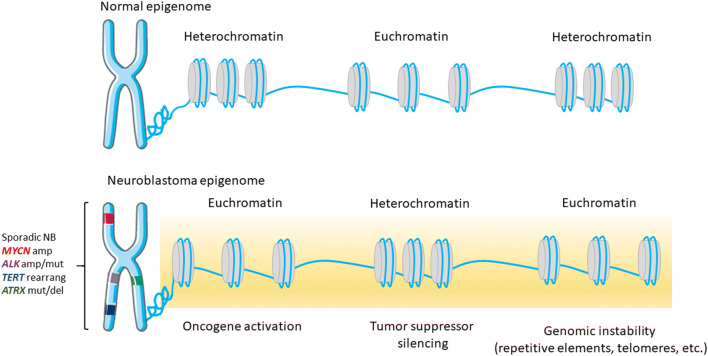
Neuroblastoma (NB) is a pediatric cancer of the sympathetic nervous system and one of the most common solid tumors in infancy. Amplification of MYCN, copy number alterations, numerical and segmental chromosomal aberrations, mutations, and rearrangements on a handful of genes, such as ALK, ATRX, TP53, RAS/MAPK pathway genes, and TERT, are attributed as underlying causes that give rise to NB. However, the heterogeneous nature of the disease-along with the relative paucity of recurrent somatic mutations-reinforces the need to understand the interplay of genetic factors and epigenetic alterations in the context of NB. Epigenetic mechanisms tightly control gene expression, embryogenesis, imprinting, chromosomal stability, and tumorigenesis, thereby playing a pivotal role in physio- and pathological settings. The main epigenetic alterations include aberrant DNA methylation, disrupted patterns of posttranslational histone modifications, alterations in chromatin composition and/or architecture, and aberrant expression of non-coding RNAs. DNA methylation and demethylation are mediated by DNA methyltransferases (DNMTs) and ten-eleven translocation (TET) proteins, respectively, while histone modifications are coordinated by histone acetyltransferases and deacetylases (HATs, HDACs), and histone methyltransferases and demethylases (HMTs, HDMs). This article focuses predominately on the crosstalk between the epigenome and NB, and the implications it has on disease diagnosis and treatment.
神经母细胞瘤(NB)是一种儿童期交感神经系统的癌症,也是婴儿期最常见的实体肿瘤之一。MYCN 扩增、拷贝数改变、数量和片段染色体异常、突变和重排,以及少数基因如 ALK、ATRX、TP53、RAS/MAPK 通路基因和 TERT 的重排,被认为是导致 NB 的根本原因。然而,该疾病的异质性特征——以及相对较少的复发性体细胞突变——加强了在 NB 背景下理解遗传因素和表观遗传改变相互作用的必要性。表观遗传机制严格控制基因表达、胚胎发生、印迹、染色体稳定性和肿瘤发生,从而在生理和病理环境中发挥关键作用。主要的表观遗传改变包括异常的 DNA 甲基化、翻译后组蛋白修饰模式的破坏、染色质组成和/或结构的改变以及非编码 RNA 的异常表达。DNA 甲基化和去甲基化分别由 DNA 甲基转移酶(DNMTs)和十号十一号转位(TET)蛋白介导,而组蛋白修饰则由组蛋白乙酰转移酶和去乙酰化酶(HATs、HDACs)以及组蛋白甲基转移酶和去甲基酶(HMTs、HDMs)协调。本文主要关注表观基因组与 NB 之间的相互作用,以及它对疾病诊断和治疗的影响。