Ortín-Piqueras Victoria, Freitag Tobias L, Andersson Leif C, Lehtonen Sanna H, Meri Seppo K, Spillmann Thomas, Frias Rafael
Department of Equine and Small Animal Medicine, Faculty of Veterinary Medicine, University of Helsinki, FIN-00014 Helsinki, Finland.
Comparative Medicine, Karolinska Institute, SE-171 77 Stockholm, Sweden.
Animals (Basel). 2021 Jan 4;11(1):79. doi: 10.3390/ani11010079.
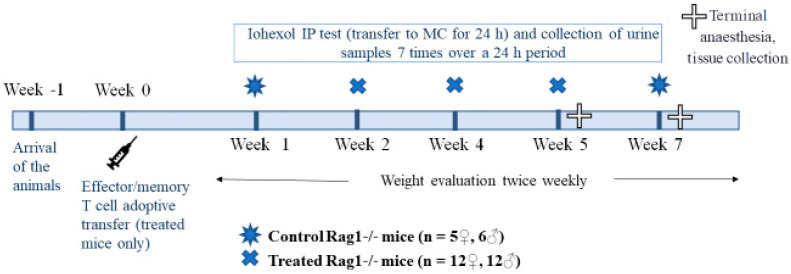
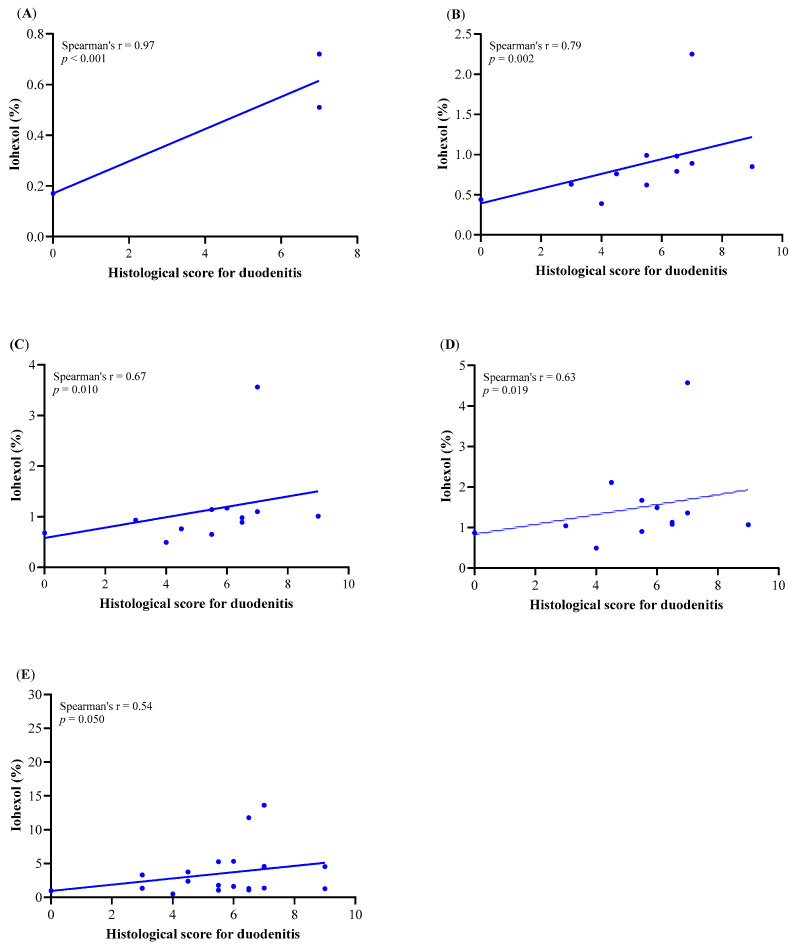
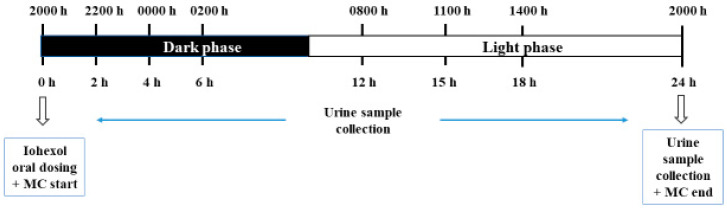
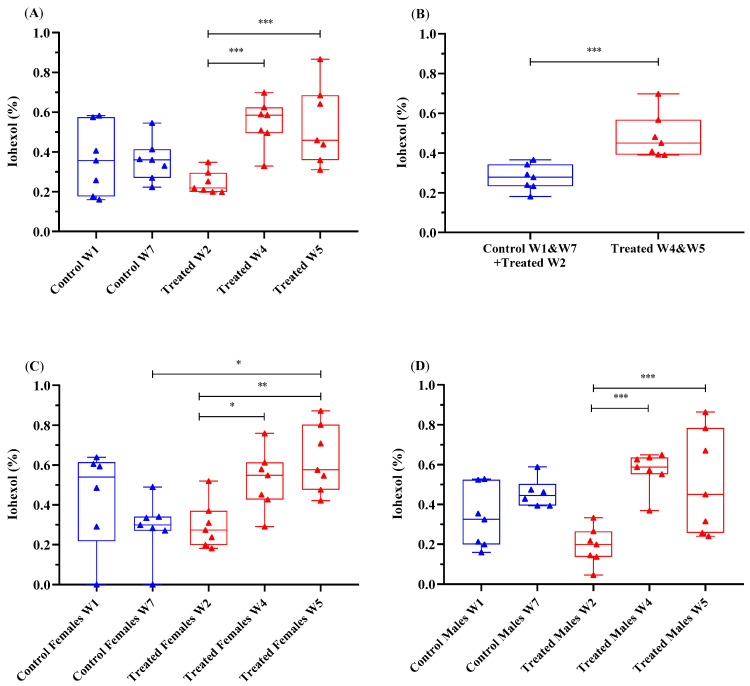
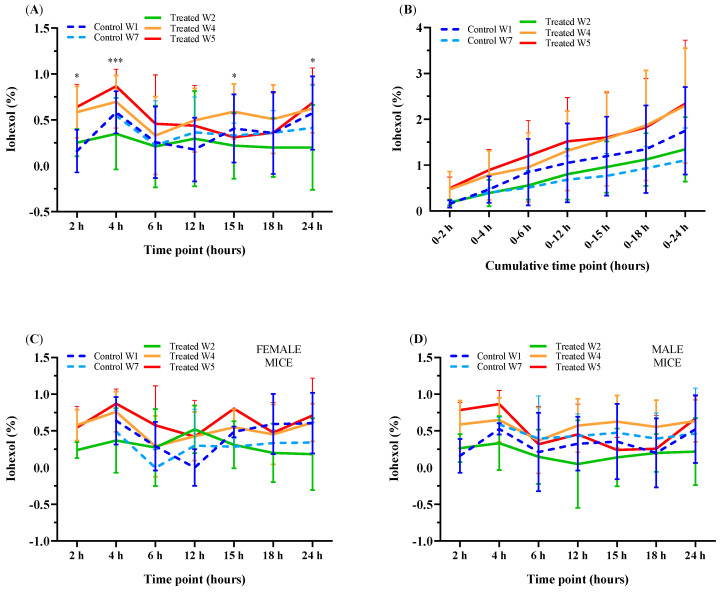
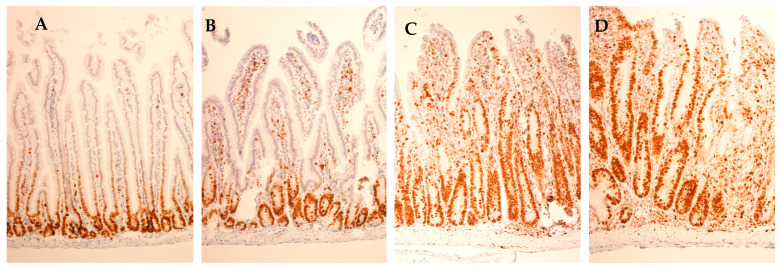
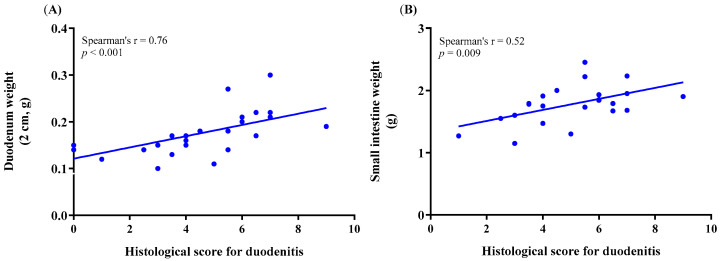
Intestinal permeability (IP) tests are used to assess intestinal damage in patients and research models. The probe iohexol has shown advantages compared to Cr-EDTA or absorbable/nonabsorbable sugars. During IP tests, animals are housed in metabolic cages (MCs) to collect urine. We examined the performance of an iohexol IP test in mice. Rag1-/- (C57BL/6) mice of both sexes were divided into controls or treatment groups, the latter receiving injections of effector/memory T cells to induce intestinal inflammation. After two, four and five weeks (W), a single dose of iohexol was orally administered. Urine was collected seven times over 24 h in MCs. Iohexol concentration was measured by ELISA. Intestinal histological damage was scored in duodenal sections. In control and treated mice of both sexes, urinary excretion of iohexol peaked at 4 h. From W2 to W4/W5, urinary iohexol excretion increased in treated mice of both sexes, consistent with development of duodenitis in this model. Positive correlations were observed between the urinary excretion of iohexol in W4/W5 and the histological severity of duodenitis in treated male mice. We conclude that a 6 h cumulative urine sample appears sufficient to evaluate small IP to iohexol in this mouse model, improving animal welfare by reducing cage periods.
肠道通透性(IP)测试用于评估患者和研究模型中的肠道损伤。与铬-乙二胺四乙酸(Cr-EDTA)或可吸收/不可吸收糖类相比,造影剂碘海醇已显示出优势。在IP测试期间,将动物饲养在代谢笼(MCs)中以收集尿液。我们检测了碘海醇IP测试在小鼠中的性能。将雌雄Rag1-/-(C57BL/6)小鼠分为对照组或治疗组,后者接受效应/记忆T细胞注射以诱导肠道炎症。在两周、四周和五周(W)后,口服单剂量碘海醇。在代谢笼中24小时内收集7次尿液。通过酶联免疫吸附测定(ELISA)测量碘海醇浓度。在十二指肠切片中对肠道组织学损伤进行评分。在雌雄对照和治疗小鼠中,碘海醇的尿排泄量在4小时达到峰值。从第2周(W2)到第4/5周(W4/W5),雌雄治疗小鼠的尿碘海醇排泄量增加,这与该模型中十二指肠炎症的发展一致。在第4/5周(W4/W5)时,雄性治疗小鼠的碘海醇尿排泄量与十二指肠炎症的组织学严重程度之间存在正相关。我们得出结论,在该小鼠模型中,6小时的累积尿液样本似乎足以评估对碘海醇的小肠通透性(IP),通过减少笼养时间提高动物福利。