
COVID-19 疫情动态与 ABO 血型分布的关联。
Association between the dynamics of the COVID-19 epidemic and ABO blood type distribution.
机构信息
Division of Sports and Rehabilitation Medicine, Department of Internal Medicine II, University of Ulm, Ulm, Germany.
Center of Interdisciplinary Emergency Care, University of Ulm, Ulm, Germany.
出版信息
Epidemiol Infect. 2021 Jan 7;149:e19. doi: 10.1017/S0950268821000030.
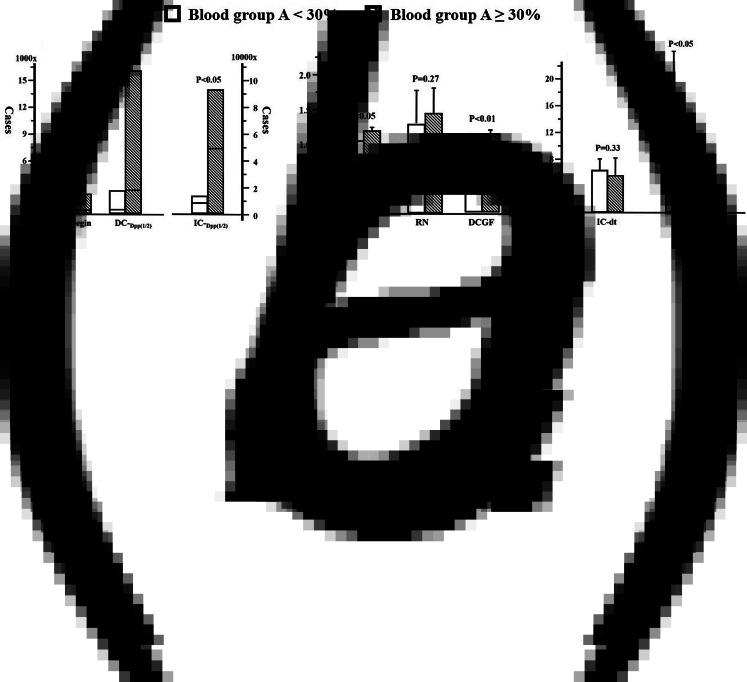
The coronavirus disease 2019 (COVID-19) pandemic is currently the most critical challenge in public health. An understanding of the factors that affect severe acute respiratory syndrome-coronavirus-2 (SARS-CoV-2) infection will help fight the COVID-19 pandemic. This study sought to investigate the association between SARS-CoV-2 infection and blood type distribution. The big data provided by the World Health Organization (WHO) and Johns Hopkins University were used to assess the dynamics of the COVID-19 epidemic. The infection data in the early phase of the pandemic from six countries in each of six geographic zones divided according to the WHO were used, representing approximately 5.4 billion people around the globe. We calculated the infection growth factor, doubling times of infection and death cases, reproductive number and infection and death cases in relation to the blood type distribution. The growth factor of infection and death cases significantly and positively correlated with the proportion of the population with blood type A and negatively correlated with the proportion of the population with blood type B. Compared with the lower blood type A population (<30%), the higher blood type A population (⩾30%) showed more infection and death cases, higher growth factors and shorter case doubling times for infections and deaths and thus higher epidemic dynamics. Thus, an association exists between SARS-CoV-2 and the ABO blood group distribution, which might be useful for fighting the COVID-19 pandemic.
新型冠状病毒病 2019(COVID-19)大流行是目前公共卫生领域最严峻的挑战。了解影响严重急性呼吸综合征冠状病毒 2(SARS-CoV-2)感染的因素将有助于抗击 COVID-19 大流行。本研究旨在探讨 SARS-CoV-2 感染与血型分布之间的关系。本研究使用了世界卫生组织(WHO)和约翰霍普金斯大学提供的大数据来评估 COVID-19 疫情的动态。使用了来自全球六个地理区域六个国家的大流行早期阶段的感染数据,代表了全球约 54 亿人。我们计算了感染增长率、感染和死亡病例的倍增时间、繁殖数以及与血型分布相关的感染和死亡病例。感染和死亡病例的增长率与 A 型血人口比例呈显著正相关,与 B 型血人口比例呈负相关。与 A 型血人口比例较低(<30%)相比,A 型血人口比例较高(⩾30%)的人群感染和死亡病例更多,增长率更高,感染和死亡病例的倍增时间更短,因此疫情动态更高。因此,SARS-CoV-2 与 ABO 血型分布之间存在关联,这可能有助于抗击 COVID-19 大流行。


 Zotero 插件