Clinical Biostatistics Unit, Hospital Universitario Ramón y Cajal, IRYCIS, CIBER of Epidemiology and Public Health, Madrid, Spain.
Department of Internal Medicine, Faculty of Medicine, Universidad de La Frontera, Temuco, Chile.
BMJ Open. 2021 Jan 6;11(1):e043004. doi: 10.1136/bmjopen-2020-043004.
Testing used in screening, diagnosis and follow-up of COVID-19 has been a subject of debate. Several organisations have developed formal advice about testing for COVID-19 to assist in the control of the disease. We collated, delineated and appraised current worldwide recommendations about the role and applications of tests to control SARS-CoV-2/COVID-19.
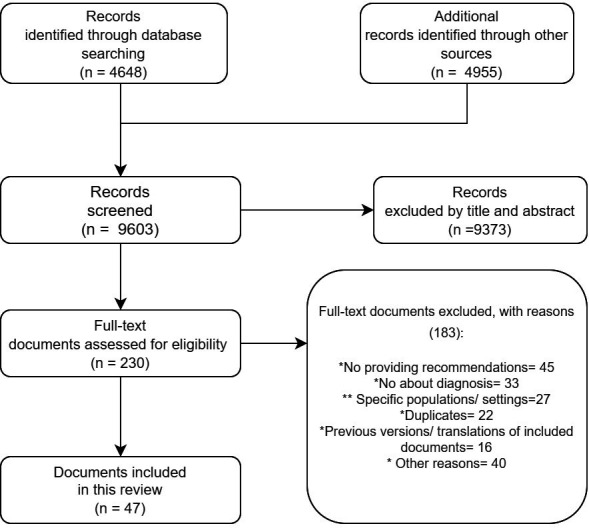
We searched for documents providing recommendations for COVID-19 testing in PubMed, EMBASE, LILACS, the Coronavirus Open Access Project living evidence database and relevant websites such as TRIP database, ECRI Guidelines Trust, the GIN database, from inception to 21 September 2020. Two reviewers applied the eligibility criteria to potentially relevant citations without language or geographical restrictions. We extracted data in duplicate, including assessment of methodological quality using the Appraisal of Guidelines for Research and Evaluation-II tool.
We included 47 relevant documents and 327 recommendations about testing. Regarding the quality of the documents, we found that the domains with the lowest scores were 'Editorial independence' (Median=4%) and 'Applicability' (Median=6%). Only six documents obtained at least 50% score for the 'Rigour of development' domain. An important number of recommendations focused on the diagnosis of suspected cases (48%) and deisolation measures (11%). The most frequently recommended test was the reverse transcription-PCR (RT-PCR) assay (87 recommendations) and the chest CT (38 recommendations). There were 22 areas of agreement among guidance developers, including the use of RT-PCR for SARS-Cov-2 confirmation, the limited role of bronchoscopy, the use chest CT and chest X-rays for grading severity and the co-assessment for other respiratory pathogens.
This first scoping review of recommendations for COVID-19 testing showed many limitations in the methodological quality of included guidance documents that could affect the confidence of clinicians in their implementation. Future guidance documents should incorporate a minimum set of key methodological characteristics to enhance their applicability for decision making.
在 COVID-19 的筛查、诊断和随访中,检测一直是一个备受争议的话题。一些组织已经制定了关于 COVID-19 检测的正式建议,以帮助控制疾病。我们收集、描述和评估了目前全球范围内关于控制 SARS-CoV-2/COVID-19 的检测的作用和应用的建议。
我们在 PubMed、EMBASE、LILACS、冠状病毒开放获取项目实时证据数据库以及 TRIP 数据库、ECRI 指南信托、GIN 数据库等相关网站上搜索了关于 COVID-19 检测的建议文件,检索时间从建库至 2020 年 9 月 21 日。两位评审员在没有语言或地域限制的情况下,应用入选标准对可能相关的参考文献进行评估。我们对数据进行了重复提取,包括使用评估研究和评估-II 工具对方法学质量进行评估。
我们纳入了 47 份相关文件和 327 条检测建议。关于文件的质量,我们发现“编辑独立性”(中位数=4%)和“适用性”(中位数=6%)两个领域的得分最低。仅有 6 份文件在“发展严谨性”领域的得分至少达到 50%。大量的建议集中在疑似病例的诊断(48%)和解除隔离措施(11%)上。推荐最多的检测方法是逆转录聚合酶链反应(RT-PCR)检测(87 条建议)和胸部 CT(38 条建议)。指南制定者达成了 22 个领域的共识,包括 RT-PCR 用于 SARS-Cov-2 确认、支气管镜检查的作用有限、胸部 CT 和 X 光用于严重程度分级以及对其他呼吸道病原体的联合评估。
这是对 COVID-19 检测建议的首次范围综述,研究发现纳入的指南文件在方法学质量方面存在许多局限性,这可能会影响临床医生对其实施的信心。未来的指南文件应纳入一组最低限度的关键方法学特征,以提高其在决策中的适用性。