Redondo Jose I, Domenech Luis, Mateu Cristina, Bañeres Alfon, Martínez Amalia, Lopes Diana
Departamento de Medicina y Cirugía Animal, Facultad de Veterinaria, Universidad Cardenal Herrera-CEU, CEU Universities, Valencia, Spain.
Departamento de Matemáticas, Física y Ciencias Tecnológicas, Escuela Superior de Enseñanzas Técnicas, Universidad Cardenal Herrera-CEU, CEU Universities, Valencia, Spain.
Front Vet Sci. 2020 Dec 21;7:592597. doi: 10.3389/fvets.2020.592597. eCollection 2020.
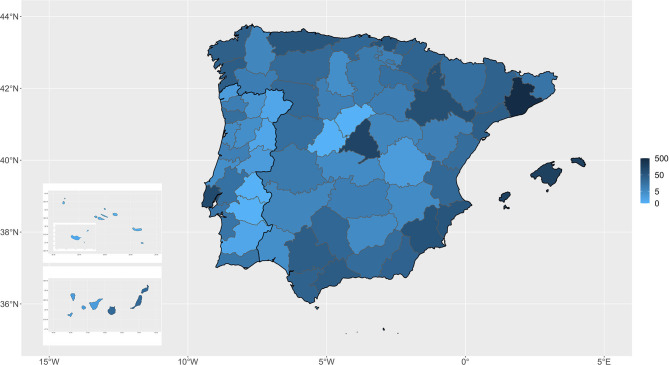
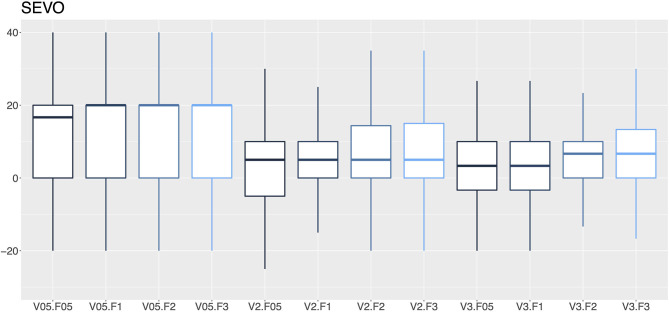
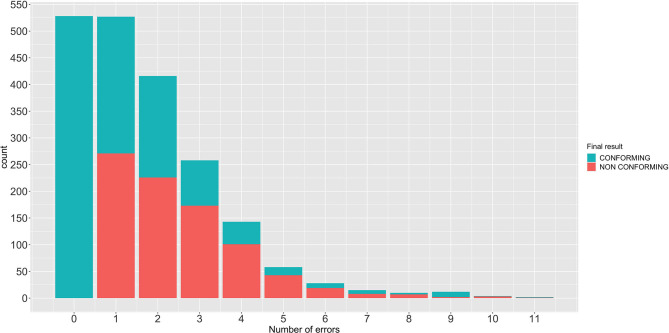
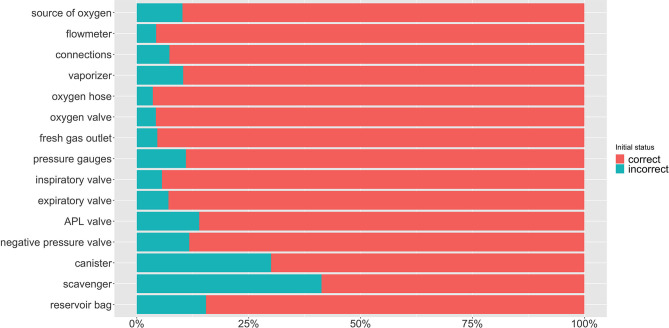
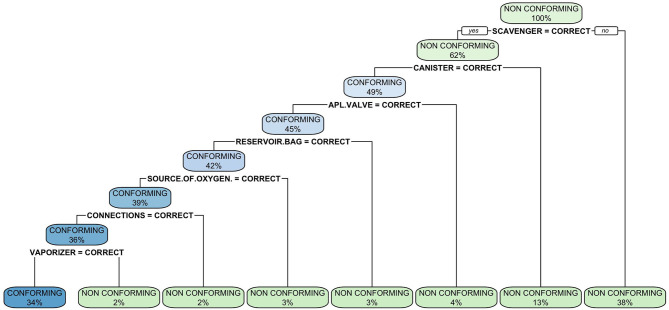
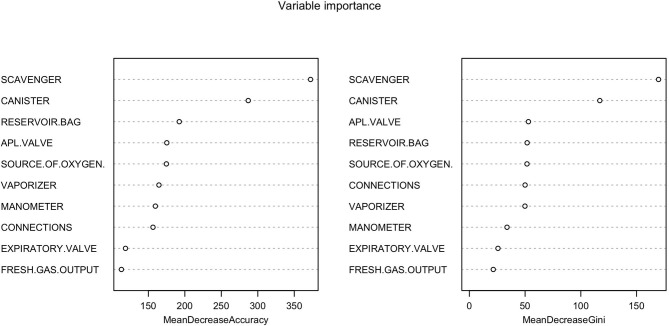
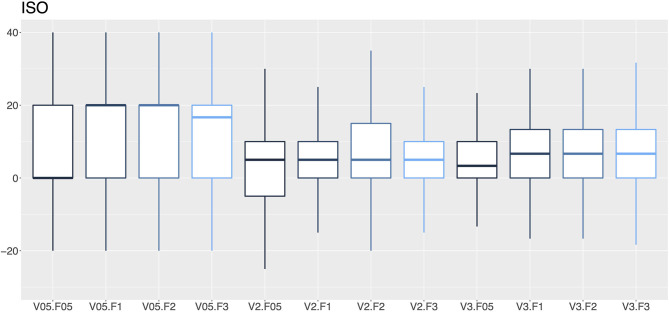
The objective of this retrospective study was to review the results of a 4-year audit performed on anesthetic machines and vaporizers used in veterinary clinics in Spain and Portugal. Data was collected between July 2016 and April 2020. Inspections were carried out by a team of seven veterinarians, using a human-modified system of checks that was adapted to a veterinary practice. The evaluation of each item was noted as "correct" or "incorrect". The vaporizers' performance was evaluated using a self-calibrating gas analyzer. The vaporizer was classified as "correct" or "incorrect" when the vaporization error was less than or equal to, or more than 20%, respectively. The anesthetic machine was classified as "conforming" if all its components were noted as "correct" and no leaks were detected, or as "non-conforming" if any of the components was noted as "incorrect" or if a leak was detected. If the inspector was able to repair on-site the item malfunctions detected and the machine was fit for use, they issued a final report as "conforming." On the contrary, if such malfunctions persisted, the final report was "non-conforming," and a recommendation to remove the machine from service until its final repair was provided. To perform statistical analysis, each inspected item was used as predictor, classification and regression trees were built, and a random forest analysis was performed. A total of 2,001 anesthetic machines and 2,309 vaporizers were studied. After inspection, 42.7 and 26.4% of the machines were non-conforming and conforming, respectively, whereas 30.9% could be repaired . A total of 27.1% of the isoflurane vaporizers and 35.9% of the sevoflurane vaporizers were incorrect. Machine learning techniques showed that the most important variables in the classification of the anesthetic machines as conforming or non-conforming were mostly the scavenger system and the canister, followed some way behind by the APL valve, source of oxygen, reservoir bag, vaporizer, and connections.
这项回顾性研究的目的是回顾对西班牙和葡萄牙兽医诊所使用的麻醉机和蒸发器进行的为期4年的审计结果。数据收集于2016年7月至2020年4月之间。由七名兽医组成的团队进行检查,使用的是经过人为修改、适用于兽医实践的检查系统。每个项目的评估结果记录为“正确”或“错误”。使用自校准气体分析仪评估蒸发器的性能。当蒸发误差分别小于或等于20%或大于20%时,蒸发器被分类为“正确”或“错误”。如果麻醉机的所有组件评估结果为“正确”且未检测到泄漏,则该麻醉机被分类为“合格”;如果任何组件评估结果为“错误”或检测到泄漏,则被分类为“不合格”。如果检查员能够现场修复检测到的设备故障且该机器适合使用,则出具最终报告为“合格”。相反,如果此类故障仍然存在,则最终报告为“不合格”,并建议将该机器停用直至最终修复。为了进行统计分析,将每个检查项目用作预测变量,构建分类和回归树,并进行随机森林分析。总共研究了2001台麻醉机和2309个蒸发器。检查后,分别有42.7%和26.4%的机器不合格和合格,而30.9%的机器可以修复。共有27.1%的异氟烷蒸发器和35.9%的七氟烷蒸发器存在错误。机器学习技术表明,将麻醉机分类为合格或不合格的最重要变量大多是清除系统和滤罐,其次是APL阀、氧气源、储气囊、蒸发器和连接部件,但差距较大。