Institut Pasteur de Dakar, Unité d'Epidémiologie des maladies infectieuses, 36, Avenue Pasteur, Dakar, Sénégal.
Organisation Mondiale de la Santé-Dakar, Dakar, Sénégal.
BMC Infect Dis. 2021 Jan 7;21(1):31. doi: 10.1186/s12879-020-05724-x.
Influenza is a major cause of morbidity and mortality in Africa. However, a lack of epidemiological data remains for this pathology, and the performances of the influenza-like illness (ILI) case definitions used for sentinel surveillance have never been evaluated in Senegal. This study aimed to i) assess the performance of three different ILI case definitions, adopted by the WHO, USA-CDC (CDC) and European-CDC (ECDC) and ii) identify clinical factors associated with a positive diagnosis for Influenza in order to develop an algorithm fitted for the Senegalese context.
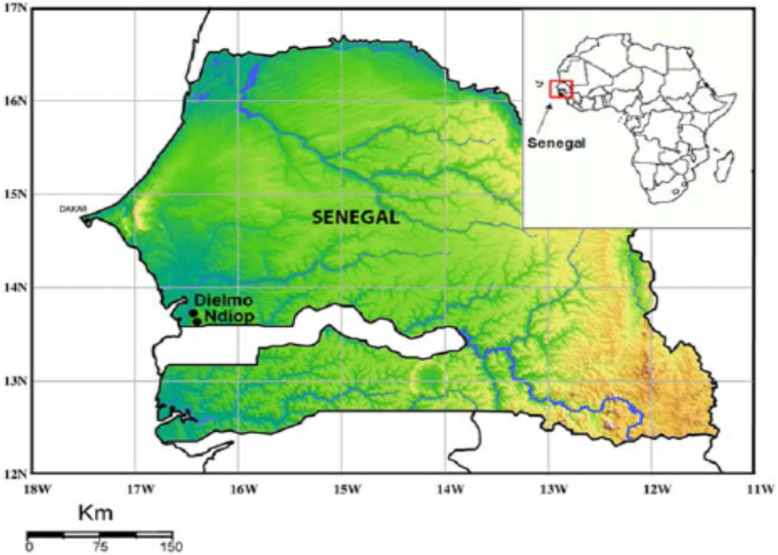
All 657 patients with a febrile pathological episode (FPE) between January 2013 and December 2016 were followed in a cohort study in two rural villages in Senegal, accounting for 1653 FPE observations with nasopharyngeal sampling and influenza virus screening by rRT-PCR. For each FPE, general characteristics and clinical signs presented by patients were collected. Sensitivity, Specificity, Positive Predictive Value (PPV) and Negative Predictive Value (NPV) for the three ILI case definitions were assessed using PCR result as the reference test. Associations between clinical signs and influenza infection were analyzed using logistic regression with generalized estimating equations. Sore throat, arthralgia or myalgia were missing for children under 5 years.
WHO, CDC and ECDC case definitions had similar sensitivity (81.0%; 95%CI: 77.0-85.0) and NPV (91.0%; 95%CI: 89.0-93.1) while the WHO and CDC ILI case definitions had the highest specificity (52.0%; 95%CI: 49.1-54.5) and PPV (32.0%; 95%CI: 30.0-35.0). These performances varied by age groups. In children < 5 years, the significant predictors of influenza virus infection were cough and nasal discharge. In patients from 5 years, cough, nasal discharge, sore throat and asthenia grade 3 best predicted influenza infection. The addition of "nasal discharge" as a symptom to the WHO case definition decreased sensitivity but increased specificity, particularly in the pediatric population.
In summary, all three definitions studies (WHO, ECDC & CDC) have similar performance, even by age group. The revised WHO ILI definition could be chosen for surveillance purposes for its simplicity. Symptomatic predictors of influenza virus infection vary according the age group.
流感是非洲发病率和死亡率的主要原因。然而,该病理学仍然缺乏流行病学数据,并且用于哨点监测的流感样疾病 (ILI) 病例定义的性能从未在塞内加尔进行过评估。本研究旨在 i)评估世界卫生组织 (WHO)、美国疾病控制与预防中心 (CDC) 和欧洲疾病预防控制中心 (ECDC) 采用的三种不同的 ILI 病例定义的性能,以及 ii)确定与流感阳性诊断相关的临床因素,以便为塞内加尔的情况制定适合的算法。
2013 年 1 月至 2016 年 12 月期间,在塞内加尔两个农村村庄进行了一项队列研究,共对 657 名发热病患者(FPE)进行了随访,共观察到 1653 次 FPE,对其进行了鼻咽取样和实时逆转录聚合酶链反应(rRT-PCR)检测流感病毒。对每位 FPE,均收集了患者的一般特征和临床体征。使用 PCR 结果作为参考试验,评估了三种 ILI 病例定义的敏感性、特异性、阳性预测值 (PPV) 和阴性预测值 (NPV)。使用广义估计方程的逻辑回归分析了临床体征与流感感染之间的关联。5 岁以下儿童缺失咽痛、关节痛或肌痛。
WHO、CDC 和 ECDC 病例定义的敏感性(81.0%;95%CI:77.0-85.0)和 NPV(91.0%;95%CI:89.0-93.1)相似,而 WHO 和 CDC 的 ILI 病例定义的特异性(52.0%;95%CI:49.1-54.5)和 PPV(32.0%;95%CI:30.0-35.0)最高。这些性能因年龄组而异。在<5 岁的儿童中,咳嗽和鼻分泌物是流感病毒感染的显著预测因素。在 5 岁以上的患者中,咳嗽、鼻分泌物、咽痛和乏力 3 级是流感感染的最佳预测因素。将“鼻分泌物”作为症状添加到 WHO 病例定义中会降低敏感性,但会提高特异性,尤其是在儿科人群中。
总之,所有三种定义(WHO、ECDC 和 CDC)的表现都相似,甚至按年龄组划分也是如此。鉴于其简单性,修订后的 WHO ILI 定义可用于监测目的。流感病毒感染的症状预测因素因年龄组而异。