• 文献检索
  • 文档翻译
  • 深度研究
  • 学术资讯
  • Suppr Zotero 插件Zotero 插件
  • 邀请有礼
  • 套餐&价格
  • 历史记录
应用&插件
Suppr Zotero 插件Zotero 插件浏览器插件Mac 客户端Windows 客户端微信小程序
定价
高级版会员购买积分包购买API积分包
服务
文献检索文档翻译深度研究API 文档MCP 服务
关于我们
关于 Suppr公司介绍联系我们用户协议隐私条款
关注我们

Suppr 超能文献

核心技术专利:CN118964589B侵权必究
粤ICP备2023148730 号-1Suppr @ 2026

文献检索

告别复杂PubMed语法,用中文像聊天一样搜索,搜遍4000万医学文献。AI智能推荐,让科研检索更轻松。

立即免费搜索

文件翻译

保留排版,准确专业,支持PDF/Word/PPT等文件格式,支持 12+语言互译。

免费翻译文档

深度研究

AI帮你快速写综述,25分钟生成高质量综述,智能提取关键信息,辅助科研写作。

立即免费体验

多米尼加共和国地方性和新出现的蚊媒传染病暴发的非同步性。

Asynchronicity of endemic and emerging mosquito-borne disease outbreaks in the Dominican Republic.

机构信息

Department of Epidemiology of Microbial Diseases, Yale School of Public Health, New Haven, CT, 06510, USA.

Department of Zoology, University of Oxford, Oxford, United Kingdom.

出版信息

Nat Commun. 2021 Jan 8;12(1):151. doi: 10.1038/s41467-020-20391-x.

DOI:10.1038/s41467-020-20391-x
PMID:33420058
原文链接:https://pmc.ncbi.nlm.nih.gov/articles/PMC7794562/
Abstract

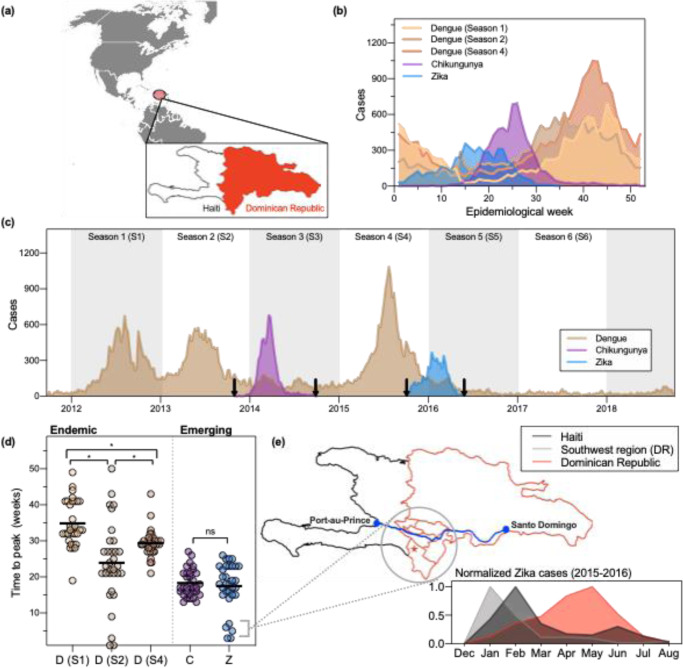
Mosquito-borne viruses threaten the Caribbean due to the region's tropical climate and seasonal reception of international tourists. Outbreaks of chikungunya and Zika have demonstrated the rapidity with which these viruses can spread. Concurrently, dengue fever cases have climbed over the past decade. Sustainable disease control measures are urgently needed to quell virus transmission and prevent future outbreaks. Here, to improve upon current control methods, we analyze temporal and spatial patterns of chikungunya, Zika, and dengue outbreaks reported in the Dominican Republic between 2012 and 2018. The viruses that cause these outbreaks are transmitted by Aedes mosquitoes, which are sensitive to seasonal climatological variability. We evaluate whether climate and the spatio-temporal dynamics of dengue outbreaks could explain patterns of emerging disease outbreaks. We find that emerging disease outbreaks were robust to the climatological and spatio-temporal constraints defining seasonal dengue outbreak dynamics, indicating that constant surveillance is required to prevent future health crises.

摘要

由于加勒比地区的热带气候和季节性接待国际游客,蚊媒病毒对其构成威胁。基孔肯雅热和寨卡热的爆发表明这些病毒传播的速度有多快。与此同时,登革热病例在过去十年中攀升。迫切需要可持续的疾病控制措施来遏制病毒传播并防止未来的爆发。在这里,为了改进当前的控制方法,我们分析了 2012 年至 2018 年期间多米尼加共和国报告的基孔肯雅热、寨卡热和登革热爆发的时间和空间模式。导致这些爆发的病毒由对季节性气候变异性敏感的伊蚊传播。我们评估气候和登革热爆发的时空动态是否可以解释新出现疾病爆发的模式。我们发现,新出现的疾病爆发对定义季节性登革热爆发动态的气候和时空限制具有稳健性,这表明需要进行持续监测,以防止未来的健康危机。
https://cdn.ncbi.nlm.nih.gov/pmc/blobs/d9ac/7794562/e55999fa6d8a/41467_2020_20391_Fig5_HTML.jpg
https://cdn.ncbi.nlm.nih.gov/pmc/blobs/d9ac/7794562/da15f3815744/41467_2020_20391_Fig1_HTML.jpg
https://cdn.ncbi.nlm.nih.gov/pmc/blobs/d9ac/7794562/ebc7759f3b8f/41467_2020_20391_Fig2_HTML.jpg
https://cdn.ncbi.nlm.nih.gov/pmc/blobs/d9ac/7794562/a38297b5573f/41467_2020_20391_Fig3_HTML.jpg
https://cdn.ncbi.nlm.nih.gov/pmc/blobs/d9ac/7794562/6ca4de644a4b/41467_2020_20391_Fig4_HTML.jpg
https://cdn.ncbi.nlm.nih.gov/pmc/blobs/d9ac/7794562/e55999fa6d8a/41467_2020_20391_Fig5_HTML.jpg
https://cdn.ncbi.nlm.nih.gov/pmc/blobs/d9ac/7794562/da15f3815744/41467_2020_20391_Fig1_HTML.jpg
https://cdn.ncbi.nlm.nih.gov/pmc/blobs/d9ac/7794562/ebc7759f3b8f/41467_2020_20391_Fig2_HTML.jpg
https://cdn.ncbi.nlm.nih.gov/pmc/blobs/d9ac/7794562/a38297b5573f/41467_2020_20391_Fig3_HTML.jpg
https://cdn.ncbi.nlm.nih.gov/pmc/blobs/d9ac/7794562/6ca4de644a4b/41467_2020_20391_Fig4_HTML.jpg
https://cdn.ncbi.nlm.nih.gov/pmc/blobs/d9ac/7794562/e55999fa6d8a/41467_2020_20391_Fig5_HTML.jpg

相似文献

1
Asynchronicity of endemic and emerging mosquito-borne disease outbreaks in the Dominican Republic.多米尼加共和国地方性和新出现的蚊媒传染病暴发的非同步性。
Nat Commun. 2021 Jan 8;12(1):151. doi: 10.1038/s41467-020-20391-x.
2
Spatio-temporal coherence of dengue, chikungunya and Zika outbreaks in Merida, Mexico.墨西哥梅里达登革热、基孔肯雅热和寨卡病毒暴发的时空一致性。
PLoS Negl Trop Dis. 2018 Mar 15;12(3):e0006298. doi: 10.1371/journal.pntd.0006298. eCollection 2018 Mar.
3
Epidemiology of Dengue, Chikungunya, and Zika Virus Disease in U.S. States and Territories, 2017.2017 年美国各州和领地登革热、基孔肯雅热和 Zika 病毒病的流行病学。
Am J Trop Med Hyg. 2019 Oct;101(4):884-890. doi: 10.4269/ajtmh.19-0309.
4
Estimating the risk of Dengue, Chikungunya and Zika outbreaks in a large European city.估算一个大型欧洲城市登革热、基孔肯雅热和寨卡病毒爆发的风险。
Sci Rep. 2018 Nov 6;8(1):16435. doi: 10.1038/s41598-018-34664-5.
5
A comparison of Zika and dengue outbreaks using national surveillance data in the Dominican Republic.使用多米尼加共和国的国家监测数据对寨卡和登革热疫情进行比较。
PLoS Negl Trop Dis. 2018 Nov 5;12(11):e0006876. doi: 10.1371/journal.pntd.0006876. eCollection 2018 Nov.
6
Vector competence of Aedes aegypti from Havana, Cuba, for dengue virus type 1, chikungunya, and Zika viruses.古巴哈瓦那埃及伊蚊对登革热病毒 1 型、基孔肯雅热病毒和寨卡病毒的媒介效能。
PLoS Negl Trop Dis. 2020 Dec 3;14(12):e0008941. doi: 10.1371/journal.pntd.0008941. eCollection 2020 Dec.
7
Concurrent outbreaks of dengue, chikungunya and Zika virus infections - an unprecedented epidemic wave of mosquito-borne viruses in the Pacific 2012-2014.登革热、基孔肯雅热和寨卡病毒感染的同时爆发——2012 - 2014年太平洋地区前所未有的蚊媒病毒流行浪潮。
Euro Surveill. 2014 Oct 16;19(41):20929. doi: 10.2807/1560-7917.es2014.19.41.20929.
8
Seasonal temperature variation influences climate suitability for dengue, chikungunya, and Zika transmission.季节性温度变化影响登革热、基孔肯雅热和寨卡病毒传播的气候适宜性。
PLoS Negl Trop Dis. 2018 May 10;12(5):e0006451. doi: 10.1371/journal.pntd.0006451. eCollection 2018 May.
9
Climate-driven mosquito-borne viral suitability index: measuring risk transmission of dengue, chikungunya and Zika in Mexico.气候驱动的蚊媒病毒适宜性指数:评估登革热、基孔肯雅热和寨卡病毒在墨西哥的传播风险。
Int J Health Geogr. 2022 Oct 27;21(1):15. doi: 10.1186/s12942-022-00317-0.
10
Experimental Zika virus infection in : Susceptibility, transmission & co-infection with dengue & chikungunya viruses.在 …… 中进行的 Zika 病毒感染实验:易感性、传播以及与登革热和基孔肯雅热病毒的合并感染。
Indian J Med Res. 2018 Jan;147(1):88-96. doi: 10.4103/ijmr.IJMR_1142_17.

引用本文的文献

1
The Seasonality and Spatial Landscape of the Historical Climate-Based Suitability of -Borne Viruses in Four Atlantic Archipelagos.基于历史气候的四种大西洋群岛虫媒病毒适宜性的季节性和空间格局
Viruses. 2025 May 30;17(6):799. doi: 10.3390/v17060799.
2
Navigating double burden: Community health workers in rural Dominican Republic living and working through the epidemiologic transition.应对双重负担:多米尼加共和国农村地区的社区卫生工作者在流行病学转变中生活与工作。
PLOS Glob Public Health. 2025 Apr 29;5(4):e0004378. doi: 10.1371/journal.pgph.0004378. eCollection 2025.
3
Dengue virus transmission in Italy: historical trends up to 2023 and a data repository into the future.

本文引用的文献

1
A survey of tire-breeding mosquitoes (Diptera: Culicidae) in the Dominican Republic: Considerations about a pressing issue.多米尼加共和国轮胎滋生蚊虫(双翅目:蚊科)调查:对一个紧迫问题的思考。
Biomedica. 2020 Sep 1;40(3):507-515. doi: 10.7705/biomedica.5200.
2
MVSE: An R-package that estimates a climate-driven mosquito-borne viral suitability index.MVSE:一个用于估算气候驱动的蚊媒病毒适宜性指数的R软件包。
Methods Ecol Evol. 2019 Aug;10(8):1357-1370. doi: 10.1111/2041-210X.13205. Epub 2019 Jun 19.
3
Vector competence of Aedes aegypti, Aedes albopictus, and Culex quinquefasciatus mosquitoes for Mayaro virus.
意大利的登革热病毒传播:截至2023年的历史趋势及未来的数据存储库。
Sci Data. 2024 Dec 5;11(1):1325. doi: 10.1038/s41597-024-04162-7.
4
The Impact of Climate on Human Dengue Infections in the Caribbean.气候对加勒比地区人类登革热感染的影响。
Pathogens. 2024 Sep 3;13(9):756. doi: 10.3390/pathogens13090756.
5
A Review of the Latest Control Strategies for Mosquito-Borne Diseases.蚊媒疾病最新防控策略综述
China CDC Wkly. 2024 Aug 16;6(33):852-856. doi: 10.46234/ccdcw2024.183.
6
North-south pathways, emerging variants, and high climate suitability characterize the recent spread of dengue virus serotypes 2 and 3 in the Dominican Republic.南北向传播途径、新兴变异株和较高的气候适宜性是导致登革病毒血清型 2 和 3 在多米尼加共和国近期传播的特征。
BMC Infect Dis. 2024 Jul 29;24(1):751. doi: 10.1186/s12879-024-09658-6.
7
North-south pathways, emerging variants, and high climate suitability characterize the recent spread of dengue virus serotypes 2 and 3 in the Dominican Republic.南北传播路径、新出现的变异毒株以及高度的气候适宜性是登革热病毒2型和3型近期在多米尼加共和国传播的特征。
medRxiv. 2024 Feb 15:2024.02.14.24302795. doi: 10.1101/2024.02.14.24302795.
8
Genomic epidemiology unveils the dynamics and spatial corridor behind the Yellow Fever virus outbreak in Southern Brazil.基因组流行病学揭示了巴西南部黄热病病毒爆发的动态和空间传播途径。
Sci Adv. 2023 Sep;9(35):eadg9204. doi: 10.1126/sciadv.adg9204. Epub 2023 Sep 1.
9
Spatiotemporal and meteorological relationships in dengue transmission in the Dominican Republic, 2015-2019.2015 - 2019年多米尼加共和国登革热传播中的时空与气象关系
Trop Med Health. 2023 Jun 2;51(1):32. doi: 10.1186/s41182-023-00517-9.
10
Global transmission suitability maps for dengue virus transmitted by Aedes aegypti from 1981 to 2019.全球登革热病毒通过埃及伊蚊传播的适宜性地图(1981 年至 2019 年)。
Sci Data. 2023 May 12;10(1):275. doi: 10.1038/s41597-023-02170-7.
埃及伊蚊、白纹伊蚊和致倦库蚊对马亚罗病毒的媒介效能。
PLoS Negl Trop Dis. 2020 Apr 14;14(4):e0007518. doi: 10.1371/journal.pntd.0007518. eCollection 2020 Apr.
4
Influence of herd immunity in the cyclical nature of arboviruses.群体免疫在虫媒病毒周期性特征中的影响。
Curr Opin Virol. 2020 Feb;40:1-10. doi: 10.1016/j.coviro.2020.02.004. Epub 2020 Mar 17.
5
Impact of temperature on the extrinsic incubation period of Zika virus in Aedes aegypti.温度对埃及伊蚊中寨卡病毒外潜伏期的影响。
PLoS Negl Trop Dis. 2020 Mar 18;14(3):e0008047. doi: 10.1371/journal.pntd.0008047. eCollection 2020 Mar.
6
Mayaro virus in Latin America and the Caribbean.拉丁美洲和加勒比地区的马亚罗病毒。
Rev Panam Salud Publica. 2020 Feb 11;44:e14. doi: 10.26633/RPSP.2020.14. eCollection 2020.
7
Reviewing estimates of the basic reproduction number for dengue, Zika and chikungunya across global climate zones.审查全球气候带登革热、寨卡和基孔肯雅热基本繁殖数的估计值。
Environ Res. 2020 Mar;182:109114. doi: 10.1016/j.envres.2020.109114. Epub 2020 Jan 3.
8
Identifying signatures of the impact of rotavirus vaccines on hospitalizations using sentinel surveillance data from Latin American countries.利用拉丁美洲国家的哨点监测数据,识别轮状病毒疫苗对住院的影响特征。
Vaccine. 2020 Jan 10;38(2):323-329. doi: 10.1016/j.vaccine.2019.10.010. Epub 2019 Oct 28.
9
Space-time dynamics of a triple epidemic: dengue, chikungunya and Zika clusters in the city of Rio de Janeiro.时空动态三重流行:里约热内卢市登革热、基孔肯雅热和寨卡病毒集群。
Proc Biol Sci. 2019 Oct 9;286(1912):20191867. doi: 10.1098/rspb.2019.1867.
10
Travel Surveillance and Genomics Uncover a Hidden Zika Outbreak during the Waning Epidemic.旅行监测和基因组学揭示了寨卡疫情消退期间的一次隐性暴发。
Cell. 2019 Aug 22;178(5):1057-1071.e11. doi: 10.1016/j.cell.2019.07.018.