Sharma Deepshikha, Aggarwal Arun Kumar, Downey Laura E, Prinja Shankar
Department of Community Medicine and School of Public Health, Post Graduate Institute of Medical Education and Research, Chandigarh, 160012, India.
School of Public Health, Imperial College, London, UK.
Pharmacoecon Open. 2021 Sep;5(3):349-364. doi: 10.1007/s41669-020-00250-7. Epub 2021 Jan 10.
Globally, a number of countries have developed guidelines that describe the design and conduct of economic evaluations as part of health technology assessment (HTA) or pharmacoeconomic analysis for decision making. The current scoping review was undertaken with an objective to summarize the recommendations made on methods of economic evaluation by the national healthcare economic evaluation (HEE) guidelines.
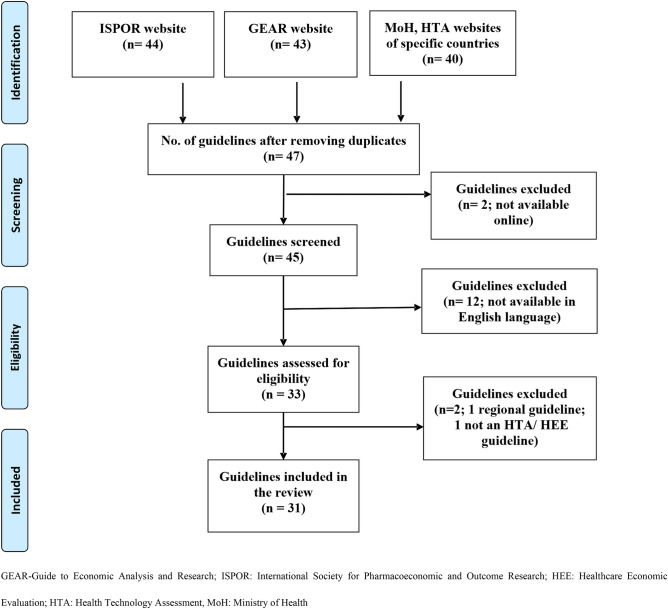
A comprehensive search was undertaken in the website repositories of the International Society for Pharmacoeconomic and Outcomes Research (ISPOR) and Guide to Economic Analysis and Research (GEAR), and websites of national HTA agencies and ministries of health of individual countries. All guidelines in the English language were included in this review. Data were extracted with respect to general and methodological characteristics, and a descriptive analysis of recommendations made across the countries was undertaken.
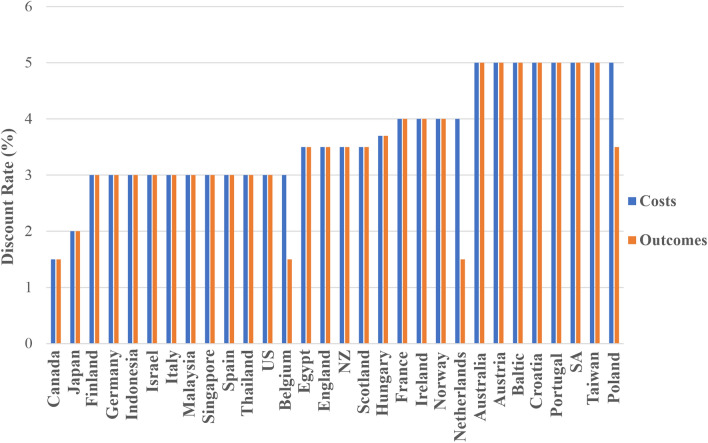
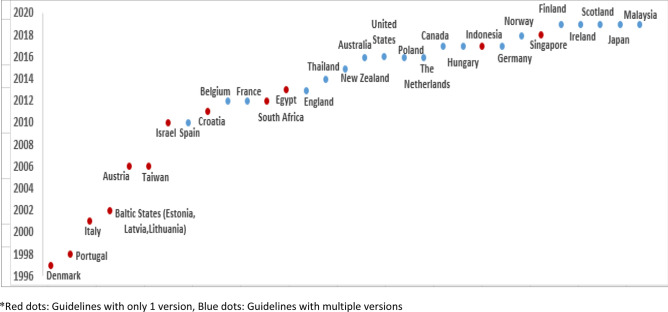
Overall, our review included 31 national HEE guidelines, published between 1997 and August 2020. Nearly half (45%) of the guidelines targeted the evaluation of pharmaceuticals. The nature of the guidelines was either mandatory (31%), recommendatory (42%), or voluntary (16%). There was a substantial consensus among the guidelines on several key principles, including type of economic evaluation (cost-utility analysis), time horizon of the analysis (long enough), health outcome measure (quality-adjusted life-years) and use of sensitivity analyses. The recommendations on study perspective, comparator, discount rate and type of costs to be included (particularly the inclusion of indirect costs) varied widely.
Despite similarity in the overall processes, variation in several recommendations given by various national HEE guidelines was observed. This is perhaps unsurprising given the differences in the health systems and financing mechanisms, capacity of local researchers, and data availability. This review offers important lessons and a starting point for countries that are planning to develop their own HEE guidelines.
在全球范围内,许多国家已制定指南,将经济评估的设计与实施描述为卫生技术评估(HTA)或药物经济学分析的一部分,用于决策。本次范围综述旨在总结国家卫生保健经济评估(HEE)指南对经济评估方法提出的建议。
在国际药物经济学与结果研究协会(ISPOR)和经济分析与研究指南(GEAR)的网站资料库,以及各国的国家卫生技术评估机构和卫生部网站上进行了全面搜索。本次综述纳入了所有英文指南。提取了有关一般特征和方法学特征的数据,并对各国提出的建议进行了描述性分析。
总体而言,我们的综述纳入了1997年至2020年8月期间发布的31项国家卫生保健经济评估指南。近一半(45%)的指南针对药品评估。这些指南的性质要么是强制性的(31%)、推荐性的(42%),要么是自愿性的(16%)。在几个关键原则上,这些指南达成了相当程度的共识,包括经济评估类型(成本效用分析)、分析的时间跨度(足够长)、健康结果指标(质量调整生命年)以及敏感性分析的使用。关于研究视角、对照物、贴现率和应纳入的成本类型(特别是间接成本的纳入)的建议差异很大。
尽管总体流程相似,但观察到各国卫生保健经济评估指南给出的若干建议存在差异。鉴于卫生系统和融资机制、当地研究人员能力以及数据可用性的差异,这或许并不令人意外。本综述为计划制定本国卫生保健经济评估指南的国家提供了重要经验教训和起点。