Foley Bridget C, Owen Katherine B, Bauman Adrian E, Bellew William, Reece Lindsey J
SPRINTER (Sport and Active Recreation Intervention & Epidemiology Research Group), Prevention Research Collaboration, Sydney School of Public Health, Faculty of Medicine and Health, D17 Charles Perkins Centre, The University of Sydney, Level 6, the Hub, Camperdown, NSW, 2006, Australia.
BMC Public Health. 2021 Jan 11;21(1):22. doi: 10.1186/s12889-020-10060-5.
There is an urgent need for scaled-up effective interventions which overcome barriers to health-enhancing physical activity for children and adolescents. In New South Wales (NSW), Australia, the state government implemented a universal voucher program, 'Active Kids' to support the cost of structured physical activity registration for school-enrolled children aged 4.5-18 years old. The objective of this study was to understand the effects a financial incentive intervention delivered in a real-world setting has on children and adolescent's physical activity participation.
In 2018, all children and adolescents registered for an Active Kids voucher provided sociodemographic characteristics, physical activity and research consent. This prospective cohort study used an online survey with validated items to measure physical activity and other personal and social factors in children and adolescents who used an Active Kids voucher. Generalized linear mixed models were used to examine changes from registration to after voucher use at ≤8 weeks, 9-26 weeks and ≥ 6 months.
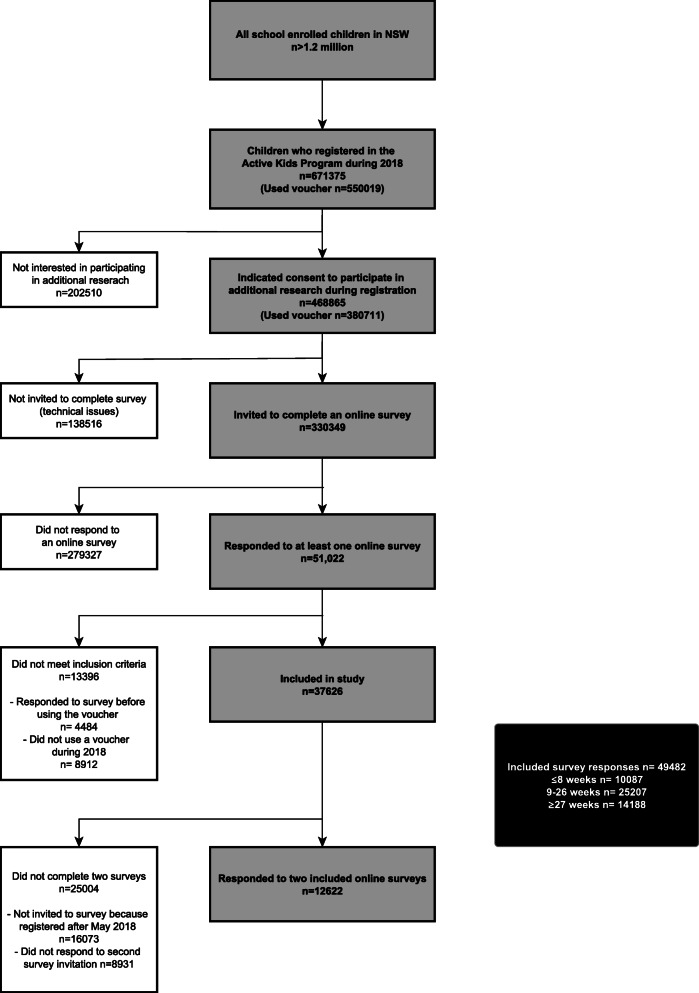
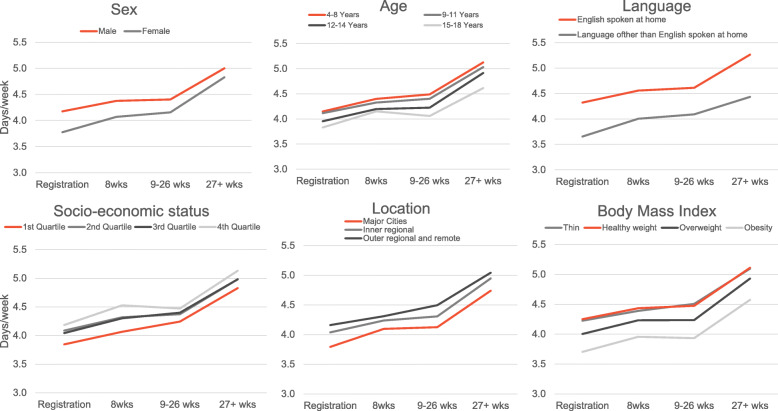
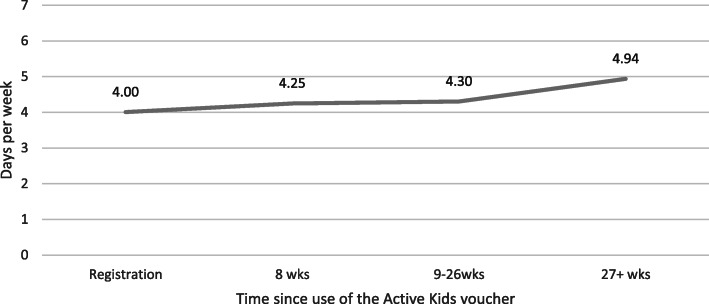
Study participants reported increasing their days achieving physical activity guidelines from 4.0 days per week (95%CI 3.8, 4.2) at registration (n = 37,626 children) to 4.9 days per week (95%CI 4.7, 5.1) after 6 months (n = 14,118 children). Increased physical activity was observed for all sociodemographic population groups. The voucher-specific activity contributed 42.4% (95%CI 39.3, 45.5) to the total time children participated in structured physical activities outside of school. Children and adolescents who increased to, or maintained, high levels of activity were socially supported to be active, had active parent/caregivers, had better concentration and were overall happier than their low-active counterparts.
The Active Kids program significantly increased children's physical activity levels and these increases continued over a six-month period. The Active Kids voucher program shows promise as a scaled-up intervention to increase children and adolescents' physical activity participation.
Australian New Zealand Clinical Trial Registry ACTRN12618000897268 , approved May 29th, 2018 - Retrospectively registered.
迫切需要扩大有效的干预措施,以克服儿童和青少年增强健康的体育活动障碍。在澳大利亚新南威尔士州(NSW),州政府实施了一项通用代金券计划“活力儿童”,以支持4.5至18岁在校儿童参加有组织体育活动的注册费用。本研究的目的是了解在现实环境中实施的经济激励干预措施对儿童和青少年体育活动参与的影响。
2018年,所有注册“活力儿童”代金券的儿童和青少年提供了社会人口学特征、体育活动情况并同意参与研究。这项前瞻性队列研究使用经过验证的在线调查问卷,来测量使用“活力儿童”代金券的儿童和青少年的体育活动以及其他个人和社会因素。使用广义线性混合模型来研究从注册到使用代金券后≤8周、9 - 26周和≥6个月的变化情况。
研究参与者报告称,在注册时(n = 37626名儿童),每周达到体育活动指南标准的天数为4.0天(95%置信区间3.8, 4.2),6个月后(n = 14118名儿童)增加到每周4.9天(95%置信区间4.7, 5.1)。所有社会人口群体的体育活动均有所增加。代金券特定活动对儿童在校外参加有组织体育活动的总时间贡献了42.4%(95%置信区间39.3, 45.5)。与低活动水平的儿童和青少年相比,增加或保持高活动水平的儿童和青少年在社交方面得到支持以保持活跃,有积极参与的父母/照顾者,注意力更集中,总体上更快乐。
“活力儿童”计划显著提高了儿童的体育活动水平,且这些增长在六个月内持续存在。“活力儿童”代金券计划有望作为一项扩大规模的干预措施,以增加儿童和青少年的体育活动参与度。
澳大利亚新西兰临床试验注册中心ACTRN12618000897268,于2018年5月29日批准 - 回顾性注册。