Souza Cristiane, Garrido Margarida V, Carmo Joana C
Iscte-Instituto Universitário de Lisboa, Cis-IUL, Lisbon, Portugal.
Faculdade de Psicologia, Universidade de Lisboa, Lisbon, Portugal.
Front Psychol. 2020 Dec 4;11:573314. doi: 10.3389/fpsyg.2020.573314. eCollection 2020.
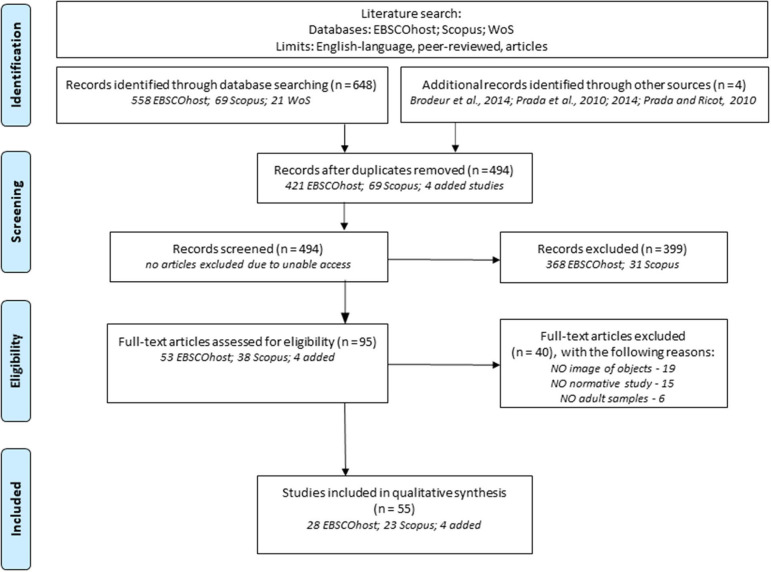
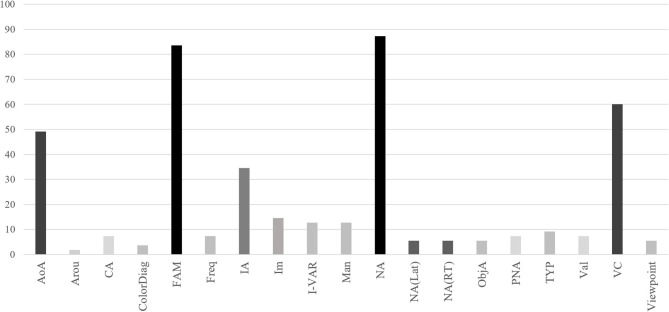
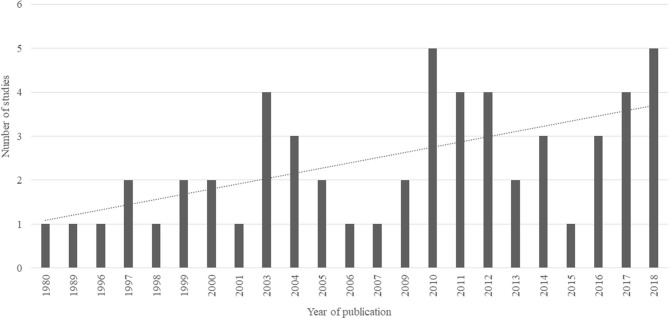
Common objects comprise living and non-living things people interact with in their daily-lives. Images depicting common objects are extensively used in different fields of research and intervention, such as linguistics, psychology, and education. Nevertheless, their adequate use requires the consideration of several factors (e.g., item-differences, cultural-context and confounding correlated variables), and careful validation procedures. The current study presents a systematic review of the available published norms for images of common objects. A systematic search using PRISMA guidelines indicated that despite their extensive use, the production of norms for such stimuli with adult populations is quite limited ( = 55), particularly for more ecological images, such as photos ( = 14). Among the several dimensions in which the items were assessed, the most commonly referred in our sample were familiarity, visual complexity and name agreement, illustrating some consistency across the reported dimensions while also indicating the limited examination of other potentially relevant dimensions for image processing. The lack of normative studies simultaneously examining affective, perceptive and semantic dimensions was also documented. The number of such normative studies has been increasing in the last years and published in relevant peer-reviewed journals. Moreover, their datasets and norms have been complying with current open science practices. Nevertheless, they are still scarcely cited and replicated in different linguistic and cultural contexts. The current study brings important theoretical contributions by characterizing images of common objects stimuli and their culturally-based norms while highlighting several important features that are likely to be relevant for future stimuli selection and evaluative procedures. The systematic scrutiny of these normative studies is likely to stimulate the production of new, robust and contextually-relevant normative datasets and to provide tools for enhancing the quality of future research and intervention.
常见物体包括人们在日常生活中与之互动的生物和非生物。描绘常见物体的图像广泛应用于不同的研究和干预领域,如语言学、心理学和教育。然而,要恰当地使用它们,需要考虑几个因素(如项目差异、文化背景和混杂的相关变量)以及仔细的验证程序。本研究对现有的常见物体图像已发表规范进行了系统综述。使用PRISMA指南进行的系统检索表明,尽管这些图像被广泛使用,但针对成年人群体的此类刺激规范的制定相当有限( = 55),特别是对于更具生态性的图像,如照片( = 14)。在所评估项目的几个维度中,我们样本中最常提及的是熟悉度、视觉复杂度和名称一致性,这表明在报告的维度上存在一些一致性,同时也表明对图像处理其他潜在相关维度的研究有限。还记录了缺乏同时考察情感、感知和语义维度的规范性研究。近年来,此类规范性研究的数量一直在增加,并发表在相关的同行评审期刊上。此外,它们的数据集和规范符合当前的开放科学实践。然而,它们在不同的语言和文化背景下仍然很少被引用和复制。本研究通过对常见物体刺激图像及其基于文化的规范进行特征描述,做出了重要的理论贡献,同时突出了几个可能与未来刺激选择和评估程序相关的重要特征。对这些规范性研究的系统审查可能会刺激新的、强大的和与上下文相关的规范性数据集的产生,并为提高未来研究和干预的质量提供工具。