Appetite Control and Energy Balance Research Group, School of Psychology, University of Leeds, Leeds LS2 9JT, UK.
School of Food Science and Nutrition, University of Leeds, Leeds LS2 9JT, UK.
Nutrients. 2021 Jan 9;13(1):182. doi: 10.3390/nu13010182.
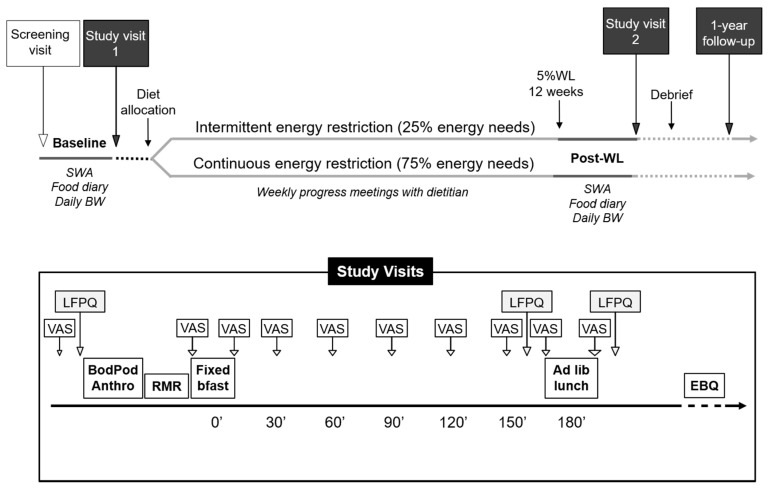
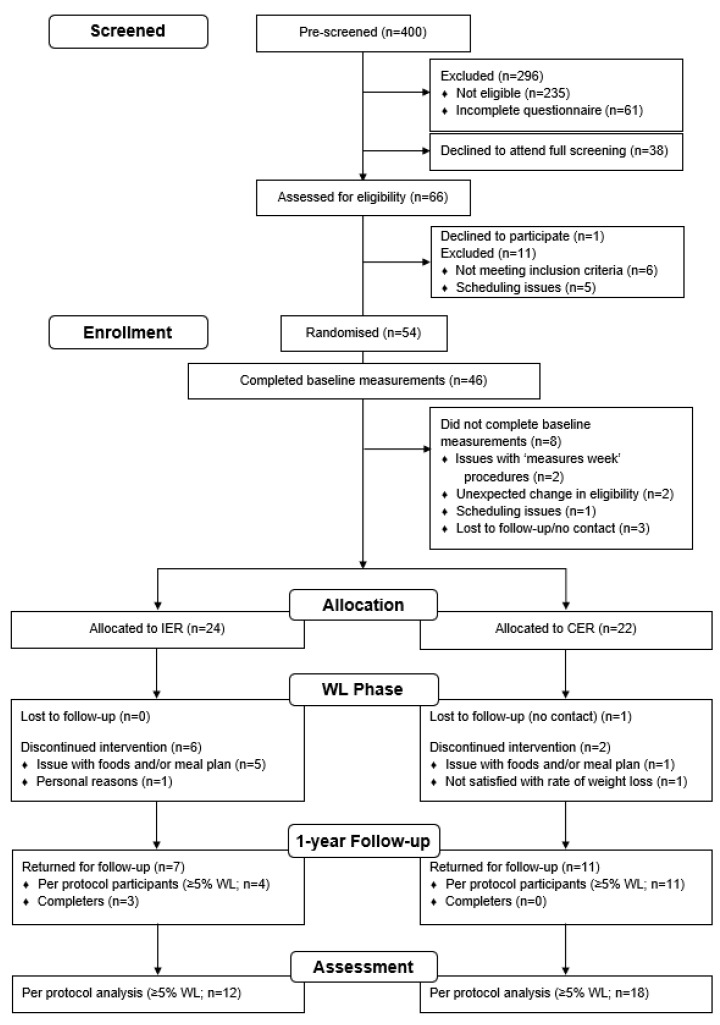
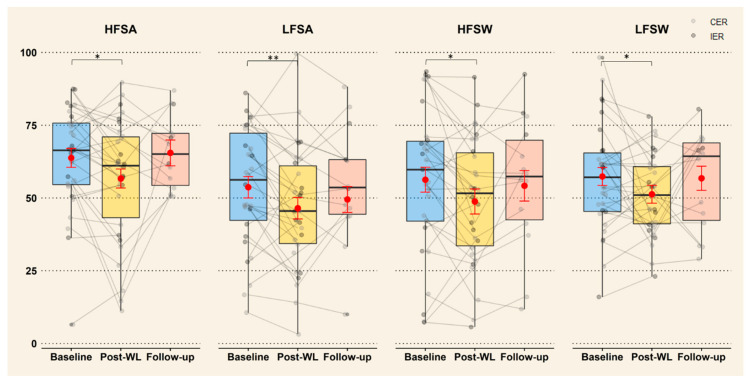
Food reward (i.e., liking and wanting) has been shown to decrease after different types of weight management interventions. However, it is unknown whether specific dietary modalities (continuous (CER) vs. intermittent (IER) energy restriction) have differing effects on liking and implicit wanting after weight loss (WL) and whether these changes are sustained after 1-year of no-contact. Women with overweight or obesity (age 18-55 years) were randomly allocated to controlled-feeding CER (25% daily energy restriction) or IER (alternating ad libitum and 75% energy restriction days). Study visits were conducted at baseline, post-WL (to ≥5% WL within 12 weeks) and 1-year post-WL. The main outcomes were liking and implicit wanting for 4 categories of common food varying in fat and taste assessed by the Leeds Food Preference Questionnaire. Linear mixed models were conducted on the 30 participants achieving ≥5% WL and 15 returners. After an initial WL of -5.1 ± 0.2 kg, after 1-year 2.6 ± 0.5 kg were regained. Liking but not wanting decreased after WL. Food reward after 1-year did not differ from baseline, but the high loss to follow-up prevents generalization. IER and CER did not differ in their effects on food reward during WL or at 1-year follow-up.
食物奖赏(即喜好和欲望)已被证明在不同类型的体重管理干预后会降低。然而,尚不清楚特定的饮食模式(连续(CER)与间歇性(IER)能量限制)对减肥(WL)后喜好和内隐欲望有何不同影响,以及这些变化在 1 年无接触后是否持续。超重或肥胖的女性(年龄 18-55 岁)被随机分配到控制喂养 CER(每日能量限制 25%)或 IER(随意和 75%能量限制日交替)。研究访问在基线、WL 后(12 周内至少 WL 5%)和 WL 后 1 年进行。主要结局是通过利兹食物偏好问卷评估的 4 类常见食物的喜好和内隐欲望,这些食物在脂肪和口味上有所不同。对达到≥5%WL 的 30 名参与者和 15 名回归者进行了线性混合模型分析。在初始 WL -5.1 ± 0.2 kg 后,1 年后又增加了 2.6 ± 0.5 kg。WL 后,喜好但不渴望降低。1 年后的食物奖赏与基线无差异,但随访失访率高,无法推广。IER 和 CER 在 WL 期间或 1 年随访期间对食物奖赏的影响没有差异。