Department of Medical, Surgical and Experimental Sciences, University of Sassari, Viale San Pietro 43, 07100 Sassari, Italy.
Department of Biomedical Sciences, University of Sassari, Viale San Pietro 43b, 07100 Sassari, Italy.
Int J Mol Sci. 2021 Jan 9;22(2):612. doi: 10.3390/ijms22020612.
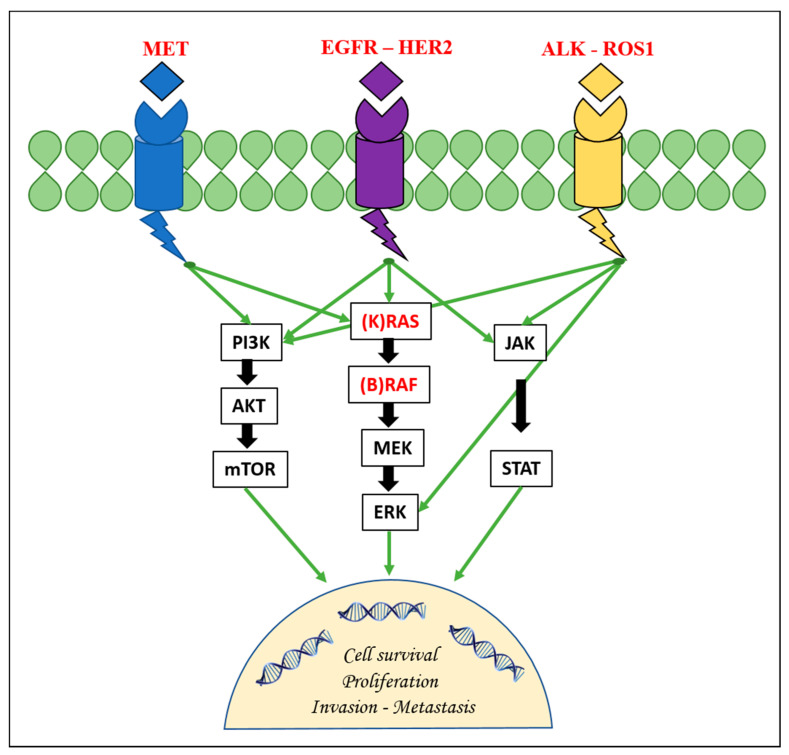
Lung cancer is the leading cause of death for malignancy worldwide. Its molecular profiling has enriched our understanding of cancer initiation and progression and has become fundamental to provide guidance on treatment with targeted therapies. Testing the presence of driver mutations in specific genes in lung tumors has thus radically changed the clinical management and outcomes of the disease. Numerous studies performed with traditional sequencing methods have investigated the occurrence of such mutations in lung cancer, and new insights regarding their frequency and clinical significance are continuously provided with the use of last generation sequencing technologies. In this review, we discuss the molecular epidemiology of the main druggable genetic alterations in non-small cell lung cancer, namely , , , , and mutations or amplification, as well as and fusions. Furthermore, we investigated the predictive impact of these alterations on the outcomes of modern targeted therapies, their global prognostic significance, and their mutual interaction in cases of co-occurrence.
肺癌是全球恶性肿瘤死亡的主要原因。对其分子谱的分析丰富了我们对癌症发生和进展的认识,并成为提供靶向治疗指导的基础。因此,检测肺癌中特定基因的驱动突变的存在极大地改变了疾病的临床管理和结果。许多使用传统测序方法进行的研究调查了这些突变在肺癌中的发生情况,并且随着新一代测序技术的使用,不断提供有关其频率和临床意义的新见解。在这篇综述中,我们讨论了非小细胞肺癌中主要可用药理学遗传改变的分子流行病学,即 、 、 、 、 和 突变或扩增,以及 和 融合。此外,我们还研究了这些改变对现代靶向治疗结果的预测影响、它们的全球预后意义以及它们在共存情况下的相互作用。