Department of Molecular Medicine, Morsani College of Medicine, University of South Florida, Tampa, Florida, USA.
Department of Internal Medicine, Morsani College of Medicine, University of South Florida, Tampa, Florida, USA.
mBio. 2021 Jan 12;12(1):e01217-20. doi: 10.1128/mBio.01217-20.
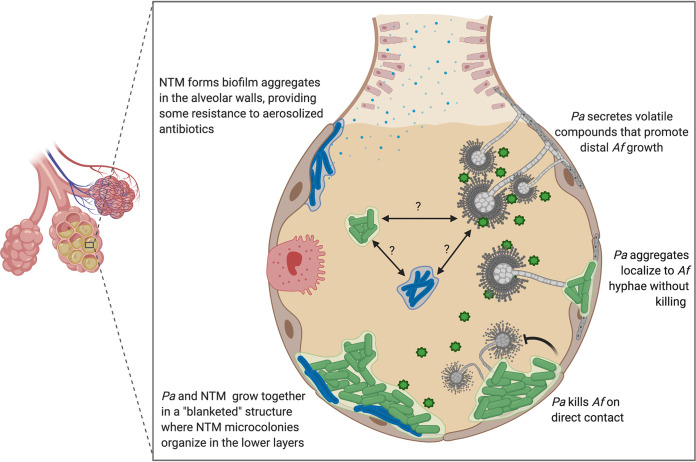
The survival rates of individuals with cystic fibrosis (CF) have significantly increased as a result of improved therapies, such as the inclusion of cystic fibrosis transmembrane conductance regulator (CFTR) modulators for some mutations. However, microbial infection of the airways remains a significant clinical problem. The well-known pathogens and continue to establish difficult-to-treat infections in the CF lung. However, in recent years, there has been an increased prevalence of both () and non-tuberculous mycobacteria (NTM) species isolated from CF patient sputa. The emergence of these pathogens opens an important area of discussion about multikingdom infections, specifically, how interspecies interactions have the potential to shape the course of infection, such as tolerance to host immune defenses and antimicrobial therapies. Their ability to establish themselves in an existing polymicrobial environment suggests to us that microbial interactions play a significant role, and characterizing these mechanisms and understanding their implications will be critical to the future development of better antimicrobial therapies. With this minireview, we hope to inspire conversations about and demonstrate the merit of more research in this area. Incidences of non-tuberculous mycobacteria (NTM) and have increased around the world over the past decade and have become a significant health threat to immunocompromised individuals such as those with cystic fibrosis (CF). CF is characterized by the buildup of mucus in the lungs which become chronically infected by a myriad of pathogens. The emergence of these pathogens in established infection sites raises many questions about the microbial ecosystems they become a part of, specifically how changes in these ecosystems impact disease outcomes. Understanding how microbial communities establish and maintain themselves despite medical treatment and host immune defenses will be critical for the development of improved therapeutic strategies.
囊性纤维化 (CF) 个体的生存率由于治疗方法的改进而显著提高,例如对某些突变体加入囊性纤维化跨膜电导调节体 (CFTR) 调节剂。然而,气道的微生物感染仍然是一个重大的临床问题。众所周知的病原体 和 继续在 CF 肺中引起难以治疗的感染。然而,近年来,从 CF 患者痰中分离出的 和非结核分枝杆菌 (NTM) 种的流行率都有所增加。这些病原体的出现开辟了一个关于多物种感染的重要讨论领域,特别是种间相互作用如何有可能影响感染过程,例如耐受宿主免疫防御和抗菌治疗。它们在现有多微生物环境中建立自己的能力向我们表明,微生物相互作用起着重要作用,描述这些机制并了解其影响将是未来开发更好的抗菌治疗方法的关键。通过这篇小综述,我们希望激发对此类问题的讨论并展示该领域更多研究的价值。在过去十年中,世界各地的非结核分枝杆菌 (NTM) 和 的发病率都有所增加,它们已成为免疫功能低下个体(如囊性纤维化 (CF) 患者)的重大健康威胁。CF 的特征是肺部黏液的积聚,这些黏液会被无数病原体慢性感染。这些病原体在已建立的感染部位出现引发了许多关于它们所进入的微生物生态系统的问题,特别是这些生态系统的变化如何影响疾病结果。了解微生物群落如何在医疗治疗和宿主免疫防御的情况下建立和维持自身,对于开发改进的治疗策略至关重要。