CAS Center for Excellence in Biotic Interactions, College of Life Science, University of Chinese Academy of Sciences, Beijing, 100049, China.
College of Life Science, Hebei Agricultural University, Baoding, 071001, China.
Cell Death Dis. 2021 Jan 12;12(1):71. doi: 10.1038/s41419-020-03314-y.
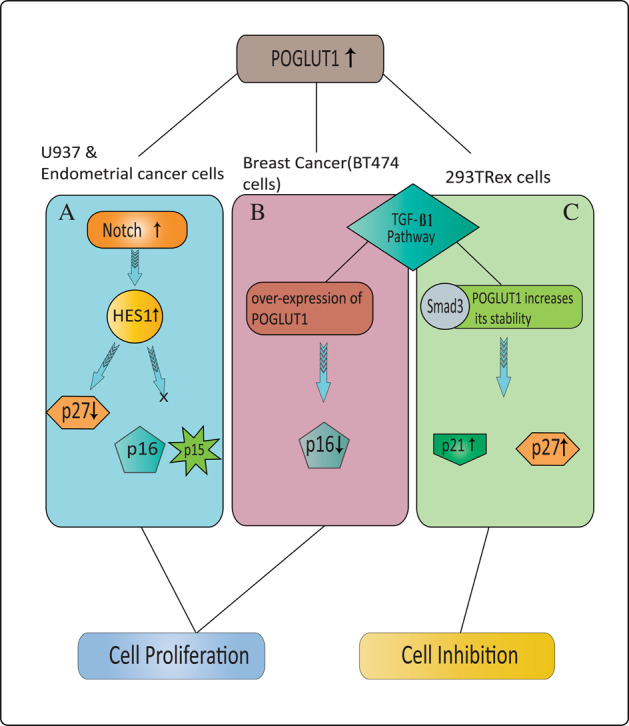
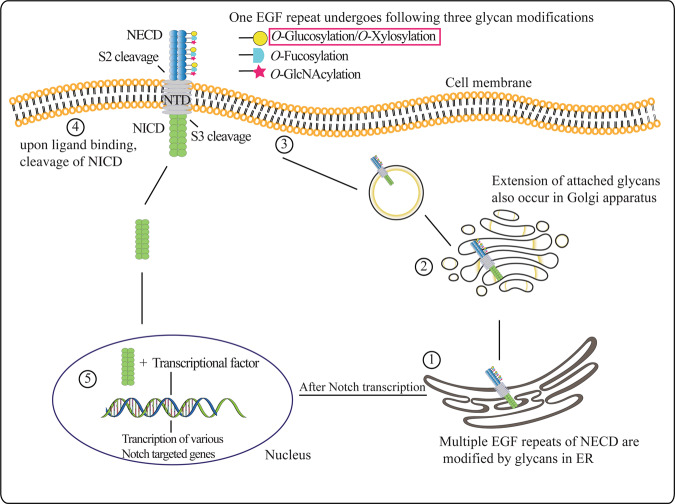
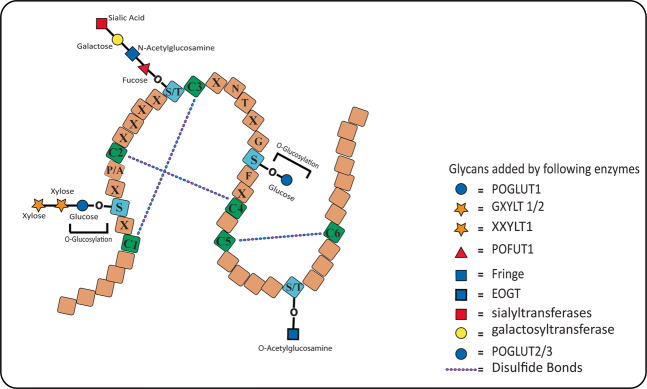
Protein O-glucosylation is a crucial form of O-glycosylation, which involves glucose (Glc) addition to a serine residue within a consensus sequence of epidermal growth factor epidermal growth factor (EGF)-like repeats found in several proteins, including Notch. Glc provides stability to EGF-like repeats, is required for S2 cleavage of Notch, and serves to regulate the trafficking of Notch, crumbs2, and Eyes shut proteins to the cell surface. Genetic and biochemical studies have shown a link between aberrant protein O-glucosylation and human diseases. The main players of protein O-glucosylation, protein O-glucosyltransferases (POGLUTs), use uridine diphosphate (UDP)-Glc as a substrate to modify EGF repeats and reside in the endoplasmic reticulum via C-terminal KDEL-like signals. In addition to O-glucosylation activity, POGLUTs can also perform protein O-xylosylation function, i.e., adding xylose (Xyl) from UDP-Xyl; however, both activities rely on residues of EGF repeats, active-site conformations of POGLUTs and sugar substrate concentrations in the ER. Impaired expression of POGLUTs has been associated with initiation and progression of human diseases such as limb-girdle muscular dystrophy, Dowling-Degos disease 4, acute myeloid leukemia, and hepatocytes and pancreatic dysfunction. POGLUTs have been found to alter the expression of cyclin-dependent kinase inhibitors (CDKIs), by affecting Notch or transforming growth factor-β1 signaling, and cause cell proliferation inhibition or induction depending on the particular cell types, which characterizes POGLUT's cell-dependent dual role. Except for a few downstream elements, the precise mechanisms whereby aberrant protein O-glucosylation causes diseases are largely unknown, leaving behind many questions that need to be addressed. This systemic review comprehensively covers literature to understand the O-glucosyltransferases with a focus on POGLUT1 structure and function, and their role in health and diseases. Moreover, this study also raises unanswered issues for future research in cancer biology, cell communications, muscular diseases, etc.
蛋白 O-糖基化是一种重要的 O-糖基化形式,涉及到在几个蛋白质(包括 Notch)的表皮生长因子(EGF)样重复序列中的丝氨酸残基上添加葡萄糖(Glc)。Glc 为 EGF 样重复序列提供稳定性,是 Notch 的 S2 切割所必需的,并且有助于调节 Notch、crumbs2 和 Eyes shut 蛋白向细胞表面的运输。遗传和生化研究表明,异常蛋白 O-糖基化与人类疾病之间存在关联。蛋白 O-糖基转移酶(POGLUTs)是蛋白 O-糖基化的主要参与者,它们使用尿苷二磷酸(UDP)-Glc 作为底物来修饰 EGF 重复序列,并通过 C 末端 KDEL 样信号驻留在内质网中。除了 O-糖基化活性外,POGLUTs 还可以执行蛋白 O-木糖基化功能,即从 UDP-Xyl 添加木糖(Xyl);然而,这两种活性都依赖于 EGF 重复序列的残基、POGLUTs 的活性位点构象以及内质网中的糖底物浓度。POGLUTs 的表达受损与人类疾病的发生和进展有关,如肢带型肌肉营养不良症、Dowling-Degos 病 4、急性髓性白血病以及肝细胞和胰腺功能障碍。POGLUTs 已被发现通过影响 Notch 或转化生长因子-β1 信号通路来改变细胞周期蛋白依赖性激酶抑制剂(CDKIs)的表达,并根据特定的细胞类型导致细胞增殖抑制或诱导,这体现了 POGLUT 的细胞依赖性双重作用。除了少数下游元件外,异常蛋白 O-糖基化导致疾病的确切机制在很大程度上尚不清楚,这留下了许多需要解决的问题。本综述全面涵盖了文献,以了解 O-糖基转移酶,重点是 POGLUT1 的结构和功能,以及它们在健康和疾病中的作用。此外,本研究还提出了癌症生物学、细胞通讯、肌肉疾病等领域未来研究中未解决的问题。