Zhang Yijian, Lu Dongdong, Ji Wei, He Fan, Chen Angela Carley, Yang Huilin, Zhu Xuesong
Department of Orthopedics, The First Affiliated Hospital of Soochow University, Suzhou, 215006, China.
Orthopedic Institute, Soochow University, Suzhou, 215006, China.
J Orthop Translat. 2020 Sep 26;26:45-53. doi: 10.1016/j.jot.2020.07.003. eCollection 2021 Jan.
To compare the clinical efficacy, complications, and reoperation rates among three major treatments for lumbar spinal stenosis (LSS): decompression, fusion, and interspinous process device (IPD), using a Bayesian network meta-analysis.
Databases including Pubmed, Embase, Cochrane Central Register of Controlled Trials (CENTRAL), and Web of Science were used for the literature search. Randomized Controlled Trials (RCTs) with three treatment methods were reviewed and included in the study. R software (version 3.6.0), Stata (version 14.0), and Review Manager (version 5.3) were used to perform data analysis.
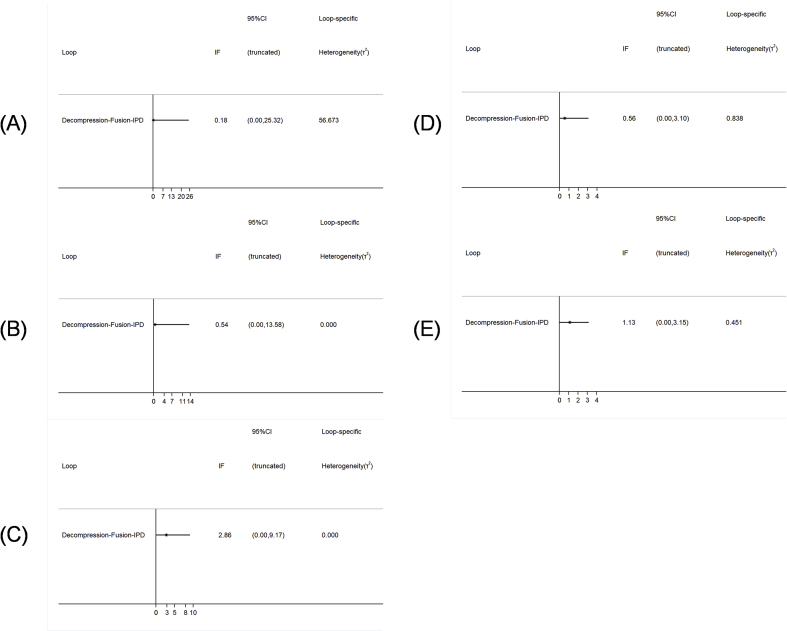
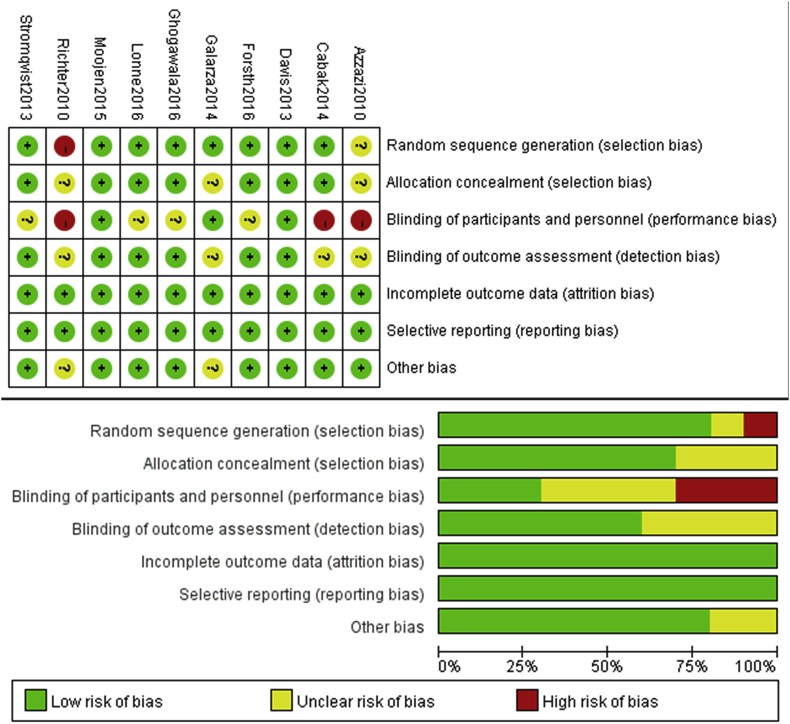
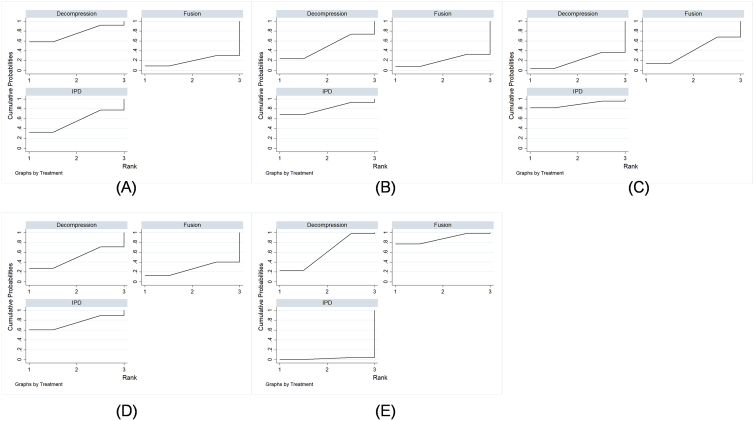
A total of 10 RCTs involving 1254 patients were enrolled in the present study and each study met an acceptable quality according to our quality assessment described later. In direct comparison, IPD exhibited a higher incidence of reoperation than fusion (OR = 2.93, CI: 1.07-8.02). In indirect comparison, the rank of VAS leg (from best to worst) was as follows: IPD (64%) > decompression (25%) > fusion (11%), and the rank of ODI (from best to worst) was: IPD (84%) > fusion (13%) > decompression (4%). IPD had the lowest incidence of complications; the rank of complications (from best to worst) was: IPD (60%) > decompression (27%) > fusion (14%). However, for the rank of reoperation, fusion showed the best results (from best to worst): fusion (79%) > decompression (20%) > IPD (1%). Consistency tests at global and local level showed satisfactory results and heterogeneity tests using loop text indicated a favorable stability.
The present study preliminarily indicates that non-fusion methods including decompression and IPD are optimal choices for treating LSS, which achieves favorable clinical outcomes. IPD exhibits a low incidence of complications, but its high rate of reoperation should be treated with caution.
For the treatment of LSS, several procedures including decompression, fusion, and IPD have been reported. However, each method has its own advantages and disadvantages. To date, the golden standard treatment for LSS is still controversial. In this network meta-analysis, our results demonstrate that both decompression and IPD obtain satisfactory clinical effects for LSS. IPD is accompanied with a low incidence of complications, however, its high rate of reoperation should be acknowledged with discretion.
采用贝叶斯网络荟萃分析比较腰椎管狭窄症(LSS)三种主要治疗方法——减压、融合和棘突间装置(IPD)——的临床疗效、并发症及再次手术率。
使用包括PubMed、Embase、Cochrane对照试验中央注册库(CENTRAL)和科学网在内的数据库进行文献检索。对采用三种治疗方法的随机对照试验(RCT)进行综述并纳入研究。使用R软件(3.6.0版)、Stata(14.0版)和Review Manager(5.3版)进行数据分析。
本研究共纳入10项涉及1254例患者的RCT,根据我们后续描述的质量评估,每项研究质量均可接受。直接比较中,IPD的再次手术发生率高于融合术(OR = 2.93,CI:1.07 - 8.02)。间接比较中,腿痛视觉模拟评分(VAS)(从最佳到最差)的排序如下:IPD(64%)>减压(25%)>融合(11%),腰椎功能障碍指数(ODI)(从最佳到最差)的排序为:IPD(84%)>融合(13%)>减压(4%)。IPD的并发症发生率最低;并发症(从最佳到最差)的排序为:IPD(60%)>减压(27%)>融合(14%)。然而,就再次手术排序而言,融合术效果最佳(从最佳到最差):融合(79%)>减压(20%)>IPD(1%)。全局和局部水平的一致性检验结果令人满意,使用环文本的异质性检验表明稳定性良好。
本研究初步表明,包括减压和IPD在内的非融合方法是治疗LSS的最佳选择,可取得良好的临床效果。IPD并发症发生率低,但其再次手术率高,应谨慎对待。
对于LSS的治疗,已报道了包括减压、融合和IPD在内的多种手术方法。然而,每种方法都有其优缺点。迄今为止,LSS的金标准治疗方法仍存在争议。在这项网络荟萃分析中,我们的结果表明,减压和IPD对LSS均能获得满意的临床效果。IPD并发症发生率低,然而,其高再次手术率应谨慎看待。